Phase 2 Projects
- AI4HPC: An Iterative Framework for AI-Assisted Scientific Software Development and Optimization (award details)
- MAESTRO: Multi-agent AI Expert for Subsurface Reasoning and Optimization (award details)
- The Multi-Office Accelerator Team Core (MOAT-Core) Project (award details)
Phase 1 Projects
- Accelerating Electromagnetic Transient Analysis through Physics-Informed Scalable Artificial Intelligence Models for Rapid Load Growth (award details)
- Agentic AI-Driven Discovery of Enzyme Conformational Dynamics in Microbial Systems (award details)
- AI-Accelerated Discovery of Multiscale Subsurface Architecture and Coupled Hydrobiogeochemical Processes (award details)
- AI-Accelerated Exploration of Droplet Collision-Coalescence Using Observation-Constrained, Multiscale Modeling of a Turbulent-Convection Cloud Chamber (award details)
- AI-Agentic Workflows to Advance Predictive Understanding of Fracture-Dominated Subsurface Energy Systems (award details)
- AI-Driven Co-Design of Protein-Van der Waals Hybrids for High-Performance Microelectronics (award details)
- AI-Driven Co-Optimization of Closed Fuel Cycles: Balancing Economics, Security, and Waste (award details)
- AI-Driven Physics-Based Digital Twins for In Situ Uranium Mining Optimization (award details)
- AI Driven Workflow with Cyber Assured Digital Twin for Autonomous Operations in Small Modular Reactors and Microreactors (award details)
- AI-Enabled Digital Twin for Scalable Injector Optimization and Control (award details)
- AI-Enabled Multi-Reference Electrochemical Digital Twin for Autonomous Molten Salt Reactor Operations (award details)
- AI-Enabled Single Cell Phenotyping to Advance Biomanufacturing (award details)
- AI-Guided Model-Experiment Framework for Predicting Water Availability in Energy Systems Using Multi-Fidelity Watershed Modeling (award details)
- AI-Orchestrated Multimodal Platforms for Accelerated Discovery, Scale-Up, and Deployment of 2D Materials (award details)
- AI-Powered Frameworks to Enhance Grid Resilience Under High-Dimensional Uncertainties (award details)
- Al-4 Algae—Unleashing Domestic Production of Algal Biomass through Physics-Informed Machine Learning Bioreactors (award details)
- AI-Augmented Mechanistic Upscaling of Pore-Scale Inertial Dynamics for Predictive Subsurface Biogeochemical Transport (award details)
- An AI-Enabled Digital Twin Framework for Coupled Surface-Subsurface Hydrologic and Biogeochemical Simulations in the Northeast U.S. Coastal Region (award details)
- Autonomous Quantum Amplifier Workflow Optimization and Learning Framework (AQUA-WOLF) (award details)
- Bridging Resolution Disparities In The Genesis Of Mixed-Phase Clouds (BRIDGE) (award details)
- Cloud Microphysics Multi-Scale Modeling Moonshot—Creating the Next Generation Of Uncertainty-Aware Cloud Models By Leveraging Multi-Fidelity AI and DOE Observation (award details)
- DL4MCS: Deep Learning Methods to Enhance Sub-Seasonal Predictions of Mesoscale Convective Systems by Physics-based Systems (award details)
- Drift-Aware Initialization of Coupled Earth System Models for Scalable Sub-Seasonal-to-Seasonal Prediction Using Agentic AI (award details)
- EARL: Earth-Atmosphere Agentic Research and Learning—Physics-Constrained AI Closure Development for Cloud Microphysics and Turbulence (award details)
- From Chip to Chiller: Verifiable Edge AI Agents for Data Center Thermal Management (award details)
- From Molecules to Precipitation: Machine Learning Bridges Aerosol Microphysics, Atmospheric Turbulence, and Cloud Formation (award details)
- Generative AI-Enabled Digital Twins for Subsurface Fracture Systems with Active Learning Multiphysics Data Assimilation (award details)
- GENESIS-AR: Generative Models and New Observations for Improved Season-to-Season Prediction of Atmospheric Rivers (award details)
- GOLD-FLOW: Geometry-aware Operator Learning for Design of Flow Systems (award details)
- IMAGINE-AI: Integrated Microbiome Analytic Generator of Interaction Network Evolution (award details)
- Latent Representation Learning for Understanding Ice Microphysical and Precipitation Processes Constrained by Radar and In Situ Observations (award details)
- LEAP-FWD: Low-latency Embedded AI for Physics—From Waveforms to Discovery (award details)
- Multi-Agent Inverse Design of Block Polypeptoids Into Hierarchical Nanomaterials (award details)
- Multimodal AI Finders for Rare Earth Element Deposits: Texas, the Colorado Mineral Belt, and the Southwest United States (award details)
- PHOCUS: PHage-Host Interaction Programming for Anaerobic Microbiome Control Using AI-Guided Design (award details)
- Physics-Informed Multi-Fidelity Neural Operators for Rapid Multi-Physics Simulation of Enhanced Geothermal Systems (award details)
- PORTUS: Automatic Performance Portability for Distributed Scientific Workflows on the Genesis Mission Platform (award details)
- RIVER-AI: Reservoir-Groundwater Interactions for River Flow Variability, Energy, and Resilience with AI (award details)
- SCOPE: Salt Chemistry Optimization and Prediction Engine for Nuclear Waste Treatment Planning (award details)
- STEAM: Smart Twin for Electrode/Electrolyte Advanced Manufacturing for Fuel Cells and Electrolyzers (award details)
- Uncertainty Quantification for Grid Planning and Operations with Multi-Sector Feedback (award details)
- Upscaling Particle-resolved Aerosol-Cloud Microphysics with Generative Modeling (award details)
- VITA-SCALE: Vitrification AI for Scale-Bridging Prediction and Process Translation (award details)
- WASTECHAT: The First Tool Towards a Domain Foundational Model for DOE-EM (award details)
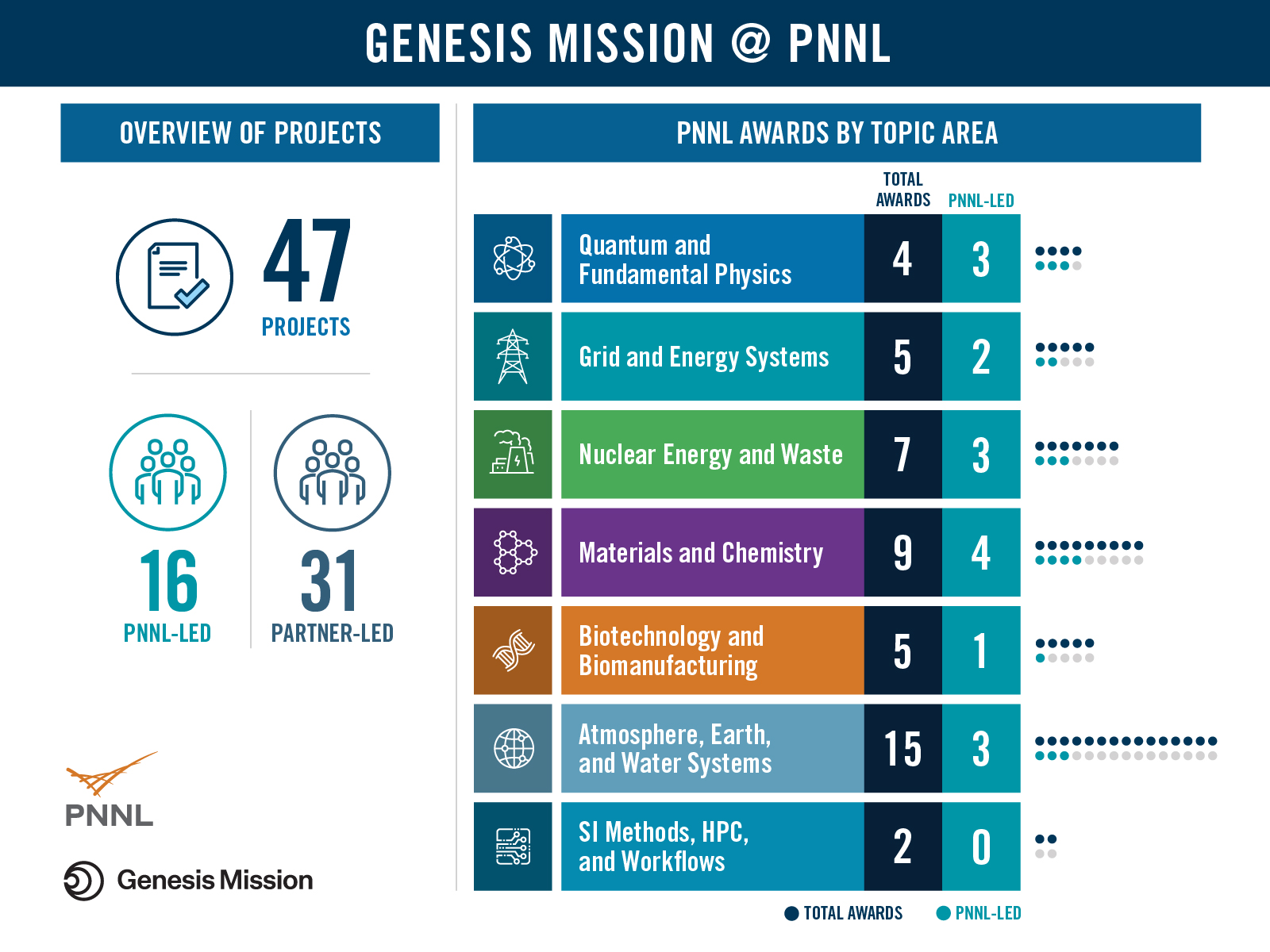
Phase 2 Projects
1. AI4HPC: An Iterative Framework for AI-Assisted Scientific Software Development and Optimization
Lead institution: Argonne National Laboratory
Scientific computing in DOE depends on complex, long-lived simulation codes that must adapt as science and hardware advance. These production codes represent decades of development effort, yet language translation, performance optimization, porting, refactoring, and integration of new models or solvers remain slow and labor-intensive. AI coding tools are increasingly effective for bounded local transformations, but they do not provide the DOE-controlled infrastructure needed for validation-intensive scientific software evolution: persistent, structured context across sessions, provenance linking model interactions to generated edits, domain-specific diagnostic interpretation, systematic decomposition of transformations, or verification of numerical/scientific correctness beyond pass/fail tests.
This project proposes vendor-neutral data products capturing source structure, model transactions, correctness specifications, and verification outcomes across DOE production codes as well as a framework that serves as their operational interface for AI-assisted scientific software development. The framework couples AI-driven transformation with execution, evaluation, verification, and refinement, recording activity into the substrate as provenance. It is model-agnostic, treating frontier and domain-specialized back ends as interchangeable agents. Five workflows—translation and modernization, porting and hardware adaptation, kernel optimization, refactoring, and integration of new capabilities—drive foundational research on substrate design, representation and context, correctness and verification, adaptive transformation methods, and algorithmic discovery.
The project pursues four objectives: (1) develop the substrate’s data products and the integrated framework that serves as their operational interface, deployable within high-performance computing (HPC) environments; (2) advance foundational research on iterative AI-assisted scientific software transformation, including substrate design, representation, correctness, verification, and adaptive orchestration; (3) enable practical community adoption through benchmarks, evaluation methodologies, and best practices; and (4) explore how AI-assisted workflows can accelerate computational discovery by lowering the barrier to experimenting with new algorithms, solvers, and scientific models.
The framework and substrate will be evaluated on production scientific codes of interest to DOE, including Flash-X, Noah-MP, NWChem, OpenFAST, and MFEM- and AMReX-based applications, spanning all transformation workflows. Industry collaboration with Google, NVIDIA, and Intel advances kernel optimization, mixed-precision algorithm design, and hardware-specific adaptation within this framework. Evaluation is comparative: Each task is run with and without the framework under the same conditions, measuring completion rate, human interaction required, time to verified completion, and cost, with scientific correctness assessed against broad correctness specifications. This Phase II effort builds on Phase I component capabilities, including staged agentic transformation pipelines (CodeScribe), retrieval-augmented program understanding (AstraAI), self-correcting parallel-code translation (LASSI), joint evolutionary kernel optimization (R3), HPC-specialized fine-tuned models (ChatHPC and ChatPort), and full-application code databases (Caravel), unifying these within a shared framework and evaluating their collective impact through a common methodology on production scientific codes.
2. MAESTRO: Multi-agent AI Expert for Subsurface Reasoning and Optimization
Lead institution: University of California, Irvine
The MAESTRO project establishes an integrated, multi-agentic artificial intelligence framework designed to revolutionize subsurface characterization, reservoir stimulation, and real-time operation in enhanced geothermal systems (EGSs). While an EGS holds the potential to supply clean, reliable baseload energy across the United States by engineering fluid circulation pathways through deep, low-permeability crystalline rock, cost-effective deployment at scale is currently hindered by deep subsurface uncertainties regarding fracture geometry, network connectivity, in situ stress, and coupled thermal-hydraulic-mechanical-chemical feedbacks. Traditional physical workflows treat these parameters in relative isolation using slow, fragmented pipelines prone to cross-disciplinary knowledge loss. MAESTRO overcomes these limitations by moving beyond descriptive, one-time trained data-fitting algorithms, establishing an active reasoning platform where a centralized, multimodal large language model–based orchestrator coordinates an array of domain-specialized physics subagents. To achieve this, the project constructs a scalable, federated cyberinfrastructure integrating continuous field observations from 20 instrumented EGS sites, multifidelity synthetic simulations (GEOS, PFLOTRAN, EGS-Sandbox, and SW4) executed on DOE exascale platforms, and unstructured EGS knowledge corpora. These data streams feed a physics-specialist subagent architecture equipped with advanced scientific machine learning (SciML) tools, including specialized physics-informed neural networks, neural operators, and diffusion-based sampling. These subagents conduct real-time Bayesian data assimilation, execute accelerated forward predictions of fracture evolution, evaluate induced seismic hazard, and model multiscale operational reservoir dynamics, which are ultimately validated through near-industrial field testbed data and provided to operators via an interactive conversational deployment interface named EGSChat.
The proposed research introduces several key mathematical and algorithmic innovations to the field of SciML. First, it establishes an active learning, simulator-in-the-loop “data flywheel,” enabling the overarching agent to autonomously identify high-uncertainty or critical physical regimes, launch targeted numerical ensembles on exascale clusters, and assimilate the outputs to self-improve over time. Second, the project designs a multi-axis reasoning and verification stack to ensure the safety and physical consistency of autonomous outputs. This includes step-level advantage-aware routing (Arbitrage) to handle long context logs cost-effectively, scientific process reward models grounded in thermodynamic conservation laws to prevent reward hacking, and adversarial code generation to continuously stress-test code constraints before model execution. Third, by deploying multifidelity learning curricula and meta-learning schemas, the framework establishes a verifiable foundation for few-shot cross-site domain transfer, empowering the system to generalize from asset-heavy, heavily instrumented environments to data-sparse marginal reservoirs.
The successful realization of MAESTRO carries profound societal, economic, and strategic benefits for U.S. energy independence. By providing real-time, uncertainty-aware operational steering guidelines, the system aims to reduce upfront capital risks and shorten development timelines for commercial EGS reservoirs by up to 35 percent. Crucially, the platform integrates continuous microseismic waveform monitoring to translate raw sensor feeds into precise “fracture-network meters,” replacing reactive traffic-light metrics with proactive containment protocols to significantly de-risk induced seismicity. Furthermore, the open, federated cyberinfrastructure fosters a collaborative, cross-office digital ecosystem connecting the DOE Office of Science with the Hydrocarbons and Geothermal Energy Office. To broaden the impacts of this work, the team will package its core spatial models into the interactive, browser-accessible GIS Copilot, allowing public, private, and academic stakeholders to perform risk-aware site screenings, inspect conditioning observations, and evaluate uncertainty across the United States. By de-risking deep geothermal infrastructure, MAESTRO directly accelerates the domestic transition toward sustainable baseload power, reduces localized energy costs, and strengthens U.S. national energy security.
3. The Multi-Office Accelerator Team Core (MOAT-Core) Project
Lead institution: Lawrence Berkeley National Laboratory
DOE particle accelerators are strategic infrastructure comprising roughly half of the Office of Science user facilities across DOE program offices, with impacts spanning science, medicine, defense, advanced semiconductor manufacturing, and industry.
Modern accelerators are among the most complex engineered machines in the world. At the same time, they must satisfy strict requirements for beam parameters and operating limits while being designed, commissioned, and operated over decades by distributed, multidisciplinary teams of experts, where knowledge is continuously transferred as personnel retire or move on.
Facility knowledge is distributed across control-system archives, electronic logbooks, manuals, wikis, technical notes and procedures, simulation scripts, academic papers, and expert know-how across myriad subdisciplines/domains.
Launched in fall 2025 through the Genesis Model ModCon: Transformational AI and Data project, the MOAT collaboration directly addresses these challenges by developing shared AI/ML and agentic AI capabilities for accelerator science across the DOE complex. The MOAT ModCon Seed Project brought together a broad range of accelerator-related institutions spanning several national laboratories (Lawrence Berkeley National Laboratory, Argonne National Laboratory, Brookhaven National Laboratory, Fermi National Accelerator Laboratory, Jefferson Lab, Oak Ridge National Laboratory, and SLAC National Accelerator Laboratory).
This teaming enabled the Seed Team to demonstrate agentic workflows for complex operations and design tasks. These demonstrations link prior developments in AI/ML for accelerators and conventional accelerator tools with powerful reasoning models and agentic workflows. The MOAT Osprey platform connects accelerator domain infrastructure/tools with frontier reasoning models, and it has now been deployed across a range of tasks at nearly a dozen particle accelerators, with already impressive results. The cross-laboratory development of Osprey enabled each lab to benefit from advances at the others, making each demonstration impactful beyond the individual facility.
Building on this foundation, the proposed MOAT-Core Phase II project will greatly expand AI-enabled capabilities for accelerator operations and design and integrate these into a reusable, cross-facility AI infrastructure platform. By connecting advanced reasoning models, AI/ML capabilities for accelerators, and conventional accelerator software tools through a shared platform, Osprey enables advances at any one facility to benefit the broader accelerator ecosystem.
The long-term vision is that AI becomes an indispensable partner across the full accelerator life cycle, from conceptual design and technology development to decades of facility operation, research and development, and workforce development. In that setting, accelerator agents become always-available experts that translate human intent into precise machine control, synthesize knowledge across facilities, predict and prevent failures, and help optimize performance for both accelerators and the experiments they enable. The platform will learn from streaming facility data and human expert feedback. It will draw on control-system archives, physics simulations, facility documentation, and operational logbooks, with these heterogeneous sources organized through shared ontologies and AI-ready formats.
MOAT-Core will substantially increase scientific throughput by improving beam quality, uptime, troubleshooting speed, commissioning efficiency, and design iteration across existing and next-generation facilities, including the Fermilab intensity-frontier complex, the electron-ion collider, and operating and planned accelerator-based light sources (e.g., free-electron lasers, future energy-frontier colliders, and spallation sources). It strengthens U.S. leadership in accelerator science while producing exportable AI methods and testbeds applicable to other complex facilities and industrial systems, such as accelerator-driven systems for nuclear waste transmutation, advanced reactor and fusion concepts, next-generation light sources for extreme ultraviolet lithography and high-energy characterization, advanced manufacturing, and compact accelerators for medical and industrial applications.
Phase 1 Projects
1. Accelerating Electromagnetic Transient Analysis through Physics-Informed Scalable Artificial Intelligence Models for Rapid Load Growth
Marcelo A. Elizondo, Xiaoli Duan
Lead institution: PNNL
This project advances a vision of AI-enabled grid planning in which physics-informed foundation models and AI copilot tools accelerate analysis, expand scenario coverage, and improve decision-making for reliable, affordable power system planning and operation. The proposed work supports DOE priorities in grid modernization by enabling scalable, physics and model-based, data-driven workflows for planning and interconnection studies under rapid load growth.
We propose to develop SwiftFlow-EMT, a self-improving, AI-driven platform for electromagnetic transient (EMT) analysis that integrates a scalable, physics-informed foundation model with an AI‑enabled planning copilot. Simulations of EMTs have recently become essential to the electricity industry for capturing fast grid dynamics driven by inverter-based resources and large data center loads, with increased model footprint and scope. But these models are computationally intensive due to fine time resolution and high model complexity. This limits their practical use in large-scale planning studies and slows interconnection timelines. SwiftFlow-EMT will enhance engineering and technical workflows by transforming traditionally sequential, compute-intensive EMT studies into iterative, AI-augmented processes. The foundation model leverages graph neural networks, neural ordinary differential equations, and physics-informed methods to learn system dynamics across grid topologies, enabling rapid approximation of EMT behavior. Rather than replacing physics-based simulators, the model complements them by accelerating scenario screening and guiding targeted high-fidelity simulations. A hybrid modeling strategy enables scalability across systems of different sizes: the model acts as a full-system surrogate for smaller networks and as an area-of-interest emulator within hybrid EMT-phasor simulations for larger systems. This approach preserves system-wide fidelity while focusing computational effort where detailed EMT analysis is required. The AI planning copilot orchestrates workflows including data generation, validation, simulation execution, and interpretation. By integrating AI into the workflow, the system reduces manual effort, improves reproducibility, and supports faster, more informed decision-making. Training data will be generated using high-fidelity EMT simulations across diverse operating conditions, contingencies, and system configurations, supplemented by hardware testbed data generation for training and validation. The project leverages DOE computing resources, including the American Science Cloud and ModCon GridAI capabilities, to support scalable model development and evaluation.
Phase I will develop a small, domain-specific foundation model for selected use cases. The project will validate the workflow, demonstrate feasibility and proof-of-concept, reach TRL 4, and set the stage for larger models and more complex tasks in the follow-up Phase II project. SwiftFlow-EMT will deliver measurable impact by enabling faster EMT analysis, reducing interconnection study timelines, improving reliability assessment, and supporting scalable planning for emerging grid challenges.
2. Agentic AI-Driven Discovery of Enzyme Conformational Dynamics in Microbial Systems
Lead institution: Arizona Board of Regents, The University of Arizona
Enzyme function in microbial systems is governed not by static structure alone, but by the ensemble of conformational states a protein visits and the transitions between them. Predicting these dynamics is essential for rational biosystems design, yet current approaches face a fundamental tradeoff: static methods like AlphaFold miss dynamic behaviors, while molecular dynamics (MD) simulations are prohibitively time-consuming at proteome scale. This project will build AI models that predict protein conformational ensembles and their responses to perturbations (ligand binding, post-translational modifications, mutations) directly from static structures, compressing weeks of MD simulation into seconds of inference. The resulting capability will address gaps in metabolic pathway analyses for microorganisms and plants by closing the gap between knowing that a gene encodes an enzyme and predicting whether that enzyme is functionally active under specific conditions. We will develop two complementary AI architectures targeting the Boltzmann-distributed conformational ensemble. Flow Matching models learn to sample directly from the equilibrium distribution; we will extend current approaches with a novel perturbation-conditioning architecture that predicts how ensembles shift in response to ligand binding, PTMs, or mutations. Neural Operators learn the time-evolution operator itself, generating trajectories that converge to the Boltzmann distribution through ergodicity while preserving transition pathways and kinetics. To train these models, we will gather and prepare an unprecedented integrated dataset from three major sources: MDRepo (the world's only open-access MD simulation repository, >21K simulations, developed by our team), DynamicPDB (~12.6K microsecond-scale trajectories), and the DDD dissociation dynamics database (~19K complexes). An uncertainty quantification framework using deep ensembles, cross-conformal prediction, and learned variance heads will score prediction confidence, preparing a Phase 2 agentic active learning loop in which AI autonomously identifies where new simulations would most improve the model.
3. AI-Accelerated Discovery of Multiscale Subsurface Architecture and Coupled Hydrobiogeochemical Processes
Lead Institution: University of Cincinnati
Accurate characterization of multiscale subsurface heterogeneity is a fundamental bottleneck limiting prediction and control of subsurface systems across DOE energy priorities, including critical mineral recovery, geothermal energy, geological carbon storage, and coupled hydrological and biogeochemical systems. Subsurface architecture must be inferred from sparse, indirect observations, and uncertainty in structure propagates directly into uncertainty in system behavior, limiting the predictive capability needed for resource recovery, reservoir management, and energy infrastructure decisions. This project addresses this bottleneck through a hybrid physics-AI framework that establishes a new paradigm for AI-driven subsurface characterization. The framework overcomes the fundamental limitation of conventional deep learning approaches, their dependence on large and externally generated training datasets, by learning directly from physics-constrained, site-conditioned data within a closed-loop, self-improving workflow. Geological priors conditioned on site observations generate an ensemble of subsurface realizations, which are iteratively updated through ensemble-based data assimilation. A deep learning surrogate trained on forward simulations accelerates ensemble updating, enabling efficient exploration of high-dimensional parameter space. The calibrated posterior ensemble serves directly as training data for a deep learning generative model operating in latent space, eliminating the need for external training datasets and sharpening structural identification beyond what stochastic methods alone can achieve. AI advantage is quantified through five metrics aligned with the Genesis Mission: structural identification accuracy, uncertainty reduction, independent cross-validation, data scaling behavior, and process prediction improvement. Phase I demonstrates and validates the framework at the highly instrumented Theis-Nash Environmental Monitoring and Modeling Site, a shallow, data-rich compound bar system managed by the principal investigator.
4. AI-Accelerated Exploration of Droplet Collision-Coalescence Using Observation-Constrained, Multiscale Modeling of a Turbulent-Convection Cloud Chamber
Lead institution: Michigan Technological University
The evolution of DSD in turbulent clouds is driven by a complex interplay of aerosol-cloud microphysics and stochastic turbulent fluctuations. Accurately predicting the transition from condensation-dominated growth to collision-coalescence, namely the onset of precipitation, remains a fundamental challenge in atmospheric science. Because resolving the governing integro-differential equations for these multi-scale interactions is computationally prohibitive for large-scale earth system models used for energy and weather decision-making, precipitation formation is often represented by highly uncertain "autoconversion" parameterizations. Directly addressing Focus Area 15A, this Phase-I effort builds on the ACDC2 collaboration to implement a physics-constrained, AI-enabled framework that uses data from multiscale models and laboratory research to discover what governs the non-linear microphysics of precipitation. To accelerate the discovery process, this effort builds an AI-ready data foundation that standardizes output from a hierarchy of detailed-physics computational models (DNS, LES, C-ODT) and observations from the Michigan Tech Pi Convection-Cloud Chamber. Using this integrated data, the research advances through two parallel AI-discovery workflows structured around the microphysical growth stages that are constrained by a rigorous theoretical description in the context of a tall convection-cloud chamber: broadening of the cloud DSD by fluctuations in relative humidity, and onset of precipitation formation through the collision and coalescence of cloud droplets. By combining physical parameter extraction (model discovery) with the development of computationally efficient, structure-preserving surrogate models, this AI workflow transforms massive, complex data streams from lab and multiscale simulations into highly interpretable, physics-bound laws of cloud microphysics.
5. AI-Agentic Workflows to Advance Predictive Understanding of Fracture-Dominated Subsurface Energy Systems
Lead institution: PNNL
This Phase I project will develop and demonstrate an expert-in-the-loop, physics-informed AI-agentic workflow for Topic 17-C: Control of Subsurface Fractures. The primary use case is understanding parent child well interference and fracture control during unconventional shale stimulation using curated Marcellus shale data (from the Marcellus Shale Energy and Environment Laboratory [MSEEL]) already available to our team. Our work will fuse MSEEL data to infer the evolving fracture connectivity and rank two key actionable control parameters: fracture-stage sequencing and pressure drawdown. MSEEL data showed that parent wells can lose roughly 19% of their gas volume over 5 years due to interference from child wells. Using this dataset, we will test a defined fracture-control window in which operators compare a small set of actionable interventions that reduce well interference. Even modest gains in interference control can preserve large gas volumes, improve recovery twofold, and translate into pad-scale economic value potentially in the millions of dollars. The scientific advance is a quantitative framework for determining which fracture-state variables are observable, predictable, and controllable from sparse, indirect, heterogeneous field data under uncertainty. The core AI method is a verifiable multifidelity controller built on two AI components. First, physics-informed Fourier Neural Operators (FNOs) serve as surrogates for fracture-driven flow. FNOs learn operator mappings between function spaces, supporting transfer across mesh resolutions and parameterized fracture geometries with limited retraining. Second, an agentic orchestration layer (e.g., using LangGraph, Grok Build) coordinates two specialized agents: 1) a fracture-aware data analysis agent and 2) a multiphysics modeling and forecasting agent. These agents fuse multivariate field data, run FNO surrogates with calibrated uncertainty, and apply decision-conditioned routing to escalate only out‑of-distribution or high-uncertainty cases to coupled fracture flow, transport, and geomechanical simulations using PFLOTRAN. The core AI method allows us to answer the scientific question: Can multivariate field data be assimilated into a reduced but decision-useful fracture state that is updated fast enough to support control decisions? The workflow is agentic because the controller autonomously invokes data, surrogate, uncertainty, and simulator tools under explicit uncertainty thresholds and expert-review guardrails. The agent interface will be designed to support various simulators in Phase II. We also will assess the transferability on a multi-well geothermal site and deepwater use case to identify the modifications needed to define a Phase II fracture-control field validation. The proposed work leverages NETL EDX Discover and DOE’s investments in the Science-informed Machine Learning for Accelerating Real-Time Decisions in Subsurface Applications (SMART) Initiative. The multifidelity controller is designed so that other Genesis teams can adapt the fracture-control agent to their own subsurface science problems. These outcomes will establish and evaluate a pathway for physics-grounded AI to improve predictive understanding and support fracture-control decisions while preserving expert oversight. The outputs will be released to the American Science Cloud (AmSC) and Transformational AI Models Consortium (ModCon) GitHub repository.
6. AI-Driven Co-Design of Protein-Van der Waals Hybrids for High-Performance Microelectronics
Lead institution: PNNL
This project will develop an AI-driven co-design ecosystem to accelerate the discovery of emerging protein van der Waals (vdW) hybrids for energy-efficient non-von Neumann microelectronics. The central vision is to leverage an AI-enabled scientific workflow that integrates molecular design, materials synthesis, high-throughput characterization, and device optimization to design protein-vdW-based devices with tunable chemistries and reversible, organized conductive filaments, thereby improving reproducibility, tunability, and energy efficiency.
Although vdW materials exhibit outstanding electronic properties that can be modulated by programmable protein structures and chemistry, their device functions arise from interrelated factors spanning multiple scales, including protein sequence and structure, assembly at vdW interfaces, reversible and controllable formation of conductive filaments, materials processing, and device-level optimization. A major challenge is that conventional manual workflows treat these domains separately, leading to slow, fragmented, and inefficient discovery.
The AI-based tools developed under this project will enhance the workflow by enabling closed-loop reasoning and optimization across molecular, materials, and device scales. The proposed platform combines a tool-augmented large language model system with integrated deep-learning-based protein-inorganic interface design and a multi-agent AI platform for reasoning over experimental data and autonomous measurement workflows. The large language model will use physics-based protein simulations and structure-property reasoning to evaluate candidate protein vdW hybrids before synthesis. The multi-agent AI will provide a structured interface between high-throughput experiments and modeling predictions by transmitting experimental observables and uncertainty estimates in one direction and predicted phase behavior and design recommendations in the other, thereby shortening design cycles and improving decision quality.
7. AI-Driven Co-Optimization of Closed Fuel Cycles: Balancing Economics, Security, and Waste
Lead institution: Colorado School of Mines
Through Phase I, we will demonstrate a lightweight, extensible co-optimization framework that enables rapid, integrated analysis of closed nuclear fuel cycles, addressing a key bottleneck in facility design and licensing workflows. Today, economics, safeguards, operations, and waste outcomes are typically evaluated using separate tools and assumptions, resulting in slow iteration cycles and limited exploration of system-level tradeoffs.
Our approach links reprocessing, fuel fabrication, reactor performance, and waste-form outcomes into a unified "cradle-to-grave" workflow capable of evaluating realistic deployment scenarios. The vision is a toolset that can rapidly compare alternative recycle and final waste form pathways and operational choices while simultaneously quantifying system performance metrics that matter for deployment: economics (including secondary value streams such as separable isotopes), safeguards and security (including built-in accountancy), and waste outcomes (e.g., total heat loading, high-activity waste volume).
By integrating existing, validated tools, the project targets near-term usability in design studies and licensing-relevant analyses. AI provides advantage by accelerating and coordinating complex workflows rather than replacing physics-based models. Closed fuel-cycle design involves nonlinear interactions and competing objectives that are difficult to evaluate using conventional parameter sweeps. Orchestration enabled by AI supports automated scenario generation, multi-objective evaluation, and systematic exploration of uncertainty, enabling faster and more robust decision-making.
Phase I will identify which workflow components benefit most from AI integration and define the data structures required for scalable analysis. The primary deliverable is a prototype demonstrating AI-accelerated scenario exploration on representative cases, with quantified improvements in time-to-answer, scenario throughput, and decision robustness.
8. AI-Driven Physics-Based Digital Twins for In Situ Uranium Mining Optimization
Lead institution: PNNL
This project will develop and demonstrate a prototype AI-enabled, physics-based digital twin for in situ recovery uranium mining to optimize wellfield pumping strategies, improve lixiviant sweep efficiency, and reduce excursion risk. In situ recovery performance is strongly influenced by poorly constrained subsurface heterogeneity, including spatial variability in permeability, porosity, mineralogy, redox conditions, and hydraulic connectivity. These uncertainties affect fluid movement, uranium mobilization, recovery efficiency, and environmental performance, limiting operators' ability to predict outcomes and optimize operations with confidence. The project will use site-specific data from Ur-Energy's Lost Creek in situ recovery operation, including well logs, pump-test-derived permeability estimates, and historical pumping records, to construct uncertainty-aware geologic realizations and define representative operating conditions. A reduced-domain five-spot wellfield model will be simulated with the massively parallel PFLOTRAN reactive transport code to generate a baseline ensemble spanning plausible subsurface conditions. These simulations will provide both the reference case for performance evaluation and the training data for AI-enabled optimization. This use of AI will provide the key performance advantage by enabling rapid exploration of operating strategies that would be impractical with full-physics simulations alone. Specifically, the project will train a fast surrogate model on the PFLOTRAN simulation ensemble and embed it within a multi-objective evolutionary optimization framework to identify optimized pumping strategies that improve sweep efficiency while minimizing lixiviant losses associated with excursions. The optimization will incorporate chance constraints to address geologic uncertainty, and an active-learning loop will selectively re-evaluate promising strategies with PFLOTRAN to improve surrogate accuracy in decision-relevant regions.
9. AI Driven Workflow with Cyber Assured Digital Twin for Autonomous Operations in Small Modular Reactors and Microreactors
Lead institution: Georgia Tech Research Corporation
This project will develop and demonstrate an AI-driven workflow with a cyber-assured digital twin to enable trustworthy autonomous operations for small modular reactors and microreactors. The proposed work directly addresses Topic 4-B, Autonomous Power Plant Operations, by building an AI-enabled digital twin system that interprets plant operational data in real time, detects anomalies, and recommends preemptive actions to maintain safety and operational performance under human supervision. Small Modular reactors and microreactors are expected to operate with lean staffing, remote supervision, multi-unit coordination, and greater reliance on digital instrumentation and control. These characteristics create a strong need for trusted plant-state awareness, explainable operator support, and resilient cyber-physical decision workflows.
The project vision is an integrated AI-enabled operational framework that continuously fuses plant measurements, virtual sensors, physics-based reactor and thermal-hydraulic models, robotics-enabled observations, and cyber telemetry to maintain accurate, explainable, and cyber-resilient awareness of plant conditions.
Phase I will complete four integrated tasks: building an AI-driven monitoring and anomaly detection workflow with digital twins, virtual sensing, fast surrogate prediction, statistical process control, and robot-assisted dynamic sensing; adding AI-driven operational recommendation and online risk assessment to support explainable, risk-informed operator actions; embedding provable cyber assurance through layered attestation, high-assurance isolation, and runtime enforcement; and integrating these capabilities into an end-to-end demonstration using Georgia Tech's full-scope simulator and test environment for small modular reactors. By the end of Phase I, the project will deliver a tangible AI-enabled workflow and quantitative evidence of AI advantage for autonomous operations, including improved state-estimation accuracy, earlier anomaly detection, faster decision support, and bounded safe operation under representative cyber-compromise scenarios.
10. AI-Enabled Digital Twin for Scalable Injector Optimization and Control
Lead institution: Old Dominion University Research Foundation
This project will develop an AI-enabled digital twin for particle accelerator injector systems to improve how these systems are monitored, tuned, and operated. The work is led by Old Dominion University in partnership with Jefferson Lab and PNNL and is aligned with DOE Genesis Mission Focus Area 13A on AI-driven accelerator facilities. The objective is to create and validate a physics-informed virtual model of the injector at Jefferson Lab’s Upgraded Injector Test Facility, a practical testbed spanning the keV-to-MeV regime, and to establish a foundation for future transfer to Continuous Electron Beam Accelerator Facility injector operations. Injector tuning at accelerator facilities remains difficult because many machine settings, including radio frequency parameters, magnets, source conditions, and beam transport controls, are tightly coupled. In current practice, tuning often depends heavily on expert knowledge and trial-and-error adjustment. While existing beam physics simulation tools are valuable for offline studies, they are generally too slow, insufficiently calibrated, or not integrated closely enough with live operations to support real-time decision-making. As a result, setup can be time consuming, reproducibility can be limited, and operational knowledge can be difficult to transfer. The vision of this project is to bridge the gap between simulation and real operation by creating a continuously updated digital representation of the injector that combines first-principles accelerator physics with machine learning and experimental data. This digital twin will ingest archived and live control system data, beam diagnostics, viewer images, and auxiliary observables, and will use those inputs to predict beam behavior, improve observability, detect anomalous conditions, and recommend more effective operating points. In this way, AI will enhance scientific and technical workflows by transforming static models and fragmented diagnostics into an adaptive decision-support framework for accelerator operation.
11. AI-Enabled Multi-Reference Electrochemical Digital Twin for Autonomous Molten Salt Reactor Operations
Kent Detrick
Lead institution: PNNL
We will create an AI enabled electrochemical (EC) workflow that turns noisy molten salt measurements into reliable, near-real-time indicators of salt chemistry and electrode health, providing a foundational capability for molten salt reactor (MSR) digital twins and autonomous operation. Molten salt reactors need a system for continuously monitoring salt chemistry, impurities, and corrosion products, but standard monitoring methods are slow/incompatible with MSR environments. Electrochemical sensors enable in situ monitoring, but current systems rely on drift-prone, ambiguous quasi-reference electrodes (QRE). In multi-component salts, signal overlap makes accurate interpretation nearly impossible. AI provides three capabilities beyond conventional calibration and thresholding:
1. Learn/remove reference electrode drift in multi-probe RE+QRE data so that QRE measurements behave like a stable reference electrode
2. Analyze overlapping signal and map the full time-series response into a small set of quantitative salt chemistry and electrode health metrics with uncertainties
3. Generate real time anomaly scores that can drive MSR digital twins and supervisory control workflows for preemptive operational decisions.
The project will deliver EC datasets for MSRs, a common metadata schema, and modular AI workflows for drift correction, state inference, and electrode monitoring that other Genesis teams can embed in AI enabled MSR plant operations tools. By de-risking AI assisted MSR monitoring and raising the TRL of EC digital twin inputs, the work will measurably advance Focus Area 4B KPIs on data fidelity, latency, and anomaly detection while providing the broader nuclear community with a template for physics-informed AI applied to harsh environment sensing.
12. AI-Enabled Single Cell Phenotyping to Advance Biomanufacturing
Lead institution: Georgia Tech Research Corporation
Biomanufacturing underpins our national security and bioeconomy, enabling production of fuels, chemicals, and bioproducts from biological systems. Despite major advances in genetic engineering and reactor design, bioprocess performance and productivity remain unpredictable, particularly during scaleup. A central and unaddressed limitation of current bioprocess design and control is phenotypic heterogeneity: even genetically identical cells frequently diverge into subpopulations with distinct metabolic states, stress responses, and production potential. Current bioprocess monitoring and control strategies rely exclusively on bulk measurements, implicitly assuming phenotypic homogeneity and providing no mechanism to detect or regulate within-culture variability.
This project aims to advance biomanufacturing by transforming bioprocess monitoring and control by developing an AI-enabled, real-time single-cell phenotyping framework that quantifies phenotypic variance in biological cultures and informs process control strategies to regulate phenotypic variance. The overarching objective is to demonstrate that phenotypic-variance-informed process control can improve productivity and reduce the risk of scale-up failures relative to conventional approaches. As a proof-of-concept, the project will focus on enhancing lipid production in microalgal cultures, with the methods and insights readily extensible to other biomanufacturing platforms.
The project will integrate low-cost flow-imaging microscopy with advanced AI models to create a fundamentally new data stream: continuous, single-cell-resolved measurements of phenotypic variability at scale. Image data will be collected in real time using the Autonomous Real-Time Microbial Scope and analyzed with unsupervised deep-learning models, including variational autoencoders, to extract biologically meaningful features linked to cell size, morphology, optical properties, and intracellular lipid accumulation. These AI-derived phenotypic embeddings will be combined with conventional online process data to predict culture state and productivity.
To ensure mechanistic validity, AI-based phenotypic variance estimates will be grounded in experimental measurements across laboratory- and pilot-scale systems. Controlled nitrogen-depletion experiments will be conducted in multiple algal species to induce lipid accumulation and phenotypic diversification. AI predictions will be validated using independent physiological measurements, including bulk lipid quantification, photosynthetic efficiency, transcriptomics, and lipidomics. Finally, the project will demonstrate practical utility through pilot-scale deployment with real-time phenotypic variance estimates incorporated into expert-guided process control strategies.
13. AI-Guided Model-Experiment Framework for Predicting Water Availability in Energy Systems Using Multi-Fidelity Watershed Modeling
Lead institution: PNNL
Water availability in watersheds is governed by coupled interactions among atmospheric forcing, land-surface processes, and subsurface hydrology across multiple spatial and temporal scales. Predicting these interactions remains a fundamental challenge because nonlinear feedback among precipitation, evapotranspiration, groundwater storage, and stream–aquifer exchange combine to introduce significant uncertainty that is difficult to quantify and interpret. This uncertainty directly impacts energy-relevant decisions related to hydropower generation, thermoelectric cooling, reservoir operations, and drought resilience.
This effort proposes an AI-guided Model–Experiment framework that integrates data, mechanistic modeling, and structured reasoning to improve prediction and reduce uncertainty. The framework uses the Advanced Terrestrial Simulator as the mechanistic prediction engine, SciLink as the semantic and executable layer for data integration and model orchestration, and the Agentic Discovery and Exploration Platform for Tools as the reasoning layer that translates water–energy questions into model-informed hypotheses, guides informative simulations and observational comparisons, and interprets outcomes under uncertainty and ambiguity. Because the Advanced Terrestrial Simulator is computationally expensive at the ensemble sizes and spatial resolutions needed for uncertainty-aware prediction, the team will also use multifidelity and surrogate models to enable rapid scenario exploration while preserving physical realism.
During Phase I, we will build and test this framework to predict late-summer streamflow and groundwater heads relevant to municipal supply reliability and prospective cooling-water demand in the South Branch Kishwaukee Watershed (Illinois), with the Oak Creek Watershed (Washington) serving as the technical benchmark and validation watershed. Using an agentic workflow that links data ingestion, simulation, evaluation, reasoning, and human validation in a closed loop, the team plans to quantify the dominant drivers and uncertainties of seasonal water availability, including the roles of forcing, parameters, and model structure. The effort will demonstrate measurable gains in predictive skill, uncertainty attribution, and workflow efficiency relative to a non-agentic baseline.
This project will provide a validated prototype demonstrating the advantage of using AI through improved predictive skill, stronger uncertainty attribution, and faster model–experimental iterations. By tightly coupling execution, mechanistic modeling, and reasoning in a closed-loop framework, this project will advance uncertainty-aware, decision-relevant prediction of water availability for energy systems. This capability can support better planning for drought, cooling-water reliability, and flood-related infrastructure risk. More broadly, the project will lay the groundwork for scalable AI‑enabled water prediction tools with regional and national relevance.
14. AI-Orchestrated Multimodal Platforms for Accelerated Discovery, Scale-Up, and Deployment of 2D Materials
Lead institution: The Pennsylvania State University
The transition from small-scale novel materials discovery to scalable, manufacturable processes remains a central bottleneck limiting the deployment of van der Waals (vdW) chalcogenides for next-generation devices. Due to the complexities of vdW material synthesis, small variations in growth conditions can lead to large, nonlinear, and nonmonotonic changes in structure and properties, resulting in poor reproducibility and limited process transferability across instruments, substrates, and laboratories. This persistent gap exemplifies the "valley of death" between laboratory discovery and deployable manufacturing.
Traditional vdW chalcogenide thin films can be synthesized by a variety of methods including molecular beam epitaxy, pulsed laser deposition, and metal organic chemical vapor deposition. In all cases, growth parameter space is vast with multiple tuning knobs, and there is often strong interdependence among parameters. Due to time and budgetary constraints, the workflows used to synthesize a new material rely heavily on sparse parameter sweeps and expert intuition. These approaches are not guaranteed to find the optimal growth parameters and do not result in an understanding of vdW chalcogenide synthesis that is generalizable to other materials or easily transferrable to other systems or synthesis techniques. Recipes that are discovered through this method are often irreproducible even within a growth chamber, further impeding progress. As a result, synthesis knowledge remains instrument-specific and difficult to generalize, impeding scaleup, recipe transfer, and industrial translation.
We propose to achieve a breakthrough in thin film synthesis scalability and manufacturability by harnessing AI and machine learning (ML), which provide an opportunity to transform materials processing from an empirical, intuition-driven practice into a predictive, transferable, and manufacturable science. Emerging AI techniques have the potential to integrate heterogeneous data streams including growth recipes, time-resolved instrument logs, in situ diagnostics, and ex situ characterization to infer latent state variables that provide the basis for universal growth recipes. However, these advances are bottlenecked by a lack of rich, curated synthesis data for training.
We will leverage Penn State's Two-Dimensional Crystal Consortium extensive Lifetime Sample Trackingdatabase to overcome this bottleneck and enable us to integrate multi-modal synthesis and characterization data with high-throughput simulations and predictive theory: reactive molecular dynamics, which is trained against Density Functional Theory data and larger-scale data from ML potentials, will be executed on demand against agent-specified growth conditions, provides physical grounding that constrains ML surrogates and arbitrates between competing actions when measurements are ambiguous.
15. AI-Powered Frameworks to Enhance Grid Resilience Under High-Dimensional Uncertainties
Lead institution: Arizona Board of Regents for Arizona State University
The electric power sector faces unprecedented challenges from the confluence of multiple stressors and uncertainties, including changes in demand, generation technologies, and extreme weather. Traditional capacity expansion models (CEMs) are too computationally intensive to explicitly represent the large number of plausible future scenarios that reflect the many dimensions of uncertainty. A computationally efficient AI emulator of a high-resolution CEM that can explore many more future scenarios at much lower computational burden than the CEM. The AI emulator can then select the best representative subset of scenarios for further detailed planning studies.
The proposed project will develop an AI-accelerated scenario selection method for capacity expansion planning to enhance grid resilience. Interpretable Bayesian Networks, a probabilistic, network-based learning algorithm, will be used to improve traditional scenario selection tools by modeling the dependencies between scenario drivers and generation/transmission mix and reducing the scenario set from thousands of possibilities to a few representative scenarios. A case study of the Northeastern United States will demonstrate the AI-advantage of this approach. The benefits of AI will be quantified in terms of reduced computation time to achieve the same quality result (target 60% reduction), increased quality results within the same computation time (target 50% increase), and increased robustness across repeated trials (target 30% increase). This project will build on prior successes among the principal investigators with grid optimization, energy planning and AI methods to develop a dynamically adaptive AI workflow that identifies the most critical scenarios for maintaining reliability. The proposed team will extend existing partnerships with several grid operators (e.g., PJM Interconnection and NYISO) to make the AI-advantage methods implementable by grid operators and maximize their value for grid resilience in practice.
16. Al-4 Algae—Unleashing Domestic Production of Algal Biomass through Physics-Informed Machine Learning Bioreactors
Lead institution: PNNL
In response to Focus Area 2E, AI-Enabled Biological Reaction Engineering, Bioreactor Design, Process Scale-up, and Integration, we propose development of Algal Cultivation Adaptive Learning and Intelligence, an AI-enabled hybrid digital twin that we envision will reduces algal biomass production cost by at least 15% and accelerates strain-to-pond scale-up by 2Ã,. Phase 1 will demonstrate three digital twin advantages over current practice, measured on held-out historical data at the month-6 go/no-go point and confirmed in the PNNL Laboratory Environmental Algae Pond Simulator pond simulator by month 9:
1. Diagnose productivity deviations in 24 hours or less, compared with the 25 days required by today's post-hoc sensor analysis, reducing biomass loss during culture upsets
2. Reduce 7-day productivity forecast error by at least 30% against the validated Huesemann Biomass Growth Model baseline, enabling proactive nutrient and harvest decisions
3. Calibrate performance of a new strain using <72 hours of operational data compared with months of current manual tuning, cutting time and cost in bringing high-value strains to production.
Together, these advances translate into a projected 15% reduction in biomass dollars per ton production cost computed via the Algae Farm Model cost structure. Phase 2 closes the loop with autonomous control under full techno-economic optimization, advancing the technology from Technical Readiness Level (TRL) 4 to 5–6. The United States could annually produce up to 152 million tons of algae for fertilizers, biostimulants, critical-mineral sorbents, and construction biomaterials, and algae farms could co-locate with data centers and power plants for evaporative cooling and carbon dioxide use. Scale-up from indoor research and development to outdoor raceways introduces interacting challenges: dissolved oxygen cuts photosynthesis by up to 37%, mixing-power trade-offs are nonlinear, temperature extremes destabilize cultures, and contamination can collapse cultures with little warning. No existing tool connects these variables in a way operators can use to make cost-reducing decisions.
AI-Augmented Mechanistic Upscaling of Pore-Scale Inertial Dynamics for Predictive Subsurface Biogeochemical Transport
Lead institution: Oregon State University
Genesis AI Opportunity: Closing the Subsurface Prediction Gap. Predictive modeling of coupled biogeochemical and hydrologic transport within the Earth’s critical zone is central to Department of Energy (DOE) priorities, such as optimizing in situ leaching for critical mineral recovery, ensuring the operational efficiency of enhanced geothermal systems, and cost-effectively extracting subsurface energy resources. A critical scaling gap persists between pore-scale mechanistic realities and field-scale predictive capabilities. The highly heterogeneous nature of the subsurface drives inertial flows, creating localized “hot spots” of intense biogeochemical activity due to incomplete solute mixing and resultant non-Fickian scalar transport. Current field-scale volume-averaged simulators, such as PFLOTRAN, rely on traditional empirical closures formulated for creeping (Stokes) flows in homogeneous media and systematically fail to capture drag forces, concentration variances, and effective reaction rates in anisotropic porous media experiencing fast advection and rapid kinetics. Structurally different closures that encode pore-scale physics are needed to close this gap.
AI-enabled operator learning—trained on high-fidelity pore-resolved simulation and experimental data—offers a transformative path to improve field-scale predictions.
Innovative AI-augmented mechanistic upscaling is a proposed multiscale, AI-augmented predictive framework that replaces purely empirical field-scale models with rigorous, volume-averaged neural closures. A physics-admissible, hybrid convolutional neural network and multilayer perceptron (CNN-MLP) architecture will be developed that guarantees physically consistent macroscopic representations of pore-scale morphology and transport by structurally embedding volume-averaged conservation laws. The CNN-MLP framework learns a higher-dimensional, geometry-conditioned closure model that generalizes across unseen porous morphologies, and its accuracy improves as the training data volume increases, demonstrating the advantage of AI-based training.
Technical Approach
The team will leverage a decade-long collaboration between Oregon State University and PNNL, which has resulted in foundation-level 3D spatiotemporal pore-resolved direct numerical simulation (PR-DNS) as well as synchrotron-based micro-CT experimental data. Additional new PR-DNS data will be generated in parallel, targeting reactive transport in synthetic packed beds and experimental geometries utilizing a high-performance pore-scale Navier–Stokes solver (CGS-FDM). Specifically, emphasis will be placed on capturing inertial flow and mixing-limited reactions across highly advective and nonlinear rapid-kinetic regimes. The team will develop a physics-admissible neural architecture based on a sparse 3D CNN morphology encoder, extracting hierarchical anisotropic geometric descriptors—porosity and its gradients, orientation tensors, specific surface area, and connectivity metrics—coupled to an MLP back end processing volume-averaged transport statistics from pore-resolved data. This will result in nonlinear upscaled closures for effective permeability (K∗), subfilter stress (τ), dispersion tensor (D∗), and the effective reaction rate factor (η∗) that satisfy physical constraints like tensor symmetry and positive-definiteness. Trained surrogate models will be implemented as modular user-defined functions within PNNL’s PFLOTRAN and assessed for improved predictive capability, resulting in an AI-augmented subsurface simulator.
Phase I Targeted Deliverables
The AI advantage will be demonstrated by (i) predictive accuracy of an AI-augmented subsurface simulator with <10 percent error for permeability and concentration variance compared with standard empirical closures, (ii) computational efficiency with 100× speedup, compared with detailed microscale closure, in predicting upscaled effective properties on unseen geometries using the trained physics-admissible CNN-MLP architecture, and (iii) open science deployment through distribution of all datasets and physics-admissible CNN-MLP models in FAIR data format (NetCDF-4/HDF5) via the Genesis Mission platform and American Science Cloud. This framework will facilitate future studies on self-altering and spatiotemporally evolving porous structures in Phase II.
17. An AI-Enabled Digital Twin Framework for Coupled Surface-Subsurface Hydrologic and Biogeochemical Simulations in the Northeast U.S. Coastal Region
Lead institution: University of Connecticut
The vision of this project is to advance predictive Earth system science toward subsurface resource sustainability by creating an AI-enabled digital twin for coupled surface-subsurface hydrologic and biogeochemical processes in the northeastern U.S. coastal region. Hydrologic and chemical transport in subsurface systems is governed by interactions among water flow, solute migration, mineral-fluid reactions, microbial processes, and surface-derived boundary fluxes. These processes are difficult to observe directly and remain challenging to simulate in heterogeneous environments such as the vadose zone, rhizosphere, aquifers, and coastal subsurface, where sparse measurements must be interpreted across multiple spatial and temporal scales.
This project addresses these challenges by integrating AI with process-based modeling and a multi-source database to build a scalable, hybrid surface-subsurface simulation framework. The research will couple land surface ecosystem models with high-fidelity subsurface simulators, including PFLOTRAN and the Advanced Terrestrial Simulator, to represent exchanges among surface water, soils, groundwater, solutes, carbon, and nutrients, including dissolved organic and inorganic carbon and nitrogen, as well as selected redox or reaction indicators. The framework will combine in situ measurements, remote-sensing observations, subsurface property information, and process-based model outputs across pore-to-regional scales over the 2002–2025 period at a 4-km spatial resolution. The unified dataset will support model training, data assimilation, uncertainty quantification, and rigorous evaluation of predictive performance against observations.
AI is central to the proposed scientific and technical workflows. Neural operator methods and other surrogate-modeling approaches will emulate computationally intensive surface and three-dimensional subsurface simulations. Temporal sequence learning and operator learning will help capture nonlinear interactions across scales, while data fusion and data assimilation will incorporate new observations to update model states and constrain uncertainty. Bidirectional coupling between AI emulators and process-based models will allow surface conditions (e.g., weather, land use, and vegetation dynamics) to inform subsurface flow, solute transport, and biogeochemical transformations.
18. Autonomous Quantum Amplifier Workflow Optimization and Learning Framework (AQUA-WOLF)
Lead institution: PNNL
Quantum sensing, quantum information science, and HEP dark matter searches depend critically on near-quantum-limited microwave amplifiers that must be precisely tuned to operate at peak performance. Finding the right operating point for these devices requires slow, manual parameter searches that consume significant operator time and limit experimental throughput. As these experiments grow in scale and complexity, this bottleneck threatens to become a fundamental limit on scientific productivity.
The Autonomous Quantum Amplifier Workflow Optimization and Learning Framework replaces manual tuning with an autonomous AI agent that learns to operate quantum parametric amplifiers without human intervention. The agent controls the key tuning parameters and uses measured device performance as feedback, converging on an optimal operating point in a fraction of the time required by traditional approaches. The system is designed to simultaneously optimize competing performance objectives—including gain and noise—mapping the trade-off frontier between them and giving experimenters a tunable operating point selectable in real time.
This work validates the approach on hardware across multiple institutions and device types, demonstrating that the trained system can be transferred to new laboratories and operated independently by new users without requiring the time of an expert. A key objective is to show that knowledge learned on one quantum amplifier technology transfers to a fundamentally different amplifier, exploiting the shared Hamiltonian structure underlying all parametric amplifiers to dramatically reduce the learning time required on a new device. All software will be released open-source and datasets contributed to shared scientific infrastructure, enabling adoption by the broader quantum sensing community.
19. Bridging Resolution Disparities In The Genesis Of Mixed-Phase Clouds (BRIDGE)
Lead Institution: University of Utah
Mixed-phase clouds are a major source (~50%) of Earth's precipitation, yet their formation remains difficult to predict because current models cannot adequately represent the first formation of ice in the cloud. Ice initiation depends on ice-nucleating particles (INPs), but existing parameterizations are poorly constrained by aerosol composition, vertical structure, and atmospheric regime. This project will develop a physics-informed AI framework to infer aerosol composition from long-term observations and predict INP activity from vertically resolved aerosol measurements, with the goal of improving mixed-phase cloud prediction and reducing uncertainty in precipitation and water-cycle. The proposed research addresses a fundamental scale gap between aerosol chemistry at the nanometer scale and cloud glaciation at kilometer scales. We will combine long-term surface aerosol measurements, vertically resolved aerosol composition profiles, and INP observations from DOE user facilities (ARM and the Environmental Molecular Sciences Laboratory) and past field campaigns data to build a two-stage AI framework. First, a multimodal inverse model will reconstruct size-resolved aerosol composition from long-term chemical, physical, optical, and meteorological observations. Second, a hybrid physics-informed model based on water-activity freezing theory will use reconstructed and directly measured vertical composition profiles, together with boundary-layer properties, to predict temperature-dependent INP activity under well-mixed and decoupled conditions. This project leverages a unique observational foundation, including more than 500 vertically resolved aerosol composition profiles spanning millions of particles collected across the continental United States. These data provide direct constraints on aerosol composition at single-particle level to evaluate how particle source, mixing state, altitude, and thermodynamic conditions influence ice formation. The proposed AI framework adds a major advantage by enabling the integration of heterogeneous multiscale observations that are not easily combined through conventional parameterizations, thereby producing AI-ready datasets, uncertainty-aware prediction workflows, and physics-informed models that can be incorporated into cloud-resolving and Earth system models.
20. Cloud Microphysics Multi-Scale Modeling Moonshot—Creating the Next Generation Of Uncertainty-Aware Cloud Models By Leveraging Multi-Fidelity AI and DOE Observation
Lead institution: The Trustees of Columbia University in the City of New York (Morningside Campus)
Transforming our understanding of the key role that cloud microphysics and turbulence plays in precipitation formation requires fundamentally new modeling approaches that seamlessly integrate data-driven discovery with existing physics-based models. Despite its key importance for safeguarding the US's energy infrastructure and water resources, precipitation prediction remains a central challenge in Earth system modeling. Persistent precipitation modeling biases arise from unresolved cloud microphysical processes and their coupling with turbulence. We propose a multi-scale, hybrid physics-ML framework, developed through rapid agentic AI code translation of an existing physics-based single column model into a differentiable programming language.
In Phase 1, we will focus on collision coalescence, the dominant pathway to precipitation in warm clouds and a major source of uncertainty in DOE's E3SM. Traditional methods to model collision-coalescence ignore the effects of turbulence, although turbulent effects can enhance precipitation intensity by up to a factor of 7. Existing Fortran-based models cannot optimize cloud microphysical processes in the context of their larger-scale dynamical environment, and process rate physical constraints that come from laboratory-scale measurements are significantly mismatched to the E3SM scale. We will simultaneously address these challenges by:
1. Neural ordinary differential equation (ODE)-based parameterizations of turbulent collision-coalescence. Neural ODEs (which integrate neural networks with numerical ODE solvers) will be used to learn process rates directly from large-eddy simulations with Lagrangian superdroplet microphysics constrained by laboratory studies, allowing stable, online learning of turbulence-aware physically consistent local bulk microphysical process rates. We will systematically compare structural representations for droplet size distributions (statistical moments and learned latent representations) to explore tradeoffs between accuracy, interpretability, and stability.
2. Differentiable multi-scale coupling via agentic AI-enabled code translation. Systematic biases related to coupling local microphysical processes to the Earth system modeling scale will be mitigated by embedding learned process rates within a fully differentiable single column modeling framework.
21. DL4MCS: Deep Learning Methods to Enhance Sub-Seasonal Predictions of Mesoscale Convective Systems by Physics-based Systems
Lead institution: Planette Analytics Inc.
Mesoscale convective systems (MCSs) account for most precipitation over many parts of the United States, including the Midwest, Great Plains, and the American South/Southeast. Skilled MCS predictions are essential for water resource management, but MCSs are notoriously difficult to forecast beyond a few days, given the confluence of remote teleconnections, large-scale weather patterns, and fine-scale microphysics that governs their genesis and evolution. While AI weather models have not yet been shown to beat physics-based models in skill beyond a few days, AI methods used in conjunction with physics-based model outputs produce the most skilled sub-seasonal forecasts today. In the proposed work, we will develop a novel AI-physics hybrid forecasting pipeline, optimized for predicting MCSs with breakthrough skill at sub-seasonal lead times (1–6 weeks), with metrics that beat those of the best operational forecasts (NOAA GEFS, ECMWF IFS) by at least 50%.
We propose physics-AI hybrid approaches to achieve breakthrough improvements in MCS forecast skill at sub-seasonal lead times, 7 days to 6 weeks:
1. An AI-driven boosting protocol to dramatically increase the ensemble size of a physics-based forecast
2. A deep-learning calibration methodology to incorporate large-scale MCS predictors not well-captured in physics-based forecasting systems, like upper ocean heat content and soil moisture, into sub-seasonal forecasts
3. A deep-learning microphysics adjustment and downscaling technique to provide operational MCS forecasts while quantifying sub-grid scale uncertainty.
22. Drift-Aware Initialization of Coupled Earth System Models for Scalable Sub-Seasonal-to-Seasonal Prediction Using Agentic AI
Lead institution: PNNL
Reliable prediction of water availability and hydrologic extremes at sub-seasonal-to-seasonal timescales is critical for U.S. energy systems, including hydropower operations, reservoir management, drought preparedness, and resilient energy-system planning. However, coupled Earth system forecasts can lose skill after initialization because the atmosphere, land, ocean, and sea-ice components may not be dynamically balanced. These imbalances can produce initialization-induced drift, accelerate early forecast error growth, and degrade forecast trajectories for water-cycle processes. Existing data assimilation, reanalysis-based initialization, and conventional drift correction reduce some errors, but they do not directly resolve state-dependent inconsistencies across the initialized coupled system. This leaves a gap between realized and potential forecast skill for water-for-energy applications.
This project will address this gap by developing a drift-aware, agentic AI framework within DOE’s Energy Exascale Earth System Model (E3SM) to improve the dynamical consistency of initialized coupled states. The framework will use a two-stage learn-then-correct strategy. First, a neural operator will learn lead-time and state-dependent drift as a structured response of the coupled system. Second, a physics-constrained offline reinforcement learning method will generate bounded, physically consistent adjustments to selected initialization variables before forecast integration. Together, these components will enable an AI agent to assess the initialized coupled state, anticipate its likely drift, and select corrective actions under physical constraints. This shifts AI from passive forecast post-processing toward active, constraint-aware initialization control.
Multi-year initialized E3SM hindcasts will be employed to characterize drift across seasons and hydrologic regimes, validate the AI framework with independent test data, and deploy it in both standard E3SM and data-assimilation-enabled E3SM Atmosphere Model–Data Assimilation Research Testbed workflows. Phase I performance will be compared with uncorrected forecasts and a conventional linear drift-correction baseline to quantify AI advantage. Evaluation will focus on reduced early forecast error growth during weeks 1–3, improved forecast skill during weeks 4–12, statistically significant gains in anomaly correlation coefficient, reduced forecast error, stable coupled-model behavior, and improved cost–skill efficiency. Hydrologic evaluation will emphasize precipitation, snow water equivalent, soil moisture, runoff, total water storage anomaly, and river discharge in representative U.S. basins. The project’s primary deliverable will be a validated, AI-enhanced E3SM initialization and hindcast workflow integrating the trained drift-prediction and correction framework with standard and E3SM Atmosphere Model–Data Assimilation Research Testbed-enabled coupled simulations. By reducing initialization-induced drift, the project supports DOE Focus Area 15C and advances the capability from Technology Readiness Levels 3–4 toward a validated Technology Readiness Level 5 demonstration within E3SM.
23. EARL: Earth-Atmosphere Agentic Research and Learning—Physics-Constrained AI Closure Development for Cloud Microphysics and Turbulence
Lead institution: PNNL
This project will advance cloud microphysics and precipitation modeling on two fronts. First, we will develop a physics-constrained ML closure for unresolved subgrid-scale (SGS) turbulence effects on cloud-droplet size distribution (DSD) broadening, formulated within two- and three-moment Predicted Particle Properties (P3) microphysics. The closure will be trained using direct numerical simulation with super-droplet microphysics benchmarks for Pi Chamber-like conditions and matched P3 box-model simulations and then implemented in the Energy Research and Forecasting (ERF) model. Second, co-developed with the closure, Earth-Atmosphere Agentic Research and Learning (EARL) will provide a human-supervised workflow for ERF closure development and agentic experimentation to explain why a given closure succeeds or fails. Together, they will deliver a machine-learned representation of the turbulence–microphysics coupling that drives cloud-droplet growth toward rain and a workflow that is extensible across model components.
The DOE water-for-energy mission depends on accurate forecasts of runoff, reservoir inflow, and cooling-water availability, all of which trace back to precipitation. Two barriers stand in the way. First, existing bulk microphysics schemes omit SGS turbulence-driven DSD broadening that drives droplets to sizes at which collision-coalescence takes over. The result is delayed drizzle onset and errors in rainfall timing and amount. Second, closure development and model experimentation are serial and manual, limiting the range and rigor of candidate evaluation and the pace of growth in process-level understanding.
The project pursues two linked objectives, both of which demonstrate advantages of AI. Under AI-for-physics, we develop an ML closure for SGS supersaturation effects on cloud condensational growth in two- and three-moment P3, formulated as a learned residual correction to analytic grid-mean tendencies. Candidate families include physics-constrained neural networks, symbolic regression, and hybrid parametric-plus-learned residual closures. The advantage of using AI is shown by improved DSD-broadening skill and stable ERF integrations. Under AI-for-workflow, we build EARL as a portable, human-supervised agentic workflow that assembles data, generates and screens closures, and stages build–test–run–score cycles, and then expands it role to orchestrate model experimentation and hypothesis generation. The AI advantage is quantified by efficiency gains in closure development and experimentation.
EARL’s agentic experimentation converts faster closure development into greater process-level understanding, delivering an advantage that neither front achieves alone.
The primary deliverable is a validated SGS condensational-growth closure deployed in the project’s P3 implementation in ERF, reducing DSD-broadening errors that propagate into water for-energy predictions. Because P3 is also the microphysics scheme in SCREAM and other E3SM configurations, the closure offers a direct transfer path into DOE’s global model ecosystem. EARL extends the project’s reach further as a portable, human-supervised agentic workflow reusable across ERF model development and experimentation, positioned for Genesis Mission coordination, American Science Cloud readiness, and broader reuse.
24. From Chip to Chiller: Verifiable Edge AI Agents for Data Center Thermal Management
Lead institution: The Johns Hopkins University
In the United States, data centers consume about 150 TWh annually and are projected to reach 200-500 TWh by 2030, yet thermal management remains limited by fragmented, non-coordinated control across chip, rack, and plant levels. Existing rule-based and model predictive control strategies operate at coarse time scales, lack multi-scale coupling, and rely on centralized computation, leading to limited adaptability to AI-driven workloads, reduced efficiency, and poor scalability. The resulting model-reality gap manifests in suboptimal energy use, limited robustness, and barriers to real-time deployment on industrial platforms. This project aims to close this gap by enabling real-time, edge-deployable, and verifiably safe thermal management from chip to chiller, achieving 15% energy reduction and sub-100ms control latency. Conventional modeling and control approaches cannot capture the multi-scale thermal-fluid dynamics, mixed-integer actuation, and nonlinear real-time constraints required for next-generation data center operation. Scientific ML provides the missing capability by integrating physics-based models with data-driven learning to enable safe, adaptive, and scalable control. The project leverages differentiable digital twins and differentiable predictive control policies trained offline and deployed on edge hardware, enabling coordinated control across chip-rack-plant hierarchies with embedded constraint handling and certified real-time execution. An agentic AI pipeline automates controller synthesis and tuning from industrial specifications, reducing development time from weeks to hours while enabling systematic exploration of the control design space for maximum performance.
This Phase I project develops a closed-loop scientific ML and agentic AI framework for hierarchical control synthesis and deployment, organized into three interlocking tasks: multi-scale differentiable digital twins and control policies, agentic AI pipelines for automated controller synthesis, and industrial-grade edge deployment and validation.
25. From Molecules to Precipitation: Machine Learning Bridges Aerosol Microphysics, Atmospheric Turbulence, and Cloud Formation
Lead institution: Regents of the University of California, Irvine
Accurate prediction of when, where, and how much precipitation will occur is essential for managing U.S. energy infrastructure including hydropower reservoir inflow forecasting, flood resilience and risk assessment for thermoelectric plants, and grid resilience planning under severe convection. Current models cannot explicitly represent the sub-grid chain of processes linking individual aerosol particles to cloud droplet activation, precipitation initiation, and storm intensity. This gap is especially pronounced for aerosol-cloud interactions, where particle viscosity, phase state, and multiphase chemistry strongly influence cloud condensation nuclei activity, cloud formation, and ultimately precipitation. This project addresses that gap by developing the first aerosol-cloud particle-resolved, physics-informed machine learning surrogate capable of making aerosol microphysics computationally feasible within cloud-resolving models. Phase-I activities demonstrate the AI advantage in aerosol-cloud microphysics workflows using a DOE Atmospheric Radiation Measurement (ARM) site in Alabama as the primary observational benchmark, targeting contrasting test scenarios like springtime new particle formation and summer organic aerosol condensational growth. Phase II will deploy the validated surrogate within WRF-Chem for regional-scale precipitation simulations, accelerating scientific discovery and improving predictive tools for energy system planning and resilience.
26. Generative AI-Enabled Digital Twins for Subsurface Fracture Systems with Active Learning Multiphysics Data Assimilation
Lead institution: Regents of the University of Minnesota
This project will develop a physics-grounded, AI-enabled digital twin for naturally fractured subsurface systems to improve the characterization, prediction, and control of fracture-dominated geothermal and unconventional hydrocarbon reservoirs. The vision is to transform fracture management from a slow, offline interpretive process into a rapid, uncertainty-aware, decision-support capability that integrates sparse field, laboratory, and simulation data to infer hidden fracture states; forecast flow, transport, and stress-sensitive responses; and guide adaptive measurements and operations.
The central challenge is that reservoir behavior is governed by fracture topology, stress-dependent permeability, and coupled hydro-mechanical(-chemical) processes, yet these controlling variables are only observable partially in practice. Although modern multiphysics simulations provide high-fidelity physical insight, they remain computationally prohibitive for real-time characterization and control of uncertain subsurface fracture states. This motivates the need for a closed-loop framework that enables rapid inversion, quantifies uncertainty, and supports adaptive reservoir control.
Artificial intelligence will enhance these scientific and technical workflows by providing a learning-enabled computational framework that integrates high-fidelity physics with sparse, multimodal observations for hidden mechanism identification. In particular, latent-space deep learning and diffusion-based generative models enable efficient representation of complex, high-dimensional, and non-Gaussian fracture geometries. Neural operator-based surrogates provide orders-of-magnitude acceleration for multiphysics prediction while maintaining accuracy through physics-informed formulations. Furthermore, model differentiability in AI models enables seamless integration within the digital twin for active learning and multiphysics data assimilation.
The project will
1. Develop topology-preserving generative representations of fracture networks
2. Construct multi-fidelity benchmark datasets for stress, flow, transport, and reaction-sensitive behavior
3. Train neural operator surrogates for rapid multiphysics prediction
4. Validate the framework using targeted core-flooding and hydro-mechanical experiments
5. Integrate these components with calibrated uncertainty quantification and active learning.
This integrated framework enables rapid data assimilation, reduces reliance on exhaustive simulations and experiments, and identifies the most informative measurements to reduce uncertainty in fracture states and reservoir response.
Phase I will demonstrate technical feasibility on natural-fracture-dominated systems under a tractable reduced-coupling strategy, establishing the foundation for Phase-II expansion to fully coupled fracture evolution and control. Expected outcomes include reusable fracture representations, curated benchmark datasets, validated neural surrogate models, uncertainty-aware inversion tools, and an end-to-end digital twin demonstration with substantial acceleration over conventional high-fidelity workflows. The resulting capability will advance DOE objectives by enabling adaptive, uncertainty-aware decision-making for geothermal and hydrocarbon resources.
27. GENESIS-AR: Generative Models and New Observations for Improved Season-to-Season Prediction of Atmospheric Rivers
Lead institution: Board of Trustees of the Leland Stanford Junior University
Atmospheric rivers (ARs) are the primary drivers of extreme precipitation and water variability along the U.S. West Coast, posing major risks to water resources, infrastructure, and the energy sector. While numerical models can predict ARs several days in advance, reliable forecasts at sub-seasonal (2–6 week) lead times remain a critical gap, limiting preparedness for hydropower inflow variability, extreme flood risk for energy infrastructure, and wind-driven power outages. This gap arises from systematic model biases, poorly calibrated probabilistic forecasts, and limited observational records for rare extremes.
This project aims to transform sub-seasonal AR prediction using a hybrid physics–AI framework that integrates physically grounded modeling, generative machine learning, and new observational constraints. The central innovation is the integration of physics-based energetics (integrated vapor kinetic energy), generative AI posterior learning, and century-scale observational extensions from microseism (i.e., the ambient seismic noise generated by atmosphere-ocean-solid Earth coupling) into a unified prediction system.
We will develop a probabilistic bias-correction framework based on diffusion models that learn the full distribution of forecast errors, enabling calibrated predictions of rare extreme events rather than simple mean corrections. In parallel, we will retrain the ACE2 emulator, incorporating integrated vapor kinetic energy and its budget to embed physically interpretable constraints on moisture transport and AR dynamics. This hybrid approach enables both improved forecast skill and insight into the physical processes controlling predictability.
We will also use microseism observations as a new data source for AR detection and characterization. Unlike satellite-based datasets limited to the past ~40 years, seismic records extend back over a century. Using ML, we will enable automated detection of AR signals from seismic data, transforming microseism into a new observational constraint that expands the data available for training, evaluation, and analysis of extreme events and low-frequency climate variability.
Together, these advances will deliver a computationally efficient, physically interpretable season-to-season prediction system capable of generating large ensembles at a fraction of the cost of traditional numerical models. This capability directly supports DOE mission needs by improving the prediction of hydropower inflow variability and extreme flood risk for energy infrastructure along the U.S. West Coast.
Phase I will demonstrate measurable AI advantage through improved probabilistic forecast skill, stable hybrid modeling performance, and validated microseism-based observational constraints. Phase II will extend the framework to seasonal-to-decadal timescales, leveraging long simulations and expanded datasets to understand how modes of variability modulate AR occurrence and clustering.
28. GOLD-FLOW: Geometry-aware Operator Learning for Design of Flow Systems
Lead institution: PNNL
GOLD-FLOW is a closed-loop geometry-aware generative AI framework for the integrated design and optimization of critical fluid flow components in energy systems. Its vision is to transform flow system component design from a slow, computational fluid dynamics (CFD)-driven process into an autonomous AI design workflow that can generate, evaluate, and optimize non-parametric geometries for U.S. Department of Energy (DOE)-relevant energy systems.
GOLD-FLOW aligns with the Topic 21-B emphasis on AI-driven design and control by improving the performance of energy systems in which component geometry, operating conditions, and flow environments are strongly coupled. Current design workflows are informed by repeated high‑fidelity CFD simulations and therefore cannot efficiently explore large free-form geometry space or co-design with operating and control variables. GOLD-FLOW addresses this bottleneck through a unified architecture that couples generative geometry modeling, geometry-aware operator learning, and latent-space design optimization in a single closed-loop workflow. At its core, GOLD-FLOW uses ArGEnT, a cross-attention, transformer-based geometry-aware neural operator, as the predictive engine for arbitrary geometries, and LION, a latent point diffusion model, as the generative engine for non-parametric point-cloud designs. These components are connected through a common geometry representation and application-specific optimization objectives constructed from predicted quantities of interest, such as flow system pressure loss, turbine performance, load constraints, and nozzle efficiency. This enables candidate designs to be generated, evaluated, and refined within one AI design loop rather than through separate manual simulation stages, while selected CFD or experimental validation provides uncertainty-gated verification.
In Phase I, GOLD-FLOW will pursue four objectives:
1. Deploy a graphics processing unit-native flow-optimization framework using NVIDIA PhysicsNeMo
2. Establish a unified design loop for generative geometry synthesis, quality of life prediction, and latent-space optimization
3. Optimize redox flow battery flow-field and electrode architectures
4. Demonstrate turbomachinery design and control for cross-flow turbines and geothermal turbine nozzle designs.
29. IMAGINE-AI: Integrated Microbiome Analytic Generator of Interaction Network Evolution
Lead institution: West Virginia University Research Corporation
The untapped metabolic potential of microbial communities could revolutionize domestic bioenergy production and ensure U.S. leadership in biochemical and bioproduct innovation. Yet realizing this potential is blocked by a fundamental barrier: an organism's genes alone (genotype) do not reliably predict its function (phenotype). In multispecies consortia, phenotypes emerge from non-linear, seemingly stochastic interaction networks that defy traditional modeling. For example, rates of nitrogen fixation by free-living bacteria (called diazotrophs), depend on neighboring species that cross-feed metabolites or consume oxygen that would otherwise disrupt nitrogen fixation. Multispecies interactions such as these that influence gene expression make genotype to phenotype predictions challenging. Predicting how interactions evolve and reshape emergent phenotypes in dynamic environments is even more difficult. However, deep learning has repeatedly solved biological prediction problems once considered intractable and a rapidly growing body of work shows the same revolution is now within reach for genotype to phenotype inference even in the context of complex microbial networks. As such, there is an excellent opportunity for AI to leverage large amounts of existing data to yield new insights into microbial consortia able to enhance biotechnology and domestic energy production.
We envision the Integrated Microbiome Growth Rate Analytic Generator of Interaction Network Evolution-AI (IMAGINE-AI) as an advanced deep learning AI model capable of predicting phenotypes for individual strains and multispecies consortia. While the AI that we propose to build will be versatile and applicable to any microbial system, we will focus model testing and refinement on diazotrophic microbial communities as the engineering and optimization of nitrogen-fixing communities would revolutionize bioenergy and agriculture for domestic food and energy security. To this end, our unique team of experts will integrate systems biology, genomics, multi-omics, and phenomics with deep learning to develop an AI advantage in genotype to phenotype prediction. IMAGINE-AI will unify transformer-based protein and genome language models, graph neural networks of gene-gene and metabolic interaction networks, and agentic AI orchestration into a single genotype to phenotype prediction framework.
30. Latent Representation Learning for Understanding Ice Microphysical and Precipitation Processes Constrained by Radar and In Situ Observations
Lead institution: Colorado State University
Ice-containing clouds are central to Earth's energy balance and hydrological cycle, generating a substantial share of global rain events through frozen hydrometeors that melt before reaching the surface. Their evolution is governed by closely linked microphysical processes whose efficiencies depend on particle habit and environmental conditions across scales. These multiscale interactions render ice-containing clouds among the most complex and least-well-constrained atmospheric systems, complicating their observation, characterization, and prediction.
Despite longstanding efforts, models still struggle with key aspects of ice-containing clouds, including glaciation, phase partitioning, and hydrometeor properties. Ice crystal growth is highly sensitive to local conditions and growth history, leading to diverse evolution pathways that cannot be fully captured by approaches requiring detailed particle properties. At the same time, observations typically sample only portions of clouds and provide limited connections between cloud processes aloft and surface precipitation. Together, these challenges highlight fundamental shortcomings of the current research paradigm and motivate the need for a new perspective.
Here, we adopt an outcome-oriented strategy that starts from surface precipitation and works backward to identify the minimal information needed to constrain its formation, phase, and intensity. This shift emphasizes physically meaningful constraints that are directly tied to observable impacts, strengthening process-level understanding while informing predictive modeling. To implement this strategy, we leverage recent advances in AI and comprehensive ARM observations and will pursue the following three objectives:
1. Develop physically interpretable latent representations of ice-containing cloud structures
2. Link AI-derived latent representations to cloud microphysical states and processes
3. Use AI-inferred microphysical evolution to inform modeling constraints across process scales.
AI is foundational to this effort because it can extract compact, physically meaningful representations from high-dimensional radar and in situ observations that cannot be fully exploited using traditional analysis methods. These AI-derived latent representations offer a pathway to understanding how microphysical processes emerge at observable scales. Importantly, this project will deliver an ARM-data-driven foundation model that represents a first-of-its-kind capability. While surface precipitation is the initial scientific focus, the learned representations can be applied to a wide range of atmospheric science applications without requiring retraining of the core model.
31. LEAP-FWD: Low-latency Embedded AI for Physics—From Waveforms to Discovery
Lead institution: PNNL
The discovery of neutrinoless double-beta decay would provide irrefutable evidence of physics beyond the Standard Model, revealing the Majorana nature of the neutrino and providing insight into the matter-antimatter asymmetry of the universe. The LEGEND (Large Enriched Germanium Experiment for Neutrinoless Double Beta Decay) program has the highest funding priority for U.S.‑based experiments aimed at discovery of this strongly motivated signature of new physics. LEGEND operates an array of high-purity germanium detectors in combination with various integrated active veto systems immersed in a liquid argon environment, enabling an ultra-low radioactivity setting for optimal background discrimination.
The scientific reach of the program and its ability to probe rare signals across a broad range of new physics can be further improved through implementation of a new AI-powered data acquisition pipeline. The current pipeline relies on a traditional threshold-based hardware trigger coupled with labor-intensive offline data cleaning that will become onerous for the next-generation LEGEND-1,000 experiment that will produce petabyte-scale datasets over the course of its lifetime.
LEAP-FWD directly addresses these challenges by developing and demonstrating AI algorithms deployable on field programmable gate arrays for real-time, low-latency event classification near the sensor edge. Building upon recent semi-supervised machine learning (ML) approaches that combine unsupervised affinity propagation with support vector machines, this work will produce an advanced, hardware-optimized iteration for direct deployment on field programmable gate arrays towards operation on the current LEGEND-200 experiment and the future LEGEND-1000 iteration. These capabilities will enable lower energy thresholds and automated event selection, laying the groundwork for an unsupervised spatiotemporal-aware anomaly detection algorithm that correlates signals across the entire detector array in real time, strengthening not only the discovery potential of rare physics signatures, but also the tagging of anomalous changes in the data quality of the experiment.
32. Multi-Agent Inverse Design of Block Polypeptoids Into Hierarchical Nanomaterials
Lead institution: Massachusetts Institute of Technology
This project will develop a multi-agent AI system for the design of hierarchically structured biomolecular materials on demand using peptoids as a model system for experimentally testing the agents' performance. The system will be composed of three key agents that work collaboratively to address this inverse design challenge: one that provides thermodynamic data necessary for calculating the self-assembled structure that a sequence forms, one that uses this data to design sequences via inverse design using both positive and negative selection to achieve the most favorable relative free energy for the target structure, and a supervisory planning agent that allocates resources for the project and triggers requests for experimental validation using peptoids as a model sequence-defined biomolecular test bed. Such requests will be lists of approximately six candidate peptoid sequences believed to form the target structure that then will be synthesized and experimentally verified. The AI advantage of this tool is that the agentic AI provides a powerful method to overcome the limited ability to translate between the coarse-grained space in which inverse design self-assembly simulations take place and the atomistic space in which the necessary interaction parameters are determined, allowing the bridges between different scales of the multiscale design challenge to be iteratively learned in design-build-test cycles driven by the agents. If successful, the multi-agent system will enable concrete molecular examples of successful inverse design for targeted nanostructures of increasing rarity.
33. Multimodal AI Finders for Rare Earth Element Deposits: Texas, the Colorado Mineral Belt, and the Southwest United States
Lead institution: Texas A&M University
The mission of this group is to create a universally applicable AI-enabled product that is trained to find rare earth elements and critical mineral resources. It will incorporate multiscale geochemical signatures (hyperspectral imagery; geochemical ground truths) with a mechanistic understanding of ore-forming processes through geodynamic and magma chamber modeling. These AI-enabled models will prescribe geologic tests to validate critical mineral deposits. This work is needed because discovery of new resources is limited by the recognition of deposits within geologically complex source areas. Typical exploration approaches rely on exhaustive, decadal-scale endeavors. While this approach remains the gold standard for characterizing new resource discoveries, alone it is too slow and costly to restore U.S. leadership in the exploration and production of critical mineral resources.
Our proposed framework addresses this gap by enabling rapid, scalable, and data-driven identification of critical mineral systems. Phase I will train and validate our models using Round Top Mountain, Texas, one of the premier HREE deposits in the country, establishing a robust benchmark for detection and characterization. Phase II will extend these capabilities to identify previously unrecognized resource potential across the southwestern United States and the Colorado Mineral Belt.
34. PHOCUS: PHage-Host Interaction Programming for Anaerobic Microbiome Control Using AI-Guided Design
Lead institution: Research Foundation for the State University of New York d/b/a RFSUNY - University at Buffalo
This proposed research aims to design and demonstrate clear advantages of an AI-guided framework to advance phage-mediated engineering of anaerobic microbiomes for high-yield medium chain carboxylic acids (MCCAs) production. These acids are important bioproducts for a plethora of applications in industry and agriculture, ranging from aviation fuel to feed additives. While anaerobic microbiomes can effectively and energy efficiently incorporate molecular building blocks into target MCCA products with minimal carbon loss, high MCCA production is largely challenging because of the presence of competitive anaerobes, such as sulfate-reducing bacteria and acetoclastic methanogens, which divert substrate carbon flux toward undesirable products. Phage-mediated engineering, through targeted discovery and cocktail assembly, is a promising strategy for inhibiting metabolic pathways that divert MCCA production. However, the efficacy of this approach is currently bottlenecked by our limited understanding of environmental phage diversity, which often leads to blind experimental designs for phage isolation. To overcome these constraints, we propose leveraging AI to accurately predict the associations between phages in diverse environmental sources and key MCCA-competing microbes. By shifting from stochastic phage hunting to evidence-based, tailored isolation, this AI-driven framework would ensure the precision and scalability required for successful phage applications. Building upon our existing computational assets, curated datasets, and experimental approach readiness, this 9-month Phase-I effort will implement a novel, staged AI framework designed to capture the complex, multi-modal features of phage-host interactions, with a specific focus on anaerobic systems. We hypothesize that an AI framework trained on experimentally validated phage-host paired features and cross-linked genomic evidence will accurately predict interactions between phages in complex environmental matrices and target anaerobes, thereby enabling the prioritization of high-probability sources for experimental phage discovery.
35. Physics-Informed Multi-Fidelity Neural Operators for Rapid Multi-Physics Simulation of Enhanced Geothermal Systems
Lead institution: Pacific Northwest National Laboratory (PNNL)
Vision. We envision deep subsurface energy reservoirs in fractured rock, such as enhanced geothermal systems (EGS), being sensed and actively controlled in real time, transforming today’s slow, post-hoc geophysical interpretations into decisions that safely steer fracture‑network evolution while minimizing induced‑seismicity risk.
Challenge and alignment. Controlling fractures in the deep subsurface is critical to realizing EGS and other strategic subsurface assets, yet interpreting seismic and electrical resistivity tomography (ERT) data in terms of fracture aperture, stiffness, connectivity, and permeability is intractable on operational timescales. Coupled thermal–hydrologic–mechanical–chemical plus geophysical simulations are required to disentangle overlapping signals, but their computational cost on high‑performance computing (HPC) precludes real-time use.
AI-enabled workflow. We will train multi‑fidelity DeepONet neural operators as physics‑informed emulators that map fracture‑network scenarios to seismic and ERT responses, combining a small number of high‑fidelity PFLOTRAN/SPECFEM simulations with larger ensembles of low‑fidelity runs. An adaptive active‑learning loop, driven by conjugate‑kernel approximations to the neural‑tangent kernel for uncertainty quantification, selects simulations that maximally reduce emulator uncertainty per node‑hour. Variational autoencoder‑based ERT encoders and dissimilarity‑trajectory seismic encoders compress monitoring data into latent spaces, ensuring the operator learns diagnostic signal structure rather than raw waveforms.
Phase I objectives and performance targets. We will 1) develop an on‑demand function that assembles PFLOTRAN/SPECFEM inputs, executes on HPC, and returns latent‑space‑encoded seismic and ERT responses; 2) bootstrap on random high‑fidelity scenarios over the EGS testbed geometry at the Sanford Underground Research Laboratory, then extend via CK‑UQ‑guided multi‑fidelity sampling with hyperparameter tuning; and 3) benchmark emulator fidelity on specific held‑out scenarios to determine suitability as the forward simulator for Phase II real‑time joint inversion. We target ≥100× wall‑clock speedup by Month 6 (≥1,000× by Month 9) relative to a ~500‑node‑hour‑per‑scenario baseline, ≤1 GPU‑second per emulator call, and ≥10× reduction in required high‑fidelity simulations.
Expected impact and broader relevance. The resulting emulators, encoders, datasets, and scaling analyses will reduce forward‑model compute cost by orders-of-magnitude, quantify accuracy versus high‑fidelity data budget, and clarify where seismic and ERT are complementary or degenerate. These products will be released to the American Science Cloud under BSD‑3‑Clause with FAIR metadata and will serve as plug‑and‑play surrogates for inversion, design‑of‑experiment, and digital‑twin workflows across Genesis subsurface teams. The framework is directly transferable to carbon storage, nuclear‑waste isolation, and critical‑mineral recovery, establishing a general paradigm for real-time, physics‑faithful control of fractured‑rock subsurface systems.
36. PORTUS: Automatic Performance Portability for Distributed Scientific Workflows on the Genesis Mission Platform
Lead institution: PNNL
The Genesis Mission will rise or fall on its ability to run agentic scientific workflows across the Genesis Mission Platform’s shifting mix of HPC and cloud resources. Today’s agentic workflows routinely change execution paths, synthesize new subgraphs online, and must cope with resources that contend, fail, and reconfigure. Without a fundamental advance over today’s workflow orchestration, Genesis scientists will either hand-tune every port or accept order-of-magnitude performance losses.
We propose to close this gap by coupling AI code generation with rigorous, compositional performance reasoning, a capability that industry has neither the incentive nor expertise to build. Our central insight is that agentic workflows are assembled from a small vocabulary of recurring motifs. If we can learn transferable surrogate models over these motifs, ground them in well-established memory and data-centric performance foundations, and introduce active learning on live telemetry, a coding agent then can reason about bottlenecks in a newly generated workflow fragment, rank alternatives, and retarget it to the current resource mix. The payoff: an average domain scientist could describe a workflow in a few lines of natural language and then obtain a port that is far more concise (compared to hand-written) and faster than default schedules on data-intensive workloads.
Our project will develop workflow performance models that guide coding agents with surrogate models that reason about workflow bottlenecks on the Genesis Mission Platform’s HPC and cloud resources. Our project has three objectives. First, instead of memorizing whole workflows, our approach will learn transferable representations of workflow motifs by decomposing complex graphs into producer-consumer primitives. Second, by combining our surrogate models with performance representations of distributed execution environments and architecture, we will rationally consider alternative subgraph realizations and alternative resource mappings. Third, the combination of dynamic workflow graphs, shifting resource availability means that dynamic feedback and adaptation is required, but that a static training set will not be sufficient.
37. RIVER-AI: Reservoir-Groundwater Interactions for River Flow Variability, Energy, and Resilience with AI
Lead institution: Lehigh University
Rivers, reservoirs, and groundwater jointly control water availability for energy systems and shape flood and drought risk. Yet most regional water models do not represent these interacting storage pathways well, especially in heavily managed basins. A central gap is that most existing models treat reservoirs through simplified operating rules and treat groundwater separately or in reduced form, limiting their ability to capture how managed storage, natural storage, and river networks interact. In practice, reservoir decisions depend not only on hydrometeorology and storage state but also on unstructured contextual information, such as operating manuals, environmental-flow provisions, and institutional practices. Conventional rule-based and physics-only models cannot directly use this information.
We propose a hybrid AI-physics river-surface-groundwater workflow for the heavily managed Delaware River Basin (DRB). The project advances Focus Area 15B by developing and testing an integrative framework for regional energy needs and flood resilience. Phase I is organized around three hypotheses:
H1: Context-aware AI using unstructured operational documents improves reservoir-release prediction and policy compliance beyond rule-based baselines.
H2: Integrating context-aware reservoir memory with groundwater memory in a coupled AI-physics framework improves predictive understanding of high- and low-flow variability beyond a physics-only regional model.
H3: These gains translate into improved hydropower water-availability and flood-resilience decision support and retain reasonable skill beyond the testbed subbasin.
Phase I follows a hierarchical workflow. First, we establish the DRB testbed, harmonize digital and contextual datasets, and define benchmark diagnostics. We then develop a context-aware reservoir module driven by large language models (LLMs) that uses unstructured policy and operational information to improve managed-storage representation, while in parallel developing a reduced-order groundwater surrogate that preserves dominant groundwater-memory effects. These components are then integrated within an existing physics-grounded regional water model to test whether a unified representation of managed and natural storage improves predictive understanding of high- and low-flow variability.
The chief innovation is a hybrid AI-physics framework, centered on a context-aware reservoir module, that represents managed and natural storage pathways, their residence-time effects, and their interactions with river networks within a single regional water model. The framework combines LLM-based use of unstructured operational and policy documents with a reduced-order groundwater surrogate that preserves dominant groundwater-memory signals in a tractable, physically meaningful form.
38. SCOPE: Salt Chemistry Optimization and Prediction Engine for Nuclear Waste Treatment Planning
Lead institution: Savannah River National Laboratory
The capacity to rapidly develop predictive capabilities with limited foundational knowledge has become increasingly necessary for accelerated innovation. The Salt Chemistry Optimization and Prediction Engine (SCOPE) will serve as a demonstration of a novel workflow created by the hybridization of NVIDIA's ALCHEMI and PhysicsNeMo AI-enabled packages. ALCHEMI, a Graphics Processing Unit (GPU)-optimized tool for rapid Density Functional Theory calculations, will be used to generate chemical descriptors that will then be used in physics-informed neural network modelling using the PhysicsNeMo engine. This unique approach will allow for the accelerated development of predictive AI models that are informed by chemical properties, governed by physical dynamics, and trainable on sparse datasets. The development of SCOPE will include the creation of this workflow and apply it to the rich salt chemistry datasets related to radioactive waste storage and treatment available at the Savannah River Site and Hanford Site. The use of radioactive salt waste data in SCOPE represents a unique opportunity to develop this workflow while generating a tool that will accelerate execution of DOE's mission of safely treating nuclear waste. DOE's catalog of available data at Savannah River Site and Hanford Site will be used to train the SCOPE model, which will then be evaluated against existing flowsheet development methods to demonstrate AI benefit and predictive capability to avoid costly shutdowns or increased risk.
39. STEAM: Smart Twin for Electrode/Electrolyte Advanced Manufacturing for Fuel Cells and Electrolyzers
Lead institution: PNNL
Smart Twin for Electrode/Electrolyte Advanced Manufacturing (STEAM) will transform solid oxide fuel cell/solid oxide/electrolyzer fuel cell (SOFC)/SOEC manufacturing from an empirical, inspect-after-failure process into a predictive, AI-enabled workflow for real-time quality prediction, process recommendation, and early defect rejection. The project supports the Genesis mission by developing a reusable manufacturing digital twin that integrates experiments, simulation, and operational data to accelerate manufacturing innovation. STEAM focuses on tape casting, the most consequential and least understood step in SOFC/SOEC fabrication, where defects introduced early often remain undetected until costly downstream processing or final electrochemical full cell/stack testing. The scientific and technical challenge is that tape quality and downstream cell performance emerge from nonlinear, strongly coupled interactions among powder characteristics, slurry formulation, rheology, drying behavior, and machine settings. These relationships span multiple length scales, are only partially observable during processing, and cannot be reliably captured by physics-only models or conventional empirical optimization. Existing quality assurance/quality control methods are limited to simple measurements such as thickness and pinhole detection and do not provide actionable prediction of fired microstructure or electrochemical performance.
STEAM will use AI to enhance the manufacturing workflow by fusing three complementary data sources into a unified predictive framework:
1. PNNL's 25+ year SOFC/SOEC fabrication dataset with 500+ records linking materials, process conditions, tape properties, microstructure, and electrochemical performance
2. 3,000+ multi-physics finite-element simulations of tape-casting behavior
3. new sensor-enhanced tape-casting experiments with synchronized in situ measurements.
A hierarchical transformer-based multimodal model will learn latent process “structure” performance relationships across heterogeneous and partially missing data, estimate hidden manufacturing states, predict green and fired tape quality with uncertainty, and connect intermediate tape states to downstream cell performance.
In Phase I, STEAM targets reducing the relative errors of the prediction to <15%, a reduced sensor suite retaining ~80% of full-model performance, and successful inverse recommendations for at least two quality objectives.
40. Uncertainty Quantification for Grid Planning and Operations with Multi-Sector Feedback
Lead institution: MIT
The overall objective is to build an AI-enhanced pipeline from multisector uncertainty characterization through stochastic nodal grid planning to outcome analysis with formal uncertainty attribution. Our key innovation connects machine learning (ML)-accelerated uncertainty quantification (UQ) of physical uncertainties to stochastic capacity expansion at nodal fidelity and hourly resolution, driven by socioeconomic uncertainties from a multisector economy-wide model. AI plays a targeted role: enabling computationally accelerated UQ by rapidly emulating expensive atmospheric weather simulations and compressing the resulting scenario space to make stochastic nodal planning tractable. The framework is demonstrated on ISO-NE (gas-electric coupling, winter peaking) and ERCOT (high variable generation, rapid load growth), in partnership with PNNL and advisors from both ISOs, National Grid, Liberty Mutual, and Verisk.
Approach
Stream 1 — Uncertainty Characterization: Co-PI Howland’s ML-accelerated Bayesian UQ (1,000× speedup) generates meteorological scenarios using conditional generative diffusion models on multiresolution data. PNNL develops network-aware latent diffusion models for nodal demand and interregional transfer scenarios. Co-PI Morris, leading MIT CS3, provides economic uncertainty scenarios from large-ensemble economy-wide model runs.
Stream 2 — Stochastic Grid Planning: PI Sun’s nodal capacity expansion model (CANOPI) is extended to multiperiod investment with coupled gas-electric operations. Co-PI Amin’s Decision cognizant scenario compression preserves risks by construction. Conformal prediction decomposes planning uncertainty into upstream (scenario) and downstream (model) components. Case studies quantify the bias from ignoring cross-sector feedbacks.
41. Upscaling Particle-resolved Aerosol-Cloud Microphysics with Generative Modeling
Lead institution: Sandia National Laboratories
Cloud microphysics and precipitation emerge from complex interactions among aerosol populations, thermodynamic forcing, and cloud dynamics. A major scientific challenge is that the aerosol properties most relevant for warm-cloud formation are distributed across particle size, composition, and mixing state, making them difficult to represent with conventional reduced descriptors such as total number concentration, bulk composition, or modal summaries. This project, addressing DE-FOA-0003612 Challenge Area 15 ("Predicting U.S. Water for Energy") Area A ("Cloud Microphysics and Atmospheric Turbulence, BER/IESO"), tests whether a physics-constrained generative AI architecture, specifically a Variational Autoencoder (VAE) coupled with a Neural Stochastic Differential Equation (Neural SDE) in the learned latent space, can identify compact aerosol descriptors that better preserve aerosol controls on warm-cloud activation and early droplet growth than conventional summaries. The VAE/Neural SDE combination is the appropriate architectural choice for this problem because aerosol-cloud microphysics is inherently stochastic and trajectory-structured, wherein the VAE learns a low-dimensional aerosol manifold from particle-resolved simulations, while the Neural SDE's learned drift and diffusion functions encode deterministic condensational forcing and stochastic activation variability along thermodynamic trajectories.
The proposed Phase I effort is a 9-month feasibility study focused on warm-cloud activation and early condensational growth. We will derive realistic thermodynamic trajectories from shallow-cloud large-eddy simulations in the DOE ARM program's LASSO case library; UIUC will use these trajectories in high-fidelity particle-resolved aerosol modeling with PartMC in cloud-parcel mode; and Sandia National Laboratories will develop and evaluate the AI framework, extending a Conditional VAE to enable inference of aerosol state from partial, observation-like inputs.
42. VITA-SCALE: Vitrification AI for Scale-Bridging Prediction and Process Translation
Lead institution: Savannah River National Laboratory
A central challenge in DOEs vitrification operations is that many laboratory- and pilot-system observations do not reliably scale to full-scale melter performance. The VITA-SCALE project aims to revolutionize the DOE waste vitrification process by developing an AI-driven workflow to bridge this gap. By leveraging partnerships with industry leaders like NVIDIA and PrimaLabs, and teaming with key national laboratories (Savannah River National Laboratory, PNNL, Oak Ridge National Laboratory), this initiative will help deliver DOE's mission of deploying future-ready energy and waste management AI frameworks. The central vision is to move away from empirical, scale-up methods and into predictive, physics-guided process translation, optimizing vitrification at laboratory, pilot, and full-scale operational facilities such as those at the Savannah River Site and Hanford Site. Although feed chemistry and many intrinsic glass properties are nominally scale independent, the process outcomes that matter most operationally including melt rate, time to homogeneity, cold-cap behavior, redox evolution, off-gas response, and throughput can shift strongly with scale because geometry, heat transfer, fluid circulation, and agitation interact nonlinearly in the melt system. Artificial intelligence serves as the foundation of VITA-SCALE's innovation. Combining NVIDIA's ALCHEMI and PhysicsNeMo platforms, the project will develop a chemistry- and physics-aware AI workflow to address scale-dependent process variability. ALCHEMI will provide a high-throughput method to expand the current chemical understanding of melter behavior, while PhysicsNeMo will integrate physics, chemistry, and scale-dependent process into a true scale-bridging surrogate model. By coupling advanced ML techniques with historical vitrification datasets, VITA-SCALE will predict key outcomes such as off-gas responses, melt temperature profiles, and process performance across scales.
43. WASTECHAT: The First Tool Towards a Domain Foundational Model for DOE-EM
Lead institution: PNNL
The Department of Energy’s Office of Environmental Management (DOE-EM) is at a critical inflection point as decades of tacit subject matter expertise related to scientific measurements, operational records, and mission knowledge risk being lost. Topic Area 6 called for scale-bridging AI systems that can integrate heterogeneous datasets, capture expert reasoning, and support high-consequence engineering workflows and the WasteCHAT tool will meet that call.
The Phase 1 development of WasteCHAT addresses this need by creating the first governed, machine-ready technical corpus for DOE-EM and deploying a domain-adaptive retrieval augmented generation system that uses scientific embedding models, metadata-rich chunking, and a grounding oriented large language model to provide citation anchored analysis of one of the most critical tank waste databases. Phase 1 will transform two key datasets: first, the Hanford Best Basis Inventory and its associated technical records into normalized, provenance aware text enriched with temporal information, sampling lineage, tank identifiers, and most importantly metadata validated by subject matter experts, enabling WasteCHAT to answer multidecade chemistry and operations questions in minutes rather than days. And second a machine-ready corpus from documented safety analysis reports, extending WasteCHAT to safety focused workflows that depend on tacit judgment from subject matter experts and deeply contextualized historical knowledge.
These foundations of WasteCHAT target further development in the support of training a fine-tuned DOE-EM domain foundation model capable of cross-site generalization, deep pattern recognition, and physics-informed reasoning that will broadly support AI implementation to accelerate DOE-EM cleanup missions; and towards establishing a functional AI platform locally at Hanford, which can form the basis of AI transformation of the cleanup missions .
This work establishes the wide data, governance, and platform infrastructure required for future domain model development and provides a scalable template for extending AI enabled performance improvements across the DOE complex.