PNNL

  • About
  • News & Media
  • Careers
  • Events
  • Research
    • Scientific Discovery
      • Autonomous Science
      • Biology
        • Chemical Biology
        • Computational Biology
        • Ecosystem Science
        • Human Health
          • Cancer Biology
          • Exposure Science & Pathogen Biology
        • Integrative Omics
          • Advanced Metabolomics
          • Chemical Biology
          • Mass Spectrometry-Based Measurement Technologies
          • Spatial and Single-Cell Proteomics
          • Structural Biology
        • Microbiome Science
          • Biofuels & Bioproducts
          • Human Microbiome
          • Soil Microbiome
          • Synthetic Biology
        • Predictive Phenomics
      • Chemistry
        • Computational Chemistry
        • Chemical Separations
        • Chemical Physics
        • Catalysis
      • Earth & Coastal Sciences
        • Global Change
        • Atmospheric Science
          • Atmospheric Aerosols
          • Human-Earth System Interactions
          • Modeling Earth Systems
        • Coastal Science
        • Ecosystem Science
        • Subsurface Science
        • Terrestrial Aquatics
      • Materials Sciences
        • Materials in Extreme Environments
        • Nondestructive Examination
        • Precision Materials by Design
        • Science of Interfaces
        • Smart Advanced Manufacturing
          • Cold Spray
          • Friction Stir Welding & Processing
          • ShAPE
      • Nuclear & Particle Physics
        • Dark Matter
        • Neutrino Physics
        • Fusion Energy Science
      • Quantum Information Sciences
    • Energy Resiliency
      • Electric Grid Modernization
        • Emergency Response
        • Grid Analytics
          • AGM Program
          • Tools and Capabilities
        • Grid Architecture
        • Grid Cybersecurity
        • Grid Energy Storage
        • Transmission
        • Distribution
      • Energy Efficiency
        • Appliance and Equipment Standards
        • Building Energy Codes
        • Building Technologies
          • Advanced Building Controls
          • Advanced Lighting
          • Building-Grid Integration
        • Commercial Buildings
        • Federal Buildings
          • Federal Performance Optimization
          • Resilience and Security
        • Residential Buildings
          • Building America Solution Center
          • Energy Efficient Technology Integration
          • Home Energy Score
        • Energy Efficient Technology Integration
      • Energy Storage
        • Electrochemical Energy Storage
        • Flexible Loads and Generation
        • Grid Integration, Controls, and Architecture
        • Regulation, Policy, and Valuation
        • Science Supporting Energy Storage
        • Chemical Energy Storage
      • Environmental Management
        • Waste Processing
        • Radiation Measurement
        • Environmental Remediation
      • Fossil Energy
        • Subsurface Energy Systems
        • Advanced Hydrocarbon Conversion
      • Nuclear Energy
        • Fuel Cycle Research
        • Advanced Reactors
        • Reactor Operations
        • Reactor Licensing
        • Nondestructive Examination
      • Renewable Energy
        • Solar Energy
        • Wind Energy
          • Wind Resource Characterization
          • Wildlife and Wind
          • Wind Systems Integration
          • Wind Data Management
          • Distributed Wind
        • Marine Energy
          • Environmental Monitoring for Marine Energy
          • Marine Biofouling and Corrosion
          • Marine Energy Resource Characterization
          • Testing for Marine Energy
          • The Blue Economy
        • Hydropower
          • Environmental Performance of Hydropower
          • Hydropower Cybersecurity and Digitalization
          • Hydropower and the Electric Grid
          • Materials Science for Hydropower
          • Pumped Storage Hydropower
          • Water + Hydropower Planning
        • Grid Integration of Renewable Energy
        • Geothermal Energy
      • Transportation
        • Bioenergy Technologies
          • Algal Biofuels
          • Aviation Biofuels
          • Waste-to-Energy and Products
        • Hydrogen & Fuel Cells
        • Vehicle Technologies
          • Emission Control
          • Energy-Efficient Mobility Systems
          • Lightweight Materials
          • Vehicle Electrification
          • Vehicle Grid Integration
    • National Security
      • Chemical & Biothreat Signatures
        • Contraband Detection
        • Pathogen Science & Detection
        • Explosives Detection
        • Threat-Agnostic Biodefense
      • Cybersecurity
        • Discovery and Insight
        • Proactive Defense
        • Trusted Systems
      • Nuclear Material Science
      • Nuclear Nonproliferation
        • Radiological & Nuclear Detection
        • Nuclear Forensics
        • Ultra-Sensitive Nuclear Measurements
        • Nuclear Explosion Monitoring
        • Global Nuclear & Radiological Security
      • Stakeholder Engagement
        • Disaster Recovery
        • Global Collaborations
        • Legislative and Regulatory Analysis
        • Technical Training
      • Systems Integration & Deployment
        • Additive Manufacturing
        • Deployed Technologies
        • Rapid Prototyping
        • Systems Engineering
      • Threat Analysis
        • Advanced Wireless Security
          • 5G Security
          • RF Signal Detection & Exploitation
        • Border Security
        • Internet of Things
        • Maritime Security
        • Millimeter Wave
        • Mission Risk and Resilience
    • Data Science & Computing
      • Artificial Intelligence
      • Graph and Data Analytics
      • Software Engineering
      • Computational Mathematics & Statistics
      • Future Computing Technologies
        • Adaptive Autonomous Systems
    • Lab Objectives
    • Publications & Reports
    • Featured Research
  • People
    • Inventors
    • Lab Leadership
    • Lab Fellows
    • Staff Accomplishments
  • Partner with PNNL
    • Education
      • Undergraduate Students
      • Graduate Students
      • Post-graduate Students
      • University Faculty
      • University Partnerships
      • K-12 Educators and Students
      • STEM Education
        • STEM Workforce Development
        • STEM Outreach
      • Internships
    • Community
      • Philanthropy
      • Volunteering
    • Industry
      • Why Partner with PNNL
      • Explore Types of Engagement
      • How to Partner with Us
      • Available Technologies
      • Procurement
      • Technology Ombuds
  • Facilities & Centers
    • All Facilities
      • Atmospheric Radiation Measurement User Facility
      • Electricity Infrastructure Operations Center
      • Energy Sciences Center
      • Environmental Molecular Sciences Laboratory
      • Grid Storage Launchpad
      • Institute for Integrated Catalysis
      • Interdiction Technology and Integration Laboratory
      • PNNL Portland Research Center
      • PNNL-Seattle
      • PNNL-Sequim (Marine and Coastal Research)
      • Radiochemical Processing Laboratory
      • Shallow Underground Laboratory

Breadcrumb

  1. Research
  2. Scientific Discovery
  3. Autonomous Science

Autonomous Science

AI and robotics to 
accelerate discovery

  • Scientific Discovery
    • Autonomous Science
    • Biology
    • Chemistry
    • Earth & Coastal Sciences
    • Materials Sciences
    • Nuclear & Particle Physics
    • Quantum Information Sciences
  • Energy Resiliency
  • National Security
  • Data Science & Computing
  • Lab Objectives
  • Publications & Reports
  • Featured Research
  • News & Updates
  • Publications

Related Researchers

Research scientists spend their careers seeking that “Aha!” moment when experiment becomes discovery. Most experiments fail, sending researchers back to the drawing board. But what if the experimental cycle—hypothesis, experiment, data, interpretation, next experiment—moved a hundred times faster?

It’s happening now at Pacific Northwest National Laboratory (PNNL) through autonomous science. We are building continuously learning scientific platforms that connect AI, robotics, and data architecture to power through frustrating failures and get to “Aha!” moments in days instead of months or years. Our goal is for autonomy to touch every experiment in five years.

Autonomy begins with automation, but it doesn’t end there. In truly autonomous systems, data pipelines, decision-making AI, and robotics operate as one tightly coupled and validated system. 

It can sense when conditions drift from the desired range, adopt a new strategy, and adjust to emerging information, while documenting each adjustment to maintain rigor. The hardware thinks. The software acts. And the whole system learns.

Across PNNL, in fields as diverse as biotechnology and critical materials separation, autonomous science is already yielding solutions to thorny research questions. Early successes are building momentum across our campus as autonomy is built into new mission areas, from chemistry to biology to new energy storage applications.

Autonomy in the lab

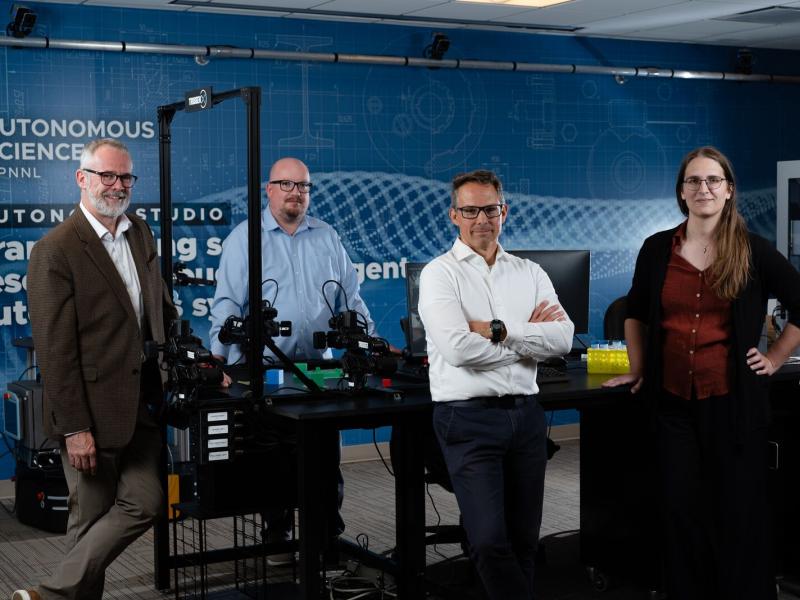
A proving ground for autonomy: the Autonomy Studio

The Autonomy Studio provides a purpose-built space for running design-build-test-learn cycles using digital twins—with their physical counterparts sitting right next to them.  

Inside, researchers can prototype and connect the building blocks of an autonomous laboratory, including robotic platforms, sensors, and control systems, then measure performance in realistic workflows. A digital twin extends the studio beyond its walls, allowing teams across PNNL to model how autonomous systems could operate in their own lab spaces before hardware is deployed. The space is outfitted with motion capture to strengthen the feedback loop between simulation and reality, improving precision, coordination, and repeatability as systems learn.

Prototype an experiment in simulation and then test it on-site. Fix the glitches and run it again. It’s a proving ground to perfect autonomous protocols and robotic handlers before moving into an operational lab.

Autonomy in battery materials innovation

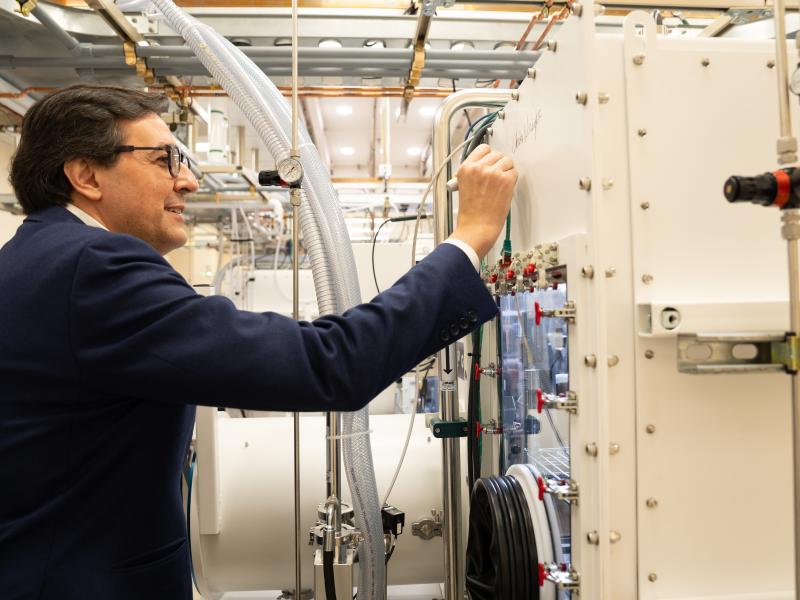
Meet MIRAL—the Materials Innovation through Robotics & AI Laboratory. It was designed to analyze thousands of experimental organic molecules and liquid electrolytes for redox flow batteries, lithium-ion batteries, sodium-ion batteries, and many other battery chemistries for energy storage. It helps researchers characterize and predict material structure, solubility, electrical conductivity, and performance. MIRAL’s intelligent database makes it easier to organize and understand complex data related to the chemical properties of materials. 

Part robot, part workstation, part intelligent database. MIRAL doesn’t assist researchers. It runs the experiment: designing, executing, and learning from hundreds of trials a day. What used to take weeks now takes hours. The result: hundreds of experiments per day, with fewer errors than manual workflows—because every run is guided by physics-informed datasets that sharpen the next one. 

Autonomy in the field

Maritime sensing and autonomy 

At PNNL-Sequim, autonomy leaves the lab and hits the open ocean. This is where we rapidly mature technology from the bench to the bay.

An autonomous surface vehicle persistently monitors marine systems for longer, over wider areas, and with more consistency: no fatigue, and no gaps in the data. Pair it with aerial drones, and you get multi-platform teaming: coordinated robots covering complex environments from the surface and the sky.

Autonomous observation platforms on commercial ships
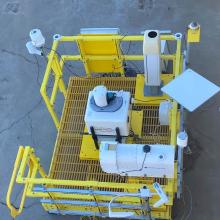
Photograph of an apparatus for autonomous atmospheric monitoring

Boundary Layer Exploration of Aerosols and Clouds ON Ships (BEACONS) demonstrates autonomous deployment of a shipborne observing system that routinely measures atmospheric, cloud, and aerosol properties without requiring a dedicated research vessel.

By delivering consistent, AI-ready observations at scale, BEACONS helps scientists resolve aerosol-cloud interactions and supports the Department of Energy mission to improve predictive weather models.
Top Stories

MARCH 18, 2026
Feature

Robotics and AI Power Biotechnology Advances at PNNL

Read
a man looks at a plastic container used for growing microorganisms
MARCH 10, 2026
Feature

Autonomy Accelerates Science on a National Scale

Read
A researcher with a control device standing behind a robotic arm holding a lab sample tray.

Featured Research

FEBRUARY 2, 2026
Article

Secretary Wright Celebrates Scientific Innovation at Pacific Northwest National Laboratory 

Read
DOE Secretary Chris Wright wearing safety glasses
NOVEMBER 17, 2025
Article

Beyond “Science as Usual”

Read
A graphic of cartoon people and the Earth.
SEPTEMBER 30, 2025
Article

Autonomous Synthesis for Redox Flow Batteries

Read
An image showing the autonomous experimentation cycle, with photographs of the robotic components
SEE MORE RELATED HIGHLIGHTS

Related Links

Genesis MissionAnaerobic Microbial Phenotyping Platform (AMP2)Environmental Molecular Sciences LaboratoryEnergy Sciences CenterPNNL-SequimAdaptive Autonomous SystemsCenter for AI

PNNL

  • Get in Touch
    • Contact
    • Careers
    • Doing Business
    • Environmental Reports
    • Security & Privacy
    • Vulnerability Disclosure Policy
    • Notice to Applicants
  • Research
    • Scientific Discovery
    • Energy Resiliency
    • National Security
Subscribe to PNNL News
Department of Energy Logo Battelle Logo
Pacific Northwest National Laboratory (PNNL) is managed and operated by Battelle for the Department of Energy
  • YouTube
  • Facebook
  • X (formerly Twitter)
  • Instagram
  • LinkedIn