PNNL

  • About
  • News & Media
  • Careers
  • Events
  • Research
    • Scientific Discovery
      • Autonomous Science
      • Biology
        • Chemical Biology
        • Computational Biology
        • Ecosystem Science
        • Human Health
          • Cancer Biology
          • Exposure Science & Pathogen Biology
        • Integrative Omics
          • Advanced Metabolomics
          • Chemical Biology
          • Mass Spectrometry-Based Measurement Technologies
          • Spatial and Single-Cell Proteomics
          • Structural Biology
        • Microbiome Science
          • Biofuels & Bioproducts
          • Human Microbiome
          • Soil Microbiome
          • Synthetic Biology
        • Predictive Phenomics
      • Earth & Coastal Sciences
        • Global Change
        • Atmospheric Science
          • Atmospheric Aerosols
          • Human-Earth System Interactions
          • Modeling Earth Systems
        • Coastal Science
        • Ecosystem Science
        • Subsurface Science
        • Terrestrial Aquatics
      • Materials Sciences
        • Materials in Extreme Environments
        • Nondestructive Examination
        • Precision Materials by Design
        • Science of Interfaces
        • Smart Advanced Manufacturing
          • Cold Spray
          • Friction Stir Welding & Processing
          • ShAPE
      • Nuclear & Particle Physics
        • Dark Matter
        • Neutrino Physics
        • Fusion Energy Science
      • Quantum Information Sciences
      • Chemistry
        • Computational Chemistry
        • Chemical Separations
        • Chemical Physics
        • Catalysis
      • Fusion Energy Science
    • Energy Resiliency
      • Critical Minerals and Materials
      • Electric Grid Modernization
        • Emergency Response
        • Grid Analytics
          • AGM Program
          • Tools and Capabilities
        • Grid Architecture
        • Grid Cybersecurity
        • Grid Energy Storage
        • Transmission
        • Distribution
      • Energy Efficiency
        • Appliance and Equipment Standards
        • Building Energy Codes
        • Building Technologies
          • Advanced Building Controls
          • Advanced Lighting
          • Building-Grid Integration
        • Commercial Buildings
        • Federal Buildings
          • Federal Performance Optimization
          • Resilience and Security
        • Residential Buildings
          • Building America Solution Center
          • Energy Efficient Technology Integration
          • Home Energy Score
        • Energy Efficient Technology Integration
      • Energy Storage
        • Electrochemical Energy Storage
        • Flexible Loads and Generation
        • Grid Integration, Controls, and Architecture
        • Regulation, Policy, and Valuation
        • Science Supporting Energy Storage
        • Chemical Energy Storage
      • Environmental Management
        • Waste Processing
        • Radiation Measurement
        • Environmental Remediation
      • Fossil Energy
        • Subsurface Energy Systems
        • Advanced Hydrocarbon Conversion
      • Nuclear Energy
        • Fuel Cycle Research
        • Advanced Reactors
        • Reactor Operations
        • Reactor Licensing
        • Nondestructive Examination
      • Renewable Energy
        • Solar Energy
        • Wind Energy
          • Wind Resource Characterization
          • Wildlife and Wind
          • Wind Systems Integration
          • Wind Data Management
          • Distributed Wind
        • Marine Energy
          • Environmental Monitoring for Marine Energy
          • Marine Biofouling and Corrosion
          • Marine Energy Innovation
          • Marine Energy Resource Characterization
          • Testing for Marine Energy
        • Hydropower
          • Environmental Performance of Hydropower
          • Hydropower Cybersecurity and Digitalization
          • Hydropower and the Electric Grid
          • Materials Science for Hydropower
          • Pumped Storage Hydropower
          • Water + Hydropower Planning
        • Grid Integration of Renewable Energy
        • Geothermal Energy
          • Geothermal Materials Research
      • Transportation
        • Bioenergy Technologies
          • Algal Biofuels
          • Aviation Biofuels
          • Waste-to-Energy and Products
        • Hydrogen & Fuel Cells
        • Vehicle Technologies
          • Emission Control
          • Energy-Efficient Mobility Systems
          • Lightweight Materials
          • Vehicle Electrification
          • Vehicle Grid Integration
    • National Security
      • Chemical & Biothreat Signatures
        • Contraband Detection
        • Pathogen Science & Detection
        • Explosives Detection
        • Threat-Agnostic Biodefense
      • Cybersecurity
        • Discovery and Insight
        • Proactive Defense
        • Trusted Systems
      • Nuclear Material Science
      • Nuclear Nonproliferation
        • Radiological & Nuclear Detection
        • Nuclear Forensics
        • Ultra-Sensitive Nuclear Measurements
        • Nuclear Explosion Monitoring
        • Global Nuclear & Radiological Security
      • Stakeholder Engagement
        • Disaster Recovery
        • Global Collaborations
        • Legislative and Regulatory Analysis
        • Technical Training
      • Systems Integration & Deployment
        • Additive Manufacturing
        • Deployed Technologies
        • Rapid Prototyping
        • Systems Engineering
      • Threat Analysis
        • Advanced Wireless Security
          • 5G Security
          • RF Signal Detection & Exploitation
        • Border Security
        • Internet of Things
        • Maritime Security
        • Millimeter Wave
        • Mission Risk and Resilience
    • Data Science & Computing
      • Artificial Intelligence
      • Graph and Data Analytics
      • Computational Mathematics & Statistics
      • Future Computing Technologies
        • Adaptive Autonomous Systems
    • Publications & Reports
    • Featured Research
  • People
    • Inventors
    • Lab Leadership
    • Lab Fellows
    • Staff Accomplishments
  • Partner with PNNL
    • Education
      • Undergraduate Students
      • Graduate Students
      • Post-graduate Students
      • University Faculty
      • University Partnerships
      • K-12 Educators and Students
      • STEM Education
        • STEM Workforce Development
        • STEM Outreach
      • Internships
    • Community
      • Philanthropy
      • Volunteering
    • Industry
      • Why Partner with PNNL
      • Explore Types of Engagement
      • How to Partner with Us
      • Available Technologies
      • Procurement
      • Technology Ombuds
  • Facilities & Centers
    • All Facilities
      • Atmospheric Radiation Measurement User Facility
      • Electricity Infrastructure Operations Center
      • Energy Sciences Center
      • Environmental Molecular Sciences Laboratory
      • Grid Storage Launchpad
      • Institute for Integrated Catalysis
      • Interdiction Technology and Integration Laboratory
      • PNNL Portland Research Center
      • PNNL-Seattle
      • PNNL-Sequim (Marine and Coastal Research)
      • Radiochemical Processing Laboratory
      • Shallow Underground Laboratory

Breadcrumb

  1. Research
  2. Data Science & Computing
  3. Future Computing Technologies

Future Computing
Technologies

Meeting challenges with
new computational capabilities

Our computing research is enabled, in part, by the Constance computing cluster. The system is a workhorse for parallel applications, including those in molecular dynamics, climate, and fluid flow calculations, or for high-throughput computing uses such as in high-energy physics or machine learning.

Andrea Starr | Pacific Northwest National Laboratory

  • Artificial Intelligence
  • Graph and Data Analytics
  • Computational Mathematics & Statistics
  • Future Computing Technologies
    • Adaptive Autonomous Systems
  • News & Updates
  • Attend a Future Computing Technologies Event
  • Publications
  • Projects
  • Explainer Articles

At Pacific Northwest National Laboratory (PNNL), future computing technologies span fundamental computer science research areas across hardware and software stacks. Research in this area has the potential to transform AI, quantum computing, HPC, edge computing, and distributed computing, and it is leading to emerging computing paradigms, such as quantum, analog, and neuromorphic computing.


What are future computing technologies?

Future computing technologies are planned or ongoing innovations in the field of advanced computing. They stem from research in high-performance scientific computing, quantum computing and artificial intelligence (AI), heterogeneous computing (systems utilizing multiple processor types), and advanced computer systems.

The following are a few examples:

  • AI-specialized computers
  • quantum computers
  • near-memory computation
  • neuromorphic computing technologies
  • optical computing technologies
  • zettascale computing technologies
  • analog computing technologies
  • brain/computer interfaces
  • advanced data storage systems
  • advanced networks from chip to system level.

Future computing technologies will achieve greater speed, energy efficiency, and problem-solving capabilities than traditional computing technologies. Examples of future computing technologies include the organization of high-performance computing (HPC) systems, quantum computers, and dedicated accelerators for AI and domain science. Equally important are advancements in the constituent components of future computers, including novel processing elements, memory, and networks.

There are far more possibilities than those listed here. PNNL is currently making strides in bringing high-performance scientific computing technologies from the lab into the real world, shaping the future of scientific computing.

The building blocks: Advanced computing and scientific computing

Advanced computing refers to computational systems, processes, and techniques that extend the capabilities of traditional computers. Ultimately serving as the foundation of advancements in computing technology, advanced computing encompasses HPC as well as the state-of-the-art in quantum computing, AI, and machine learning.

Scientific computing is the use of advanced computing technologies, simulations, data analytics, and machine learning to further scientific research and discovery. Researchers use scientific computing to plan and conduct experiments, model physical systems, and analyze data.

Why do future computing technologies matter?

In the years to come, scientific computing technologies will not only benefit researchers but also lead to benefits for the nation as a whole.

Potential benefits include the following:

  • new scientific discoveries
  • quicker and more efficient computing capabilities
  • quicker communications
  • more automation in research and industry
  • stronger digital security and cybersecurity.

How will future computing technologies be used?

Future computing technologies will accelerate scientific discovery, reduce the burden on researchers, speed up computational problem-solving and data analysis, and drive the development of new innovations for industry and consumers.

The integrated computational tools being developed at PNNL will enable domain science researchers to analyze, model, simulate, and predict complex phenomena in areas ranging from molecular, biological, subsurface, and atmospheric sciences to complex networked systems.

Future computing technologies at PNNL
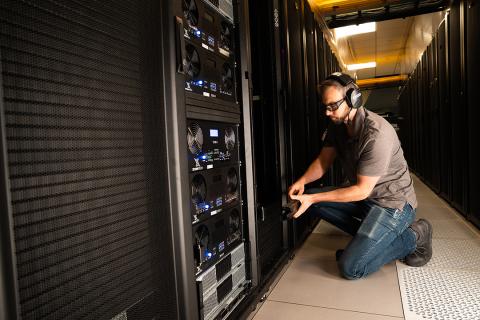
a technician in safety goggles and ear protection works on a server rack

PNNL is leading the next generation of computing for scientific discovery.       
Explore our Computing & AI story

PNNL provides science, technologies, and leadership in creating and enabling new computational capabilities to solve challenges using extreme-scale simulation, data analytics, and machine learning. PNNL delivers the computer science, mathematics, computer architecture, and algorithmic advances that enable the integration of extreme-scale modeling and simulation with knowledge discovery and model inference from petabytes of data.

Research areas

Research at PNNL covers a multitude of areas, including the following:

  • advanced computer systems and architectures
  • advanced memory systems  
  • system software and runtime systems
  • performance modeling and analysis
  • quantum computing
  • high-performance data analytics
  • machine learning techniques at scale.

Current projects

PNNL has recognized expertise in evaluation and capability prediction for both current and emerging large-scale system architectures. Our researchers also lead efforts to prepare the Department of Energy (DOE) for future eras of advanced computing, including through the development of new software tools.

  • AMAIS: Advanced Memory to Support AI for Science (AMAIS) explores novel large disaggregated shared memory systems.
  • ENCODE: The End-to-end Co-design for Performance, Energy Efficiency, and Security in AI-enabled Computational Science (ENCODE) project continues the success of CENATE by designing, deploying, and operating advanced architecture test beds for the assessment of novel hardware designs.
  • DeCoDe: Democratization of Co-design for Energy-Efficient Heterogeneous Computing (DeCoDE), with roots in the Data-Model Convergence Initiative, has helped to establish expertise and develop the cross-disciplinary acumen required to implement hardware-software co-design while meeting energy-efficiency challenges spanning traditional high-performance computing, to edge computing, to the integration of sensor data from DOE’s experimental user facilities.
  • Global Arrays Toolkit: The Global Arrays Toolkit is a programming model that provides primitives for one-sided communication and atomic operations.
  • Lamellar HPC Runtime: The Lamellar HPC Runtime is an asynchronous tasking runtime for HPC systems.
  • SHAD: The Scalable High-Performance Algorithms and Data-Structures library (SHAD) provides scalability and performance to support different application domains, including graph processing, machine learning, and data mining.

PNNL is also innovating in areas of data–model convergence and charting a new path in integrating the elements of HPC with data analytics to enable new scientific discoveries and computational capabilities.
Recent News

JUNE 15, 2026
Feature

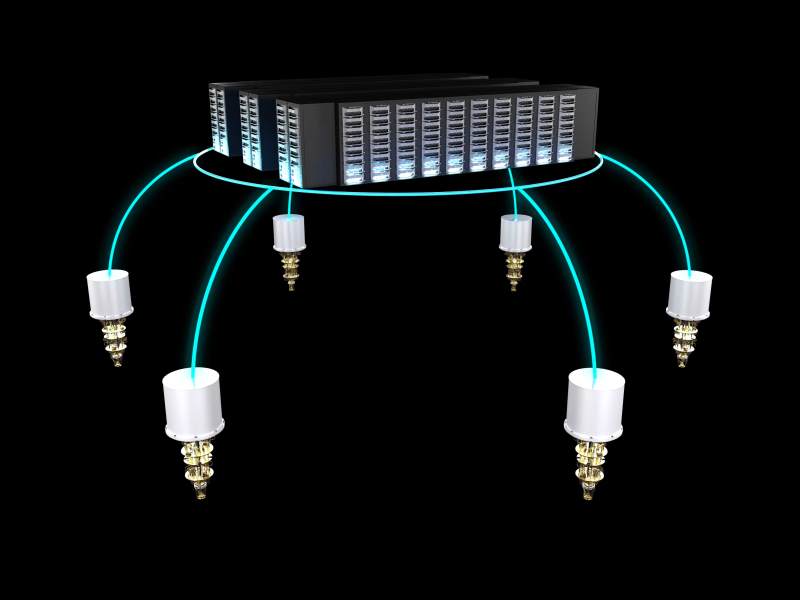
PNNL Prepares for Quantum Advantage

Read
Illustration of a high-performance computer connected to a series of individual quantum computers
JUNE 10, 2026
Staff Accomplishment

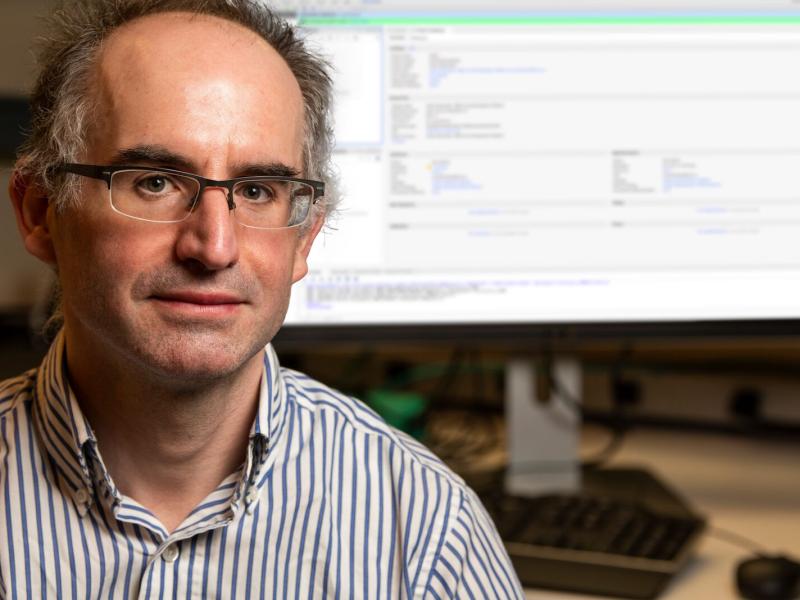
Tumeo Editing Special Issue on Democratizing Microelectronics

Read
Antonio Tumeo wears a striped shirt and glasses, with a computer screen in the background
APRIL 30, 2026
News Release

PNNL Researchers to Speak About Genesis Mission at National Science Bowl

Read
2026 National Science Bowl Presenters Rallo (left) and Hodas (right)
SEE MORE RELATED NEWS

Research Highlights

JUNE 1, 2026
Article

PNNL Researchers Achieve High-Level Quality of Service

Read
A man posing next to large computers
DECEMBER 10, 2025
Article

PNNL Leads the Latest SciDAC Institute

Read
Panos Stinis
SEPTEMBER 23, 2025
Article

DIMPLES Unlocks New Levels of Success in Influence Maximization

Read
A person looking at a data visualization
SEE MORE RELATED HIGHLIGHTS

Facilities & Centers

Environmental Molecular Sciences Laboratory

Related Divisions

Advanced Computing, Mathematics, and Data
AI and Data Analytics Division

Related Links

What is Graph Analytics?CENATEExascale Computing Project

Contact

Kevin J. Barker
Group Leader, Future Computing Technologies Group
kevin.barker@pnnl.gov
509-375-6743

Lab-Level Communications Priority Topics

Computing

PNNL

  • Get in Touch
    • Contact
    • Careers
    • Doing Business
    • Environmental Reports
    • Security & Privacy
    • Vulnerability Disclosure Policy
    • Notice to Applicants
  • Research
    • Scientific Discovery
    • Energy Resiliency
    • National Security
Subscribe to PNNL News
Department of Energy Logo Battelle Logo
Pacific Northwest National Laboratory (PNNL) is managed and operated by Battelle for the Department of Energy
  • YouTube
  • Facebook
  • X (formerly Twitter)
  • Instagram
  • LinkedIn