
PNNL

  • About
    • Science and Technology Strategy
    • Awards
    • Our History
    • Contact Us
    • Lab Leadership
    • Sponsors
    • Visitors
    • Cultural Resources
    • Economic Impact
    • Tour PNNL Virtually
    • FAQ
  • News & Media
  • Careers
  • Events
  • Research
    • Scientific Discovery
      • Autonomous Science
      • Biology
        • Chemical Biology
        • Computational Biology
        • Ecosystem Science
        • Human Health
          • Cancer Biology
          • Exposure Science & Pathogen Biology
        • Integrative Omics
          • Advanced Metabolomics
          • Chemical Biology
          • Mass Spectrometry-Based Measurement Technologies
          • Spatial and Single-Cell Proteomics
          • Structural Biology
        • Microbiome Science
          • Biofuels & Bioproducts
          • Human Microbiome
          • Soil Microbiome
          • Synthetic Biology
        • Predictive Phenomics
        • Toward a Standard Model of Biology
      • Earth & Coastal Sciences
        • Global Change
        • Atmospheric Science
          • Atmospheric Aerosols
          • Human-Earth System Interactions
          • Modeling Earth Systems
        • Coastal Science
        • Ecosystem Science
        • Subsurface Science
        • Terrestrial Aquatics
      • Materials Sciences
        • Materials in Extreme Environments
        • Nondestructive Examination
        • Precision Materials by Design
        • Science of Interfaces
        • Smart Advanced Manufacturing
          • Cold Spray
          • Friction Stir Welding & Processing
          • ShAPE
      • Nuclear & Particle Physics
        • Dark Matter
        • Neutrino Physics
        • Fusion Energy Science
      • Quantum Information Sciences
      • Chemistry
        • Computational Chemistry
        • Chemical Separations
        • Chemical Physics
        • Catalysis
      • Fusion Energy Science
    • Energy Resiliency
      • Critical Minerals and Materials
      • Electric Grid Modernization
        • Emergency Response
        • Grid Analytics
          • AGM Program
          • Tools and Capabilities
        • Grid Architecture
          • Basic Terms & Principles
          • Resource Library
        • Grid Cybersecurity
        • Grid Energy Storage
        • Transmission
        • Distribution
      • Energy Efficiency
        • Appliance and Equipment Standards
        • Building Energy Codes
        • Building Technologies
          • Advanced Building Controls
          • Advanced Lighting
          • Building-Grid Integration
        • Commercial Buildings
        • Federal Buildings
          • Federal Performance Optimization
          • Resilience and Security
        • Residential Buildings
          • Building America Solution Center
          • Energy Efficient Technology Integration
          • Home Energy Score
        • Energy Efficient Technology Integration
      • Energy Storage
        • Electrochemical Energy Storage
        • Flexible Loads and Generation
        • Grid Integration, Controls, and Architecture
        • Regulation, Policy, and Valuation
        • Science Supporting Energy Storage
        • Chemical Energy Storage
      • Environmental Management
        • Waste Processing
        • Radiation Measurement
        • Environmental Remediation
      • Fossil Energy
        • Subsurface Energy Systems
        • Advanced Hydrocarbon Conversion
      • Nuclear Energy
        • Fuel Cycle Research
        • Advanced Reactors
        • Reactor Operations
        • Reactor Licensing
        • Nondestructive Examination
      • Renewable Energy
        • Solar Energy
        • Wind Energy
          • Wind Resource Characterization
          • Wildlife and Wind
          • Wind Systems Integration
          • Wind Data Management
          • Distributed Wind
        • Marine Energy
          • Environmental Monitoring for Marine Energy
          • Marine Biofouling and Corrosion
          • Marine Energy Innovation
          • Marine Energy Resource Characterization
          • Testing for Marine Energy
        • Hydropower
          • Environmental Performance of Hydropower
          • Hydropower Cybersecurity and Digitalization
          • Hydropower and the Electric Grid
          • Materials Science for Hydropower
          • Pumped Storage Hydropower
          • Water + Hydropower Planning
        • Grid Integration of Renewable Energy
        • Geothermal Energy
          • Geothermal Materials Research
      • Transportation
        • Bioenergy Technologies
          • Algal Biofuels
          • Aviation Biofuels
          • Waste-to-Energy and Products
        • Hydrogen & Fuel Cells
        • Vehicle Technologies
          • Emission Control
          • Energy-Efficient Mobility Systems
          • Lightweight Materials
          • Vehicle Electrification
          • Vehicle Grid Integration
    • National Security
      • Chemical & Biothreat Signatures
        • Contraband Detection
        • Pathogen Science & Detection
        • Explosives Detection
        • Threat-Agnostic Biodefense
      • Cybersecurity
        • Discovery and Insight
        • Proactive Defense
        • Trusted Systems
      • Nuclear Material Science
      • Nuclear Nonproliferation
        • Radiological & Nuclear Detection
        • Nuclear Forensics
        • Ultra-Sensitive Nuclear Measurements
        • Nuclear Explosion Monitoring
        • Global Nuclear & Radiological Security
      • Stakeholder Engagement
        • Disaster Recovery
        • Global Collaborations
        • Legislative and Regulatory Analysis
        • Technical Training
      • Systems Integration & Deployment
        • Additive Manufacturing
        • Deployed Technologies
        • Rapid Prototyping
        • Systems Engineering
      • Threat Analysis
        • Advanced Wireless Security
          • 5G Security
          • RF Signal Detection & Exploitation
        • Border Security
        • Internet of Things
        • Maritime Security
        • Millimeter Wave
        • Mission Risk and Resilience
    • Data Science & Computing
      • Artificial Intelligence
      • Graph and Data Analytics
      • Computational Mathematics & Statistics
      • Future Computing Technologies
        • Adaptive Autonomous Systems
    • Science & Technology Strategy
    • Publications & Reports
    • Featured Research
  • People
    • Inventors
    • Lab Leadership
    • Lab Fellows
    • Staff Accomplishments
  • Partner with PNNL
    • Education
      • Undergraduate Students
      • Graduate Students
      • Post-graduate Students
      • University Faculty
      • University Partnerships
      • K-12 Educators and Students
      • STEM Education
        • STEM Workforce Development
        • STEM Outreach
      • Internships
    • Community
      • Philanthropy
      • Volunteering
    • Industry
      • Why Partner with PNNL
      • Explore Types of Engagement
      • How to Partner with Us
      • Available Technologies
      • Procurement
      • Technology Ombuds
  • Facilities & Centers
    • All Facilities
      • Atmospheric Radiation Measurement User Facility
      • Electricity Infrastructure Operations Center
      • Energy Sciences Center
      • Environmental Molecular Sciences Laboratory
      • Grid Storage Launchpad
      • Institute for Integrated Catalysis
      • Interdiction Technology and Integration Laboratory
      • PNNL Portland Research Center
      • PNNL-Seattle
      • PNNL-Sequim (Marine and Coastal Research)
      • Radiochemical Processing Laboratory
      • Shallow Underground Laboratory

Breadcrumb

  1. Research
  2. Science & Technology Strategy

Science and Technology Strategy

  • Scientific Discovery
  • Energy Resiliency
  • National Security
  • Data Science & Computing
  • Science & Technology Strategy
  • Publications & Reports
  • Featured Research

Advancing the Frontiers of Discovery

PNNL is pursuing ambitious scientific objectives to build the foundations for transformative discoveries, strengthen national capabilities, and address some of the nation’s most consequential challenges.


At Pacific Northwest National Laboratory (PNNL), we are advancing a vision for the future of science and technology that integrates our distinctive strengths in biology, chemistry, materials, and computing to achieve breakthroughs beyond the reach of individual disciplines.

A new era of scientific discovery has emerged. Advances in Super Intelligence (SI), autonomous experimentation, quantum technologies, and predictive modeling are transforming what researchers can understand, design, and control. At the same time, increasingly complex challenges in energy, national security, and other areas demand new approaches that connect scientific disciplines and accelerate the translation of discovery into impact.

PNNL will lead this transformation. Our deep expertise across scientific domains, advanced experimental and computational capabilities, and strengths in energy systems, advanced materials, and nuclear and national security create a powerful environment for innovation. Fundamental discoveries inform new technologies and solutions, while challenges encountered in real-world applications drive new scientific questions. Together, these mutually reinforcing strengths allow us to pursue advances that would not be possible through isolated research efforts.

Four Frontiers for Transformational Science
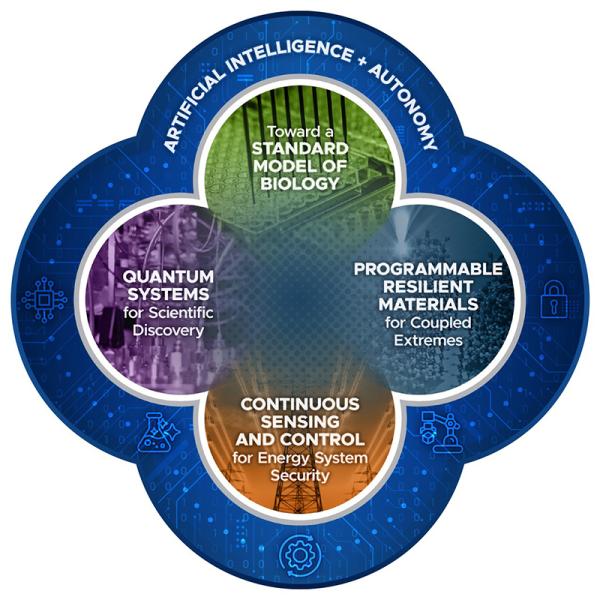
a clover-shaped diagram showing the four laboratory objectives surrounded be an overarching focus on AI and autonomy

PNNL has established four long-term objectives that focus our scientific ambitions on areas where we will make distinctive, enduring contributions to the Department of Energy, the nation, and the broader scientific community.

Toward a Standard Model of Biology  

Establishing the scientific foundations for predictive, designable biology

PNNL is pursuing a fundamental understanding of the principles that govern biological function, from molecular interactions to the emergent behavior of complex systems. By integrating biology with chemistry, physics, mathematics, and advanced computing, we aim to move beyond describing biological systems toward reliably predicting and engineering their behavior.

This new scientific foundation will transform how biological systems are designed and harnessed for energy, critical minerals, environmental applications, biomanufacturing, and national security.

Learn how PNNL is working toward a standard model of biology

Programmable Resilient Materials for Coupled Extremes  

Creating materials that adapt and perform in demanding environments

PNNL is advancing a new paradigm for materials design: moving beyond materials engineered to withstand extreme conditions to materials that can adapt their structure and function as conditions change.

By combining predictive materials science, precision synthesis, advanced characterization, and autonomous experimentation, we aim to establish the foundations for programmable resilience in materials exposed to interacting extremes such as heat, radiation, and mechanical stress. These advances could enable new capabilities in nuclear energy, advanced manufacturing, microelectronics, and national security.

Quantum Systems for Scientific Discovery  

Turning quantum systems into dependable instruments for scientific discovery

PNNL is unlocking the scientific potential of quantum computing by connecting emerging quantum technologies with complex research challenges in chemistry, materials science, biology, and energy systems.

Our goal is to establish the methods, algorithms, and capabilities needed to make quantum systems reliable scientific instruments, expanding the frontiers of what scientists can model, understand, and ultimately discover.

Continuous Sensing and Control for Energy System Security  

Enabling energy infrastructure that can sense, learn, defend, and recover in real time

PNNL is advancing the scientific foundations for a new generation of intelligent, resilient energy infrastructure capable of responding to rapidly evolving physical and cyber threats.

By integrating advanced sensing, physics-informed SI, predictive modeling, and autonomous control, we will enable energy systems that can anticipate disturbances, adapt to changing conditions, and maintain secure, reliable operation.

Greater Impact Through Integrated Science

Each of these objectives represents a significant, long-term scientific ambition. The opportunities at their intersections offer potential for even greater discovery.

Biological principles can inspire adaptive materials and resilient energy systems. Quantum computing may open the door to new approaches to modeling complex biological and chemical phenomena. SI and autonomous experimentation can accelerate discovery across all four areas.

These connections reflect a defining strength of PNNL: the ability to integrate deep scientific expertise across disciplines and connect fundamental discovery with applications that advance energy security, strengthen national security, and address other critical challenges facing the nation.

PNNL’s Laboratory Objectives build on a broader foundation of scientific capabilities, sponsor-driven programs, advanced facilities, and partnerships across the research ecosystem. Together, they provide a focused direction for developing the scientific knowledge, technologies, and enduring capabilities that will help shape the future.

PNNL is bringing the breadth of its scientific enterprise together to pursue transformational discoveries for science, energy resiliency, and national security. 

Contact

William A. Pike, PhD
Deputy Director for Science and Technology
William.Pike@pnnl.gov

PNNL

  • Get in Touch
    • Contact
    • Careers
    • Doing Business
    • Environmental Reports
    • Security & Privacy
    • Vulnerability Disclosure Policy
    • Notice to Applicants
  • Research
    • Scientific Discovery
    • Energy Resiliency
    • National Security
Subscribe to PNNL News
Department of Energy Logo Battelle Logo
Pacific Northwest National Laboratory (PNNL) is managed and operated by Battelle for the Department of Energy
  • YouTube
  • Facebook
  • X (formerly Twitter)
  • Instagram
  • LinkedIn