Water, which covers over two-thirds of the Earth’s surface, is a vast, untapped resource that can provide improved energy security across the United States. The ocean, rivers, and other large bodies of water are promising energy sources that can meet growing electricity demand, improve energy resilience in remote and coastal communities, and power growing ocean-based industries. While there is momentum around ocean energy innovation, many marine energy technologies are still emerging, requiring further testing, evaluation, and refinement. Industry advancement is slow because of several factors, including engineering challenges, market adaptation, and permitting barriers around possible environmental impacts. While developers continue to refine their energy harvesting technologies for U.S. deployments, there are opportunities to identify, better understand, and mitigate the potential environmental effects that may arise from marine energy devices and their associated infrastructure.
History of marine energy
The earliest forms of marine energy were used over 1,000 years ago, when tides were used to power grain mills in medieval Europe. Incoming tidewater was retained in storage ponds, and outgoing tidal movement was used to turn waterwheels and mill grain. (Learn more here).
Centuries later, in 1799, French inventor Pierre-Simon Girard and his son designed a new machine to capture the energy of ocean waves. The first technology of its kind, Girard’s device was designed to power heavy machinery including mills and pumps. In the 19th century, wave energy converters and motors were developed as people searched for innovations to solve local environmental issues and provide power to small communities. (Learn more here).
Then, in the 1940s, Yoshio Masuda, chief scientist at the Japan Marine Science and Technology Center, created the oscillating water column, which was a navigation buoy powered by wave energy and equipped with an air turbine. This technology has been commercialized since 1965, and Masuda became widely known as the father of modern wave energy (Ocean Energy Systems).
Several decades later, the oil crisis of the 1970s sparked marine energy research across different technologies, including ocean thermal energy conversion (OTEC), salinity gradient technologies, and wave energy. In 1974, Stephen Salter, a professor of Engineering Design at the University of Edinburgh, explored the seas around Scotland and launched the world’s first major wave energy project, known as “Salter’s Duck” (CorPower Ocean 2024, Triton Initiative 2023).
In the decades since the innovations made by Masuda, Salter, and others, marine energy technology has continued to advance in the United States and across the globe.

What is marine energy and how does it work?
Marine energy typically refers to marine hydrokinetics, the natural energy present in moving water in the world’s oceans, seas, and rivers suitable to generate electricity (DOE 2026, Tethys 2026). Different forms of marine energy include wave energy, tidal energy, ocean current energy, and river current energy. Thermal, pressure, and salinity gradients are sources of potential energy in water and are also considered marine energy. The specific devices used to generate power vary depending on the marine energy resource, but these devices typically use rotating or moving parts forced by moving water for hydrokinetics or with electrical/electrochemical processes for ocean gradients (OES-Environmental 2024, 2025). Marine energy differs from conventional hydropower and tidal barrages, which rely on dams or reservoirs to control and direct water flow, whereas marine energy employs the movement of free-flowing water and naturally occurring gradients.
The power generated from marine energy devices may be exported to land via electric power cables or used to directly power off-grid applications at sea, such as aquaculture. For land-based energy needs, underwater power cables are typically buried, laid on the seafloor, or draped in the water column (OES-Environmental 2025). Inter-array cables are used to connect multiple devices within an array or to an offshore substation, and export cables are used to transmit the power to shore (OES-Environmental 2024). Energy may also be used at sea to power activities occurring in the open ocean or deep water, including powering buoys and other equipment used for ocean observation, navigational aids or markers used to guide vessels, or charging of underwater autonomous vehicles (LiVecchi et al. 2019).

Marine energy devices and associated infrastructure are at varying stages of development, and questions remain about how this technology may affect and impact marine animals, habitats, and ecosystem processes. Addressing these knowledge gaps is important to support regulatory processes and permitting, facilitate confident decision-making for testing and development, and to ensure the responsible advancement of marine energy.
The different interactions between marine energy systems and the marine environment are commonly described as stressors and receptors. Stressors are the parts of a device or system that may cause harm to or negatively affect a marine animal or the environment, including moving parts of a device, mooring lines, and cables. On the other hand, receptors describe the marine animals living in and traveling near a marine energy development area, the habitats where devices are deployed, or ecosystem processes, like nutrient cycling and food web dynamics (OES-Environmental 2024). It is important to note that not all impacts result in substantial harm or injury to marine animals or their habitats. In fact, marine energy can also offer possible ecological benefits by functioning as artificial reefs and de‑facto marine reserves, supporting biodiversity and providing refuge for fish and invertebrates.

For any device deployed into the water, changes in habitat are a consideration. These changes involve alterations to benthic or pelagic habitats that support marine animals, including changes in community composition on or near devices and the artificial reef effect (OES-Environmental 2024). These changes can alter where species live, which can lead to habitat loss, modify ecological patterns or functions, affect behavior, or provide opportunities for the establishment of invasive species (OES-Environmental 2024).
Whenever electricity is produced and transported, electromagnetic fields (EMFs) are also a stressor to consider. In particular, there is slight concern that EMFs, which are low-frequency electromagnetic radiation generated from natural and anthropogenic sources, may change the behavior and movement of sensitive species (OES-Environmental 2025, SEER 2022).
Marine energy devices may also contribute to underwater sound through installation and operation. These acoustic impacts may affect marine mammals, fish, and other marine fauna that depend on sound for communication, prey detection or avoidance, reproduction, migration, and feeding (Haxel et al. 2023, OES-Environmental 2024, Popper et al. 2023). Research on underwater sound has primarily focused on impacts to marine mammals which rely on changes in sound pressure to hear; however, the impacts on fishes and invertebrates that hear by detecting acoustic particle motion as well as substrate vibration are less well known, making these effects an active area of research. (Learn more about acoustic particle motion here).
The various marine energy resources, devices, and additional potential environmental effects are described below.
Wave energy
Wave energy is energy harnessed directly from the surface motion of waves formed when wind blows over the ocean’s surface (Tethys 2026, Triton Initiative 2023). Power in waves depends on their height and period, and larger waves form in places where there is a long distance over which wind can blow and build.
Wave energy is typically captured by wave energy converters (WECs), which convert the kinetic energy of ocean waves into electricity (Triton Initiative 2023). One common form of WEC is a point absorber, which uses a floating buoy that moves in response to the motion of passing waves, capturing and converting energy from the surface waves into electricity through a generator. Additionally, floating devices called surface attenuators have many connected segments parallel to incoming waves. As the attenuator moves with the swell, internal generators capture the movement of the joints between segments and convert the energy to electricity. Other WECs include oscillating wave surge devices, which have one end fixed to the seabed or a floating structure, while the other end moves like a flap or paddle perpendicular to the base. This motion can drive a generator or pressurizes fluid to produce electricity. They are typically deployed in shallow water, often just outside the surf zone. Last, oscillating water columns are devices that use a partially submerged hollow structure open to the sea below the waterline. Waves press and pull the trapped air above the water column through a turbine. Many other types of WECs have been proposed and tested, including variations on these primary device types; different WECs may be better suited to different wave resources. You can learn more about wave energy devices on the Tethys website.

WECs could potentially pose a risk to marine life through displacement of animals naturally occurring in the areas surrounding a deployment, or from entanglement with lines, cables, or debris suspended in the water column. While primary entanglement from cables or mooring lines is a concern, secondary entanglement—where marine debris like derelict fishing gear is caught on infrastructure and that gear poses an entanglement risk to animals—is a more salient concern.
Regarding point absorbers, these devices may either attract organisms or cause them to avoid the area. There are similar concerns about the environmental effects of surface attenuators, as well as the concern that organisms could be pinched in the joints of the device (Tethys 2026). However, WECs may also protect areas threatened by coastal erosion (OES-Environmental 2024) or create new habitats or substrate for species to settle and thrive (Fonesca et al. 2024).
Tidal energy
Tides are driven by the gravitational pull of the moon and sun, which causes ocean water to rise and fall. As this tidal water moves, it may pass through narrow areas such as straits or inlets. These constrictions cause the water to move faster, and are typically found close to shore. Tidal energy devices can convert this powerful movement of water into electricity (PNNL 2023, Tethys 2026).
Most tidal energy devices utilize turbines—as moving water interacts with turbine blades, its kinetic energy is converted into mechanical energy as the rotating blades spin a drive shaft. A generator, often through a gearbox, then converts the mechanical energy to electricity. Axial-flow turbines are the most similar to commonly-seen wind turbines, while cross-flow turbines utilize blades oriented in a different direction relative to the flow. A tidal kite is a less common design that uses a hydrodynamic wing with an onboard turbine, tethered to the seafloor. As currents lift and propel the wing in looping paths, water flows rapidly through the turbine to generate power. This design allows energy production in relatively low‑speed tidal currents. You can learn more about other types of tidal energy devices here.

The primary environmental effect that may result from tidal energy devices is possible animal encounters, the outcomes of which are dependent on how a marine animal responds. Encounters can include avoidance by swimming in the opposite direction, above, below, or around the turbine; evasion at the last minute; or collision involving a direct interaction (Cotter et al. 2026, OES-Environmental 2024, Tethys 2026). For both axial- and cross-flow turbines, potential concerns include possible collision with turbine blades, attraction to the device, or inability to avoid the turbine in strong currents.
River current energy
River current energy, also known as riverine energy, utilizes the kinetic energy from flowing water in rivers to generate electricity (Tethys 2026). The power produced in a specific area depends on the volume of water and the speed of the current (Marine Renewables Canada 2026).
River current energy devices consist of turbines, similar to those used for tidal energy, except they are designed to extract energy from water that flows in only one direction. Because of these similarities, river current energy is often grouped with marine energy even though it occurs in fresh water. River current turbines can be mounted on the riverbed, shoreline, attached to a fixed or floating structure, or suspended in the water column. You can learn more about these devices on the Tethys website. Similar to tidal turbines, the primary environmental effect that may result from river current energy devices is possible collision (OES-Environmental 2024, Tethys 2026).
Ocean thermal energy conversion

OTEC uses the difference in temperature between layers of deep cold water and warm surface water in tropical and subtropical oceans to generate power through thermal heat engines (Tethys 2026).
Different OTEC systems use one, or a combination of, thermodynamic processes to convert the temperature difference into mechanical energy. These include closed-cycle, open-cycle, and hybrid-cycle systems. OTEC systems can be located on land with pipes in the water or floating, and they are typically quite large and can often be paired with desalination or used for seawater air conditioning rather than power conversion. More information on OTEC systems can be found on the Tethys website.
The primary environmental effect associated with OTEC involves changes in water quality. As cool, nutrient rich water is withdrawn from the deep ocean and released higher in the water column, the transport of nutrients and the cooler water could impact nearby habitats through temperature change or increased biological growth, though water is often released in a similar temperature depth to avoid changes (Tethys 2026). Closed-cycle systems that use ammonia or other liquids may also experience accidental leakage of these chemicals as gas, which could be harmful to marine fauna (OES-Environmental 2024). Additionally, the return of large volumes of cold water to the surface water may lead to temperature-shock and the destabilization of the water column. Another unique environmental effect associated with OTEC is the entrainment of marine life in deep cold-water pipes, where organisms, eggs, and larvae are drawn into water intake systems (OES-Environmental 2024). Similar to other marine energy technologies, attraction, entanglement, displacement and changes to migratory routes are potential environmental effects associated with OTEC.
Salinity gradient energy
Salinity gradient technologies generate electricity from the chemical pressure differential created by differences in ionic concentration (concentration of salt) between freshwater and seawater (Tethys 2026). Based on the current state of the technology, there are only a few locations worldwide where salinity gradient is a viable marine energy resource because this power can be produced exclusively in areas where large rivers empty directly into the ocean (OES-Environmental 2024).
Salinity gradient technologies use semi-permeable membranes, or a barrier that selectively allows molecules or ions to pass through. As these molecules move through the membrane, they generate an osmotic potential that is used to generate electricity. Salinity gradient technology is currently in the early stages of testing, and little is known about its potential environmental effects (OES-Environmental 2024). However, speeding up the natural mixing process between freshwater and seawater could lead to ecological imbalances or risks to organisms, impacting water quality and the physical environment (Tethys 2026).
Marine energy project scales
Marine energy has the potential to generate electricity at a variety of scales, ranging from small-scale community generation to large-scale grid-connected generation. Marine energy is also explored as an alternative form of electricity generation for coastal areas with access to suitable resources, as well as a mechanism to power off-grid applications including powering ocean observation and navigational buoys, recharging autonomous vehicles, or supporting marine aquaculture (Hemery et al. 2025), and data centers.
The sections below describe representative examples of marine energy demonstration and deployment across different scales and applications. Additional information on past projects across the world can be found in the Portal and Repository for Information on Marine Renewable Energy (PRIMRE) Marine Energy Projects Database and the Tethys Marine Energy Environmental Monitoring Metadata.
Tidal energy demonstration in Roosevelt Island, New York
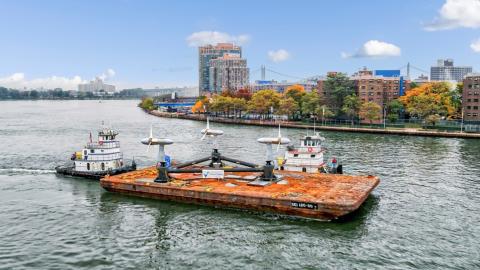
The Roosevelt Island Tidal Energy (RITE) projects were located in the East Channel of the East River, a tidal strait connecting the Long Island Sound with the Atlantic Ocean in New York Harbor. Known as the “six-pack,” this demonstration served as the first multi-turbine grid-connected marine energy array. The RITE Demonstration Project, completed in 2008, showed that the system was able to successfully provide grid connected power without compromising power quality (PRIMRE 2025). The success of the demonstration project informed the RITE Pilot Project, which became the first commercially licensed tidal power project in the United States. For this pilot, three operating axial-flow turbines were installed on a TriFrame mount on the river bottom, resulting in the turbines not being visible from the surface (National Hydropower Association 2022).
Environmental monitoring data collection conducted during the deployment included species characterization, species detection for Endangered Species Act-listed and acoustically tagged species, and seasonal bird observations (see Bevelhimer et al. 2016 and Tethys 2021 for more information). After nine months of continuous operation, the pilot generated and delivered 312 MWh of electricity to the grid, which is enough to power roughly 1,000 homes (National Hydropower Association 2022, PRIMRE 2025). This project was also one of the first to fully decommission when, in December 2021, all infrastructure was removed and the site was returned to its original state.
Wave energy pilot project in San Diego, California

From 2021 to 2022, CalWave Technologies conducted an open-ocean wave energy pilot project off the coast of San Diego, California, which continuously operated for 10 months (PRIMRE 2026). The 14-foot by 14-foot prototype of CalWave’s xWave™ technology, a fully submerged pressure differential wave energy converter, was deployed 1,800 feet away from the Ellen Browning Scripps Memorial Pier at the Scripps Institution of Oceanography (DOE 2023). The autonomous device survived two severe storms, required no interventions, and remained operational for 99 percent of the time during its deployment (DOE 2023). Additionally, in partnership with Integral Consulting and the Pacific Northwest National Laboratory (PNNL), CalWave collected environmental monitoring data, which was exported via subsea cable directly to the Scripps Institution of Oceanography research pier (see Haxel et al. 2026 and Hemery et al. 2022 for more information). This pilot represented California’s first at-sea, long-duration wave energy project, while also working toward developing the commercial viability of wave energy.

Wave energy testing in the Pacific Northwest
The Ocean-2 system, developed by Panthalassa, is an “overtopping” wave energy converter that generates power as the device bobs up and down in the waves and forces water through an internal pipe and down through a turbine (PRIMRE 2025). The device was deployed for a 3-week trial from Everett Ship Repair off the Washington Coast in February 2024, testing systems required for full operation (PRIMRE 2025). Panthalassa is also developing the Ocean-3 system, an autonomous floating platform designed to host data centers. The system generates its own electricity utilizing wave energy conversion.
Testing and application of river current energy devices

The RivGen® Power System, developed by the Ocean Renewable Power Company (ORPC), generates electricity from river currents and connects directly into community grids through smart grid technology. Specifically, the RivGen device is a horizontal cross-flow hydrokinetic turbine that consists of a Turbine Generator Unit mounted on a structural frame. The full power system includes the devices, mooring systems, transmission and data cables, and an onshore station for system electronics (Tethys 2026).
Since 2013, ORPC has partnered with the Igiugig Village Council in Alaska to develop a river current energy project that could deliver baseload energy without harming the salmon, the central component of Igiugig’s subsistence lifestyle (Salmon et al. 2023). In 2014, ORPC tested the first generation of the RivGen Power System and delivered electricity to Igiugig’s diesel microgrid; however, the device was removed before the winter over concerns about the impact of ice flow (Jenkins and Beaver 2025). In 2015, the RivGen system was reinstalled for two months to demonstrate technology advancements, and in turn, it reduced the community’s diesel fuel use by one-third when operating (Tethys 2026). After receiving a 10-year Federal Energy Regulatory Commission Pilot license in 2019, the first grid-connected RivGen device was deployed in 2019 and the second was deployed in 2023 (Tethys 2026).
In January 2023, ORPC deployed a low-flow Modular RivGen System in Maine’s Milinocket Stream, with a second device deployed in May 2023. The Modular RivGen System is specifically designed to produce power in low-flow environments (DOE 2024). The devices were deployed at One North, a sustainable development hub located at a former paper mill and managed by Our Katahdin, a local nonprofit. The goal of the project was to demonstrate the potential of the Modular RivGen System to be integrated into existing or new infrastructure, like electric vehicle charging stations, hydroelectric facilities, irrigation canals and bridges, and flood control systems (DOE 2024, PRIMRE 2025).
Wave energy opportunities: PacWave
PacWave is an open-water wave energy testing facility based at Oregon State University. The facility has two sites located several miles off the coast of Newport, Oregon—PacWave North, which is an established autonomous test site for small-scale, prototype, and maritime market technologies; and PacWave South, an open-ocean wave energy test site that is pre-permitted for up to 20 WECs (PRIMRE 2026). As of 2025, the Bonneville Power Association has entered into an agreement with PacWave to purchase all power generated at the site, which is licensed to produce up to 20 MW of electricity per hour, enough to power several thousand homes (Baumhardt 2025). PacWave completed planning and permitting in 2021 and construction in 2025, officially opening in 2026.

Opportunities for power and data connectivity: CRABEE
The Cabled Research Array for the Blue Economy (CRABEE) provides power and data connectivity to Sequim Bay from PNNL-Sequim, DOE’s only marine research facility. This system utilizes an underwater node positioned in the channel, which functions as a power strip and router for connecting different technologies or equipment to other areas of the bay. In May and June 2025, a floating platform featuring solar panels and an advanced environmental monitoring system became the first system connected to CRABEE, which enabled underwater sensing and photography. CRABEE provides an opportunity to streamline marine deployments and monitoring, allowing researchers to gain quick access to data collected (PNNL 2026).

Benefits and challenges of marine energy
Marine energy technologies have several benefits. Many of these resources, like tides, are highly predictable and can be accurately forecasted years in advance. The predictability, as well as the daily and seasonal cycles of these resources enable marine energy to complement other traditional sources of power production (Preziuso et al. 2019). Certain marine energy resources also provide a high energy density, meaning that marine energy devices can generate large amounts of electricity within a relatively small spatial footprint.
Marine energy can also provide communities with social and economic benefits. Access to commercially available marine energy devices can support energy independence for coastal, island, and remote communities by reducing reliance on imported fuels for local energy generation. Marine energy deployments can also increase opportunities for education and workforce development or provide opportunities for groups that have not historically received benefits from marine industries (Cardinal et al. 2024, OES-Environmental 2024). For more information on social and economic effects of marine energy, see Chapter 4 of the 2024 OES-Environmental State of the Science Report.
However, several challenges persist. First, marine energy technologies in the United States are at an early stage of development compared to other energy sources, with most projects in the demonstration phase and no large-scale or commercial deployments to date (Caballero et al. 2023, Kilcher et al. 2021). Marine energy devices also need to be designed and built to withstand harsh marine environments, including processes like biofouling, corrosion, and extreme weather, sea states, and hydrodynamic conditions (Tiron et al. 2015). Key community groups have also expressed concerns related to marine energy, such as possible displacement from historical fishing grounds, loss of income or livelihood, and uncertainty around potential effects on long-term ecosystem health (OES-Environmental 2024).
Across marine energy device types and technologies, there is potential for environmental effects. However, these effects depend on several factors, including the type of technology and associated infrastructure, the geographic and bathymetric characteristics of a site, placement of the device, and the potential for conflicts and cumulative effects with other ocean uses (Copping et al. 2024). When permitting marine energy projects, potential environmental effects require stringent review by federal and state regulatory agencies, which relies on monitoring data and research around these topics.
PNNL research on marine energy
Researchers at PNNL are working to understand marine energy opportunities and applications, explore solutions to technological challenges, and identify and address the environmental effects associated with these technologies. PNNL projects, funded by the Department of Energy Hydropower and Hydrokinetic Office, span multiple areas related to the environmental effects of marine energy—from developing methodologies and monitoring technologies to synthesizing research conducted across the globe.

The Triton Initiative works to comprehensively assess the potential environmental effects of marine energy, reduce uncertainties regarding regulatory concerns, and facilitate confident decision-making based on empirical observations and data-driven science that supports the responsible deployment of marine energy. Triton actively conducts research in three key areas: (1) behavioral and physiological responses of animals to marine energy, (2) animal interactions with devices and infrastructure, and (3) science communication and outreach for environmental monitoring. These projects aim to advance knowledge around potential stressors as identified by regulators and the 2024 State of the Science Report.
The Nereus Project is a field-based effort that serves to collect and analyze comprehensive monitoring data around operational marine energy sites and devices in the United States. The goal of Nereus is to collect data around environmental stressors of concern using tested and validated monitoring technologies and standardized analytical methods. Nereus provides empirical datasets that are transferable and applicable across different marine energy projects and applications.
OES-Environmental is an international collaborative that works to accelerate the responsible development and operation of marine energy through the synthesis and dissemination of information on marine energy environmental effects as a global scale. This collaborative consists of 16 member nations and the European Commission. One key component of OES-Environmental are the State of the Science Reports, which are released every four years and summarize the current state of environmental effects of marine energy research.
Tethys serves as a knowledge hub that provides access to environmental data and information for researchers, regulators, developers, consultants, students, educators, and other stakeholders. The documents and tools housed within Tethys preserve knowledge as the marine energy industry progresses. Tethys also provides tools and resources to support knowledge sharing and decision-making.
Tethys is one of seven knowledge hubs under the PRIMRE, which provides centralized access to marine energy data and information, from power performance data and environmental monitoring reports to device testing and software codes. PRIMRE acts as a centralized source for marine energy data and resources, ensuring this information is accessible for decision-makers and the general public. Additional knowledge hubs under PRIMRE include the Marine Hydrokinetic Data Repository (MHKDR), Tethys Engineering, Telesto, and the Marine Energy Atlas.
As ongoing research, testing, and collaborative development continue, the marine energy industry is steadily advancing. The commitment to data-driven science and transparent communication ensures that the industry progresses toward providing ocean-based energy in an environmentally responsible manner.
Quick Link Resources
- What is wave energy? https://www.pnnl.gov/projects/triton/stories/triton-explains-wave-energy
- PNNL Tidal Energy explainer: https://www.pnnl.gov/explainer-articles/tidal-energy
- 2024 State of the Science: https://tethys.pnnl.gov/publications/state-of-the-science-2024
- Tethys marine energy knowledge base: https://tethys.pnnl.gov/knowledge-base-marine-energy
- Marine Energy metadata on Tethys: https://tethys.pnnl.gov/marine-energy-metadata
- PRIMRE marine energy device glossary: https://openei.org/wiki/PRIMRE/Basics