PNNL

  • About
  • News & Media
  • Careers
  • Events
  • Research
    • Scientific Discovery
      • Autonomous Science
      • Biology
        • Chemical Biology
        • Computational Biology
        • Ecosystem Science
        • Human Health
          • Cancer Biology
          • Exposure Science & Pathogen Biology
        • Integrative Omics
          • Advanced Metabolomics
          • Chemical Biology
          • Mass Spectrometry-Based Measurement Technologies
          • Spatial and Single-Cell Proteomics
          • Structural Biology
        • Microbiome Science
          • Biofuels & Bioproducts
          • Human Microbiome
          • Soil Microbiome
          • Synthetic Biology
        • Predictive Phenomics
      • Chemistry
        • Computational Chemistry
        • Chemical Separations
        • Chemical Physics
        • Catalysis
      • Earth & Coastal Sciences
        • Global Change
        • Atmospheric Science
          • Atmospheric Aerosols
          • Human-Earth System Interactions
          • Modeling Earth Systems
        • Coastal Science
        • Ecosystem Science
        • Subsurface Science
        • Terrestrial Aquatics
      • Materials Sciences
        • Materials in Extreme Environments
        • Nondestructive Examination
        • Precision Materials by Design
        • Science of Interfaces
        • Smart Advanced Manufacturing
          • Cold Spray
          • Friction Stir Welding & Processing
          • ShAPE
      • Nuclear & Particle Physics
        • Dark Matter
        • Fusion Energy Science
        • Neutrino Physics
      • Quantum Information Sciences
    • Energy Resiliency
      • Electric Grid Modernization
        • Emergency Response
        • Grid Analytics
          • AGM Program
          • Tools and Capabilities
        • Grid Architecture
        • Grid Cybersecurity
        • Grid Energy Storage
        • Transmission
        • Distribution
      • Energy Efficiency
        • Appliance and Equipment Standards
        • Building Energy Codes
        • Building Technologies
          • Advanced Building Controls
          • Advanced Lighting
          • Building-Grid Integration
        • Commercial Buildings
        • Federal Buildings
          • Federal Performance Optimization
          • Resilience and Security
        • Residential Buildings
          • Building America Solution Center
          • Energy Efficient Technology Integration
          • Home Energy Score
        • Energy Efficient Technology Integration
      • Energy Storage
        • Electrochemical Energy Storage
        • Flexible Loads and Generation
        • Grid Integration, Controls, and Architecture
        • Regulation, Policy, and Valuation
        • Science Supporting Energy Storage
        • Chemical Energy Storage
      • Environmental Management
        • Waste Processing
        • Radiation Measurement
        • Environmental Remediation
      • Fossil Energy
        • Subsurface Energy Systems
        • Advanced Hydrocarbon Conversion
      • Nuclear Energy
        • Fuel Cycle Research
        • Advanced Reactors
        • Reactor Operations
        • Reactor Licensing
        • Nondestructive Examination
      • Renewable Energy
        • Solar Energy
        • Wind Energy
          • Wind Resource Characterization
          • Wildlife and Wind
          • Wind Systems Integration
          • Wind Data Management
          • Distributed Wind
        • Marine Energy
          • Environmental Monitoring for Marine Energy
          • Marine Biofouling and Corrosion
          • Marine Energy Resource Characterization
          • Testing for Marine Energy
          • The Blue Economy
        • Hydropower
          • Environmental Performance of Hydropower
          • Hydropower Cybersecurity and Digitalization
          • Hydropower and the Electric Grid
          • Materials Science for Hydropower
          • Pumped Storage Hydropower
          • Water + Hydropower Planning
        • Grid Integration of Renewable Energy
        • Geothermal Energy
      • Transportation
        • Bioenergy Technologies
          • Algal Biofuels
          • Aviation Biofuels
          • Waste-to-Energy and Products
        • Hydrogen & Fuel Cells
        • Vehicle Technologies
          • Emission Control
          • Energy-Efficient Mobility Systems
          • Lightweight Materials
          • Vehicle Electrification
          • Vehicle Grid Integration
    • National Security
      • Chemical & Biothreat Signatures
        • Contraband Detection
        • Pathogen Science & Detection
        • Explosives Detection
        • Threat-Agnostic Biodefense
      • Cybersecurity
        • Discovery and Insight
        • Proactive Defense
        • Trusted Systems
      • Nuclear Material Science
      • Nuclear Nonproliferation
        • Radiological & Nuclear Detection
        • Nuclear Forensics
        • Ultra-Sensitive Nuclear Measurements
        • Nuclear Explosion Monitoring
        • Global Nuclear & Radiological Security
      • Stakeholder Engagement
        • Disaster Recovery
        • Global Collaborations
        • Legislative and Regulatory Analysis
        • Technical Training
      • Systems Integration & Deployment
        • Additive Manufacturing
        • Deployed Technologies
        • Rapid Prototyping
        • Systems Engineering
      • Threat Analysis
        • Advanced Wireless Security
          • 5G Security
          • RF Signal Detection & Exploitation
        • Border Security
        • Internet of Things
        • Maritime Security
        • Millimeter Wave
        • Mission Risk and Resilience
    • Data Science & Computing
      • Artificial Intelligence
      • Graph and Data Analytics
      • Software Engineering
      • Computational Mathematics & Statistics
      • Future Computing Technologies
        • Adaptive Autonomous Systems
    • Lab Objectives
    • Publications & Reports
    • Featured Research
  • People
    • Inventors
    • Lab Leadership
    • Lab Fellows
    • Staff Accomplishments
  • Partner with PNNL
    • Education
      • Undergraduate Students
      • Graduate Students
      • Post-graduate Students
      • University Faculty
      • University Partnerships
      • K-12 Educators and Students
      • STEM Education
        • STEM Workforce Development
        • STEM Outreach
      • Internships
    • Community
      • Philanthropy
      • Volunteering
    • Industry
      • Why Partner with PNNL
      • Explore Types of Engagement
      • How to Partner with Us
      • Available Technologies
      • Procurement
      • Technology Ombuds
  • Facilities & Centers
    • All Facilities
      • Atmospheric Radiation Measurement User Facility
      • Electricity Infrastructure Operations Center
      • Energy Sciences Center
      • Environmental Molecular Sciences Laboratory
      • Grid Storage Launchpad
      • Institute for Integrated Catalysis
      • Interdiction Technology and Integration Laboratory
      • PNNL Portland Research Center
      • PNNL-Seattle
      • PNNL-Sequim (Marine and Coastal Research)
      • Radiochemical Processing Laboratory
      • Shallow Underground Laboratory

Advanced Metering Best Practices

  • Metering 101
  • Program Objectives
    • Advanced Metering System Costs and Savings Potential
    • Common Metering Challenges
  • Electricity Metering
  • Water Metering
  • Connectivity Troubleshooting
    • Pre-Troubleshooting Checklists
    • Decision Trees
  • Glossary

Breadcrumb

  1. Home
  2. Projects
  3. Advanced Metering Best Practices

Connectivity Troubleshooting: Pre-Troubleshooting Checklists

Consult these checklists before leaving to troubleshoot the meter. You can download an Excel version of these checklists at the link below: 

File

Advanced Meter Connectivity Pre-Troubleshooting Checklists (.xlsx)

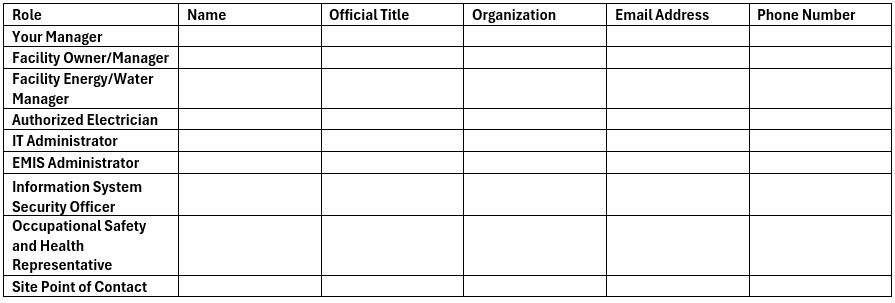
Contact List

Table of contacts

Questionnaire 

Answer the following questions to determine whether you have the information and authorization necessary to troubleshoot the meter:

  1. Meter location:
    1. What building/structure is the meter located in, on, or nearest to?
    2. If the meter is located inside of a building, what room is it located in? Note: Meters located in a building are usually found inside of a mechanical room.
    3. Can you describe the specific location of the meter? Include details such as the orientation of the wall/post on which the meter is mounted, the electrical panel ID with which the meter is associated, whether the meter is in a separate enclosure or mounted within the panel itself, the approximate height of the meter, and helpful identifying visual details—include photos if available.
    4. Are any special tools needed to access the meter? For example, keys, proximity access cards, or alphanumeric codes are typically required to access mechanical rooms and enclosures. If the meter is located high up in an electrical panel, a ladder may be required for safe access.
  2. Travel planning:
    1. How will you travel to the meter location?
    2. If the meter is located at a remote site, does your organization require you to obtain pre-travel authorization?
      1. Book any necessary flights, rental cars, and accommodations before you travel.
        1. If you are flying, consider whether any travel restrictions apply to items on your checklist. For example, a screwdriver longer than 7 in. must be checked; bear spray is not allowed (see the Transportation Security Administration’s What Can I Bring? webpage for additional information).
      2. If necessary, do you have a point of contact who will meet you at the travel destination?
    3. Where will you obtain the tools to troubleshoot the meter? When reviewing the Tool Checklist below, note whether you will obtain the tool from home, your office, or the meter location. 
  3. Authorization, training, and tools:
    1. If the meter is located in a mechanical room, do you have authorization and tools necessary to enter the room? If not, contact the responsible facility owner/manager.
    2. Do you have the authorization, training, and tools necessary to open the meter enclosure? If not, contact an authorized electrician at the facility to assist you.
    3. Do you have authorization, training, and tools necessary to open an electrical panel and perform electrical work? If not, contact an authorized electrician at the facility to assist you.
    4. Do you have authorization, training, and tools necessary to open a server rack/cabinet and reconfigure network connections? If not, contact the responsible IT administrator at the facility to assist you.
    5. Do you have access credentials to log into the meter and the EMIS front-end client software? If not, contact the EMIS administrator.
    6. Have you received the necessary safety training to perform other tasks related to meter troubleshooting? (E.g., ladder safety training). If not, contact your facility/organization’s occupational safety and health representative.
  4. Connectivity:
    1. Will you need to use a network-connected device while troubleshooting the meter? If so, will one or more of the following options be available?
      1. Ethernet
      2. Wi-Fi
      3. Cellular connection
      4. Satellite connection
    2. Do you have authorization to take the network-connected device with you to the meter location? Personal devices may not be allowed in some spaces.
  5. Personal safety:
    1. Is any personal protective equipment (PPE) required at the meter location? E.g., safety boots for a boiler plant or warehouse; hard hat, safety glasses, high-visibility vest for a construction site.
    2. What will the weather be like when you visit the meter location? Dress appropriately, particularly if the work must be conducted outdoors. Consider whether conditions may be icy, rainy, or hot.
    3. Are there any animal dangers at the meter location? Review relevant safety precautions for potential interactions with insects and wild animals (e.g., mosquitoes, ticks, wasps, bears). 

Tool Checklist

Refer to the following checklist to ensure that you have the necessary tools.
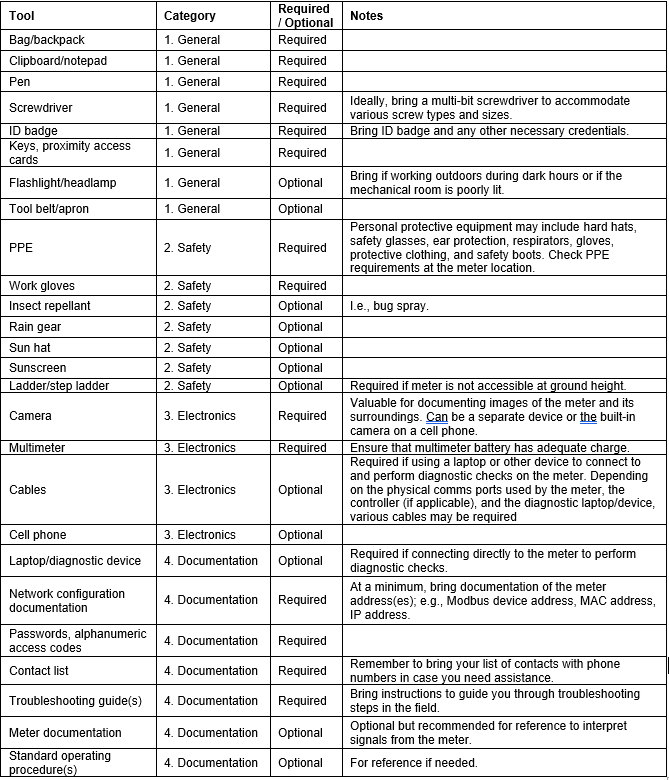
Tool checklist

Meter Inventory Data Checklist

When inspecting a meter in the field, document as much of the following information as possible if it is available and not already recorded in an official meter inventory database. Take photos of the following to supplement this data:

  • meter manufacturer
  • meter model
  • meter serial number
  • date of meter manufacture
  • date of meter installation
  • firmware version
  • meter device address(es) (e.g., MAC address, IP address, Modbus device address)
  • meter communication protocol(s)
  • connected communication port(s)
  • meter location
    • building
    • room (if applicable)
    • description
    • electrical panel ID
    • circuit ID
  • phase and wiring configuration
  • analog inputs
  • controller ID (if applicable)
  • controller device address(es) (if applicable)
  • brief description of loads metered
  • any information on physical labels affixed to the meter or enclosure
  • photos/videos (or link to directory path):
    • front entrance of building
    • hallway(s)
    • room entrance
    • meter enclosure on wall/post
      • include related items such as electrical panel
    • meter in enclosure
    • meter front, sides, back (if accessible)
  • tools needed
  • access permissions required to access facility and meter
  • relevant points of contact
    • facility
    • meter location
    • meter owner (if applicable)
    • utility account number (if applicable)

Next: Connectivity Troubleshooting Decision Trees

Use following decision trees to walk through a connectivity troubleshooting process for your advanced electricity meter.

PNNL

  • Get in Touch
    • Contact
    • Careers
    • Doing Business
    • Environmental Reports
    • Security & Privacy
    • Vulnerability Disclosure Policy
    • Notice to Applicants
  • Research
    • Scientific Discovery
    • Energy Resiliency
    • National Security
Subscribe to PNNL News
Department of Energy Logo Battelle Logo
Pacific Northwest National Laboratory (PNNL) is managed and operated by Battelle for the Department of Energy
  • YouTube
  • Facebook
  • X (formerly Twitter)
  • Instagram
  • LinkedIn