RemPlex Expands Leadership to Reflect Commitment to Environmental Remediation
Director David Peeler, Deputy Director Carolyn Pearce, and Operations Director Christian Johnson are joined by advisors with multidisciplinary subsurface research expertise
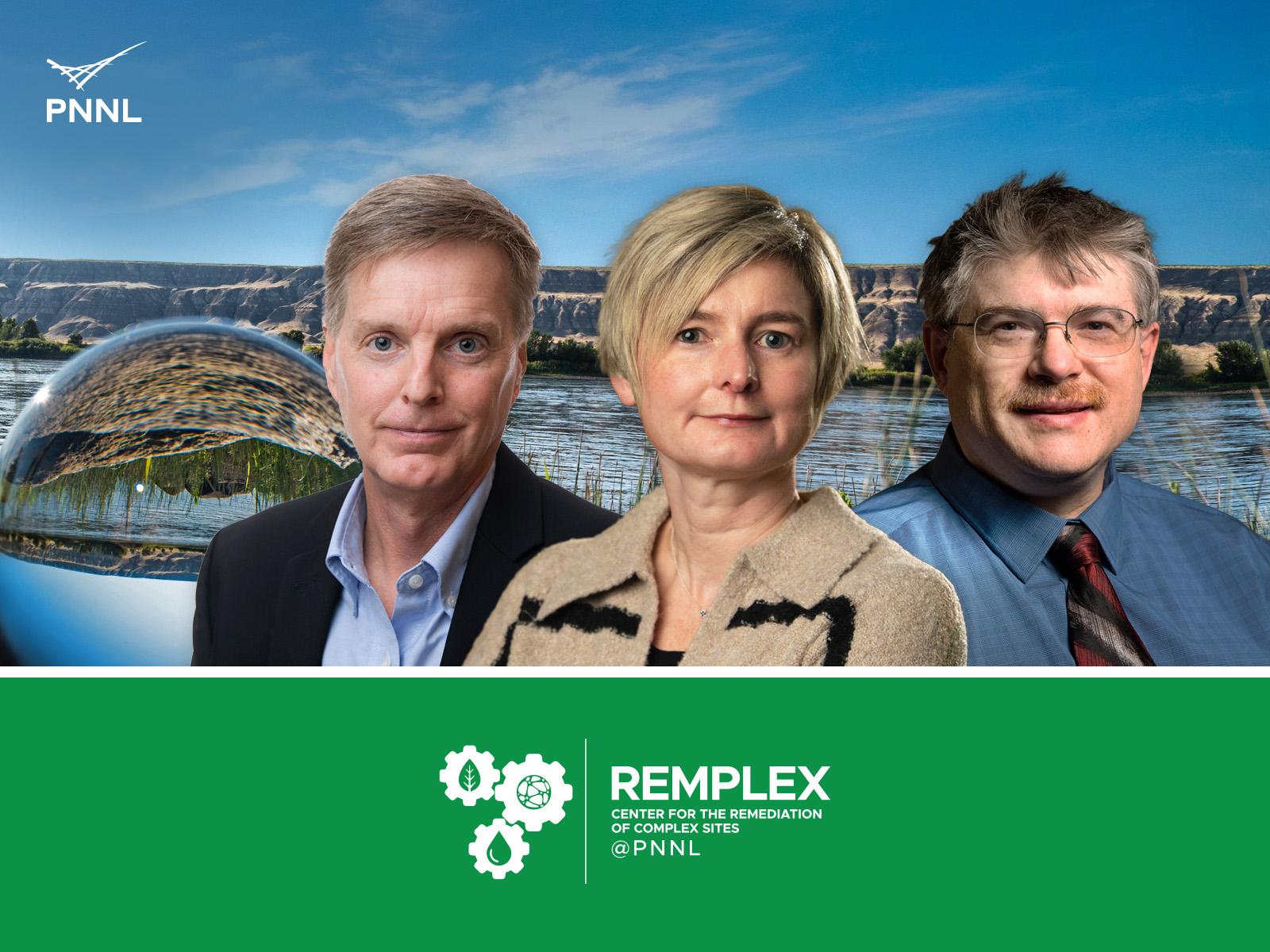
The Center for the Remediation of Complex Sites (RemPlex) inducted new leadership in March 2026: (from left to right) Director David Peeler, Deputy Director Carolyn Pearce, and Operations Director Christian Johnson. They are joined by an expanded team of advisors who bring multidisciplinary subsurface research expertise to RemPlex.
(Composite image by Kelly Machart | Pacific Northwest National Laboratory)
Three researchers with in-depth experience in contamination cleanup science have been named to new leadership roles with the Center for the Remediation of Complex Sites (RemPlex).
David Peeler is the RemPlex director, Carolyn Pearce is the deputy director, and Christian Johnson is the operations director. Karen P. Smith, deputy director of operations for five years, is retiring after a nearly 40-year career in environmental science that includes substantial service to the international remediation community.
“Karen’s global perspective on complex cleanup has been instrumental to RemPlex’s growth, including our cooperation with the International Atomic Energy Agency’s Network on Environmental Management and Remediation,” Peeler said. “Carolyn and Chris are well-suited to carry forward both the worldview and connections.”
RemPlex objectives are to foster technical leadership, collaborative research, and professional development in the environmental remediation arena. Based at Pacific Northwest National Laboratory (PNNL) adjacent to the Department of Energy’s Hanford Site in Washington State, RemPlex offers seminars, workshops, and the bi-annual Global Summit. All RemPlex presentations are posted online as a resource. Registration is open for RemPlex’s next seminar on March 31, titled “Research Priorities for Environmental Remediation.” Sign up for the RemPlex newsletter to connect and learn about future events.
A full slate of subsurface research
As the interim sector director for PNNL’s environmental management programs, Peeler took on the RemPlex director role from Tom Brouns, who has new leadership responsibilities at PNNL. Peeler oversees innovative research and technology development for remediation of subsurface contamination, radioactive waste processing, and the environmental effects of energy development.
Pearce is a widely published geochemist who brings leadership experience and international connections to RemPlex. She is active in research ranging from unraveling the chemistry of radioactive tank waste to resolving contamination in subsurface soil and groundwater. Pearce also is director of Ion Dynamics in Radioactive Environments and Materials (IDREAM), a PNNL-led multi-institutional Energy Frontier Research Center, and holds appointments at Washington State University and the University of Manchester in the United Kingdom.
Johnson, a chemical engineer by training, has been in the field of environmental restoration/remediation technology since 1992—including six years with RemPlex. He is well-versed in remediation technology development and application, groundwater flow and transport modeling, and environmental data analysis and visualization.
Additional advisors bring extra depth
To further broaden the environmental remediation expertise represented in RemPlex programming, new advisors have joined the team including Lab Fellow Fred Day-Lewis, Hilary Emerson, Debbie Fagan, Rebecka Iveson, Alex Kugler, Katherine Muller, and Sarah Saslow.
“Our new advisors will partner with experienced RemPlex leaders—Lab Fellow Nik Qafoku, Inci Demirkanli, Rob Mackley, and Judy Robinson,” Peeler said.
“This multidisciplinary team will further the RemPlex mission of providing a forum to facilitate cost-effective remediation of complex sites through application of proven and innovative solutions.”
Importance of international partnerships
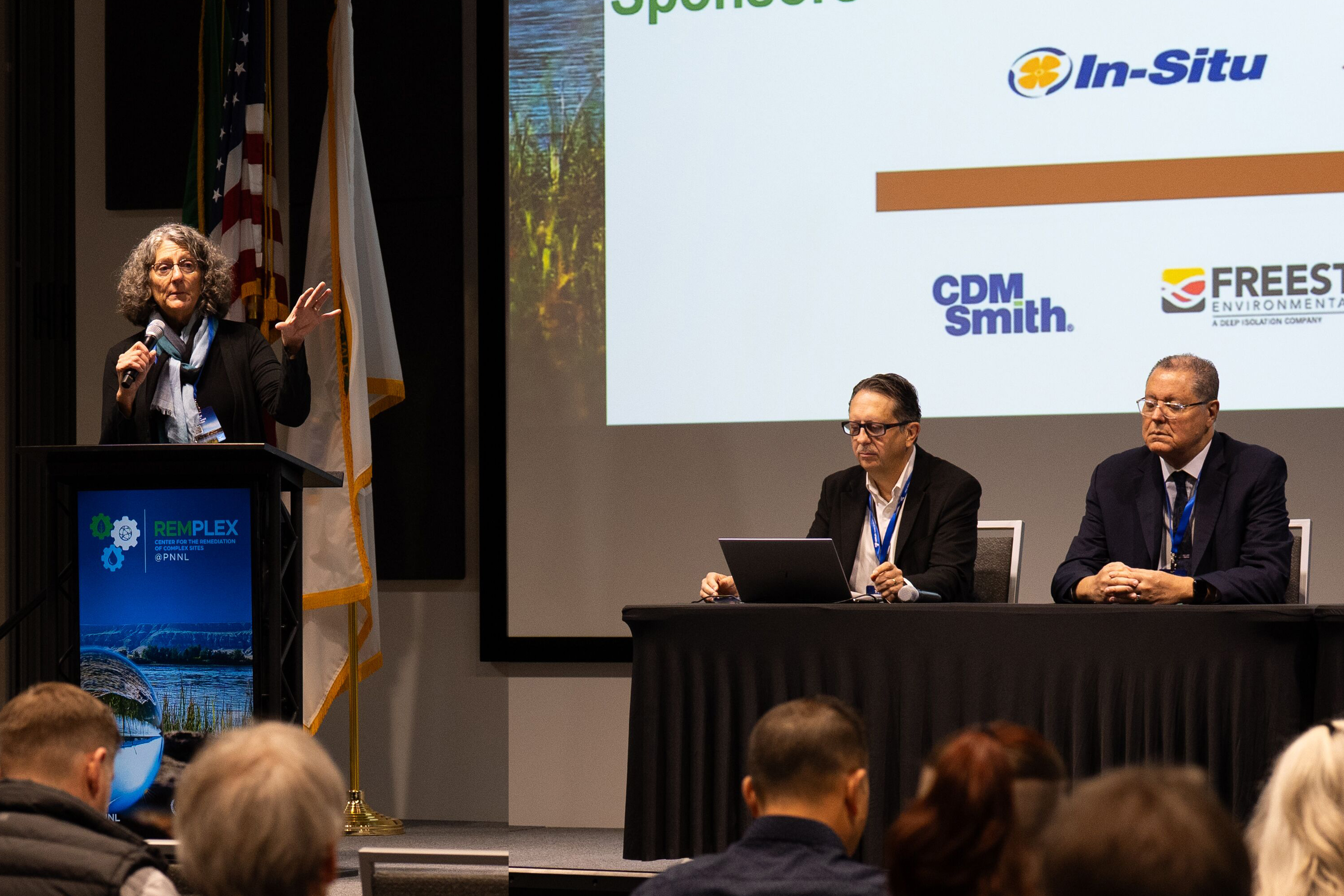
RemPlex convenes researchers, site managers, cleanup practitioners, regulators, and stakeholders to discuss remediation challenges and to collaborate on proven and innovative solutions. The spirit of inclusion extends from U.S. federal agencies like the Department of Energy’s offices of Environmental Management and Legacy Management, to global institutions such as Canadian Nuclear Laboratories, the University of Tsukuba in Japan, and Sellafield and the Nuclear Decommissioning Authority in the UK. This global involvement brings a range of expertise that helps move the field of environmental remediation forward.
Smith, RemPlex’s outgoing deputy director, joined PNNL in 2020 following 30 years at Argonne National Laboratory. Her longtime colleague at the International Atomic Energy Agency, Horst Monken-Fernandes, described her career accomplishments in a LinkedIn post.
“(Karen) championed my work at the IAEA with a generosity of spirit that is rare...she shaped not only projects but people,” Monken-Fernandes wrote. “At PNNL, she poured her energy into RemPlex, giving life to the RemPlex Summits—spaces where thoughtful, honest, high-quality discussions on environmental remediation could flourish. She carried the best of the USA into every room she entered: competence, integrity, reliability, and a deep commitment to public good.”
Published: March 10, 2026