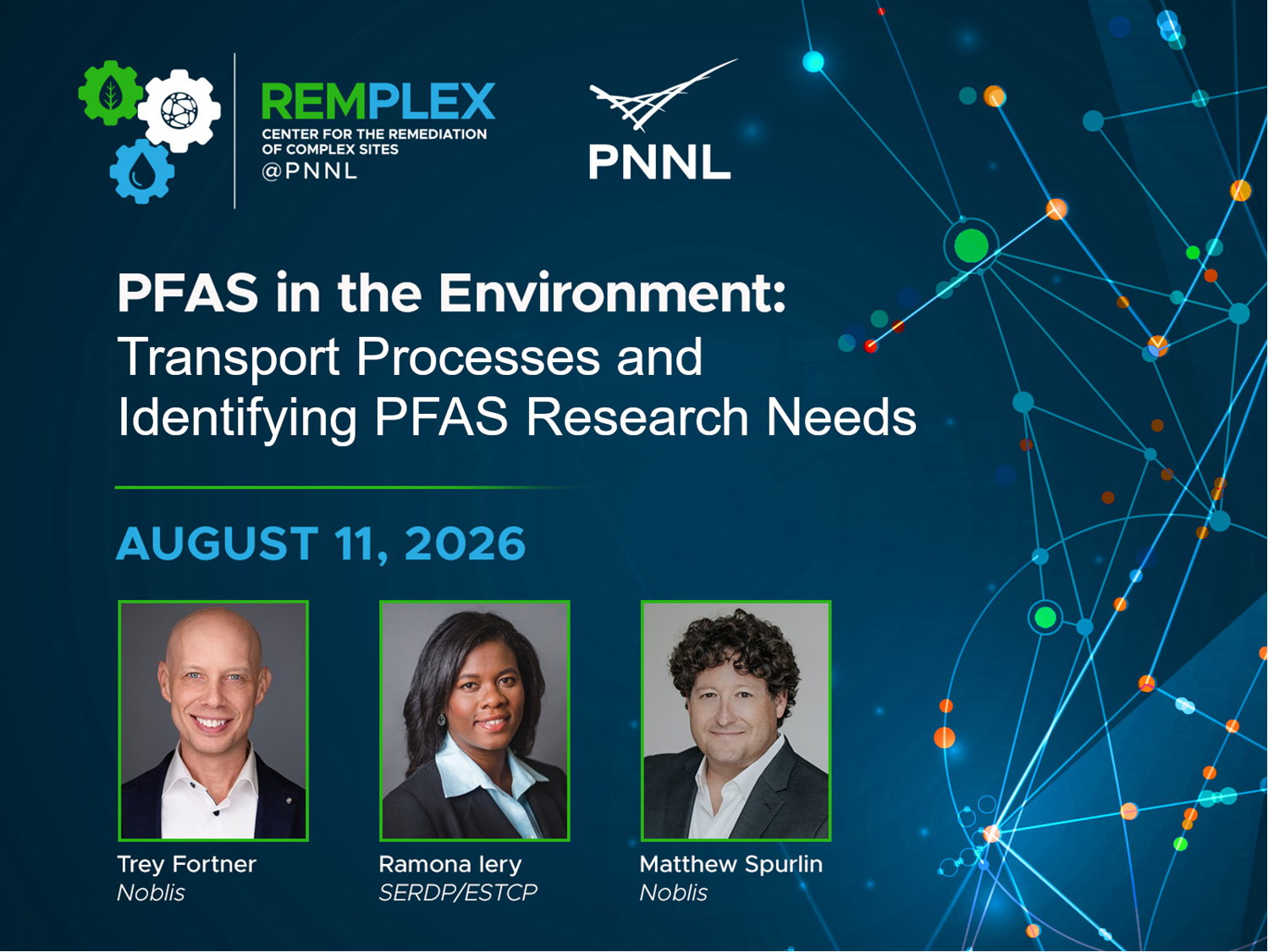
Transport Processes and Identifying PFAS Research Needs
August 11, 2026
Presenters
- Trey Fortner, hydrogeologist, Noblis
- Ramona Iery, PhD, PE, Environmental Restoration program manager, SERDP/ESTCP
- Matthew Spurlin, hydrogeologist, Noblis
Facilitators
- Christian D. Johnson, operations director, RemPlex; senior development engineer, PNNL
- Debbie Fagan, advisor, RemPlex; statistician, PNNL
Presentations
Recording
Seminar Abstract
This set of talks related to per- and polyfluoroalkyl substances (PFAS) in the environment provides insights into identifying research priorities and how PFAS transport can be evaluated in unsaturated systems and groundwater/surface water interactions. Ramona Iery discusses identifying data gaps and research questions to arrive at Statements of Need for research, demonstrations, and technology transition under the Strategic Environmental Research and Development Program (SERDP) and Environmental Security Technology Certification Program (ESTCP). Trey Fortner examines a structured, phased approach for groundwater–surface water interaction (GSI) investigations, which have increased in priority for PFAS releases at Air Force installations, given PFAS fate and transport properties and low regulatory levels. Matthew Spurlin presents information on updated best practices for PFAS soil-to-groundwater leaching evaluations at Air Force installations, which employes a tiered approach for determining site-specific soil screening levels and makes use of the PFAS-LEACH data modeling tool.
About the Speakers
Everett “Trey” Fortner III, PG | Hydrogeologist| Noblis
Presentation: From Rocky Seas to Smooth Sailing: Which Path Will your GSI Investigation Take?
Abstract: Investigating PFAS-contaminated groundwater impacting surface water is complex because of dynamic hydrogeologic environments and multiscale transport mechanisms. GSI encompasses physical, geochemical, and biological processes, with site-specific characteristics driving contaminant migration through interconnected pathways. GSI investigations have increased in priority with PFAS releases at Air Force installations given PFAS fate and transport properties and low regulatory levels. This presentation discusses a structured, phased approach to GSI investigations informed by a comprehensive review of nearly 100 peer-reviewed publications, case studies, and guidance documents. The phased approach incorporates existing GSI evaluation frameworks into a stepwise data quality objective process, aligning methods from small to large scales while leveraging a fluid conceptual site model to optimize resources and improve investigation outcomes. Case studies demonstrate challenges and how the phased approach equips technical teams to improve investigation outcomes.
Bio: Mr. Trey Fortner is a subject matter expert hydrogeologist at Noblis and holds a master’s degree in geological sciences and a professional geologist license. He specializes in quantitative hydrogeologic assessments that support conceptual site model (CSM) development, contaminant fate and transport analysis, and remediation strategy design. He has led multiple initiatives to develop comprehensive data management strategies, including solutions for large-scale datasets. His expertise includes groundwater hydraulics, high resolution in situ instrumentation, data visualization, and advanced analysis with applications to refine CSMs and optimize remediation approaches. At Noblis, Mr. Fortner focuses on understanding PFAS and other contaminants affecting U.S. government facilities across North America, bringing both technical skill and creative problem-solving to complex environmental challenges.

Ramona Iery, PhD, PE | Environmental Restoration Program Manager | SERDP/ESTCP
Presentation: Developing SERDP and ESTCP Statement of Needs
Abstract: The SERDP and ESTCP provide research and demonstration of technologies in a range of program areas important to the U.S. Department of War, including environmental restoration. SERDP is a partnership between the Department of War, Department of Energy, and the Environmental Protection agency to conduct advanced technology development through fundamental research to impact real-world environmental management. ESTCP is the program for demonstrating innovative and cost-effective technologies for improved environmental management, establishing cost and performance information and a pathway for technology transfer. This presentation will discuss how the SERDP and ESTCP programs approach identifying data gaps and research questions to prioritize research, demonstrations, and technology transition. This leads to definition of a Statement of Needs and solicitation of proposals. Research into PFAS has been a key focus for over a decade.
Bio: Dr. Ramona Iery is an environmental engineer with 17 years of experience in the field of environmental remediation. Her areas of expertise include fate and transport, site characterization, and long-term monitoring and remediation of contaminants such as chlorinated solvents, petroleum hydrocarbons, and emerging contaminants including 1,4-dioxane and PFAS. She started her career at Battelle Memorial Institute as a senior research scientist conducting research and managing task orders on Navy contracts. She then worked as an engineer at NAVFAC EXWC. Her experience also includes working overseas in Brazil, Japan, and Singapore. Dr. Iery currently is the Environmental Restoration program manager at the SERDP and ESTCP. She received a PhD in environmental engineering and science from Clemson University and a Master of Engineering in civil and environmental engineering from Tennessee State University.

Matthew Spurlin | Hydrogeologist | Noblis
Presentation: Updated Best Practices for PFAS Soil-to-Groundwater Leaching Evaluations at USAF Installations
Abstract: In more recent years, lysimeter investigations have emerged as a best practice to measure point-in-time PFAS leaching from undisturbed soils. More than 80 Air Force installations are actively investigating PFAS and rely on the use of suction lysimeters to evaluate PFAS leaching from soils to determine soil cleanup standards that are protective of groundwater. However, unexpected complexities were encountered at several installations following data analysis of lysimeter results that were based on 2019–2024 Air Force Civil Engineer Center (AFCEC) Standard Guidance. Updates to the Standard Guidance were needed to incorporate best practices that minimize uncertainties in data collection and interpretation, with the objective of providing an updated framework for conducting soil-to-groundwater leaching evaluations using a new tiered approach for determining site-specific soil screening levels. The foundation for this new approach was derived from a comprehensive review of the state-of-the-science for PFAS behavior in the vadose zone and lysimeter investigations, as well as contributions from leading scientists and engineers in industry and academia based on scientific research and insights gained from lysimeter field investigations.
Bio: Mr. Matthew Spurlin is a senior hydrogeologist at Noblis with over 23 years of environmental restoration experience. Noblis is a nonprofit science and technology organization with a proud tradition of serving federal clients objectively and with the highest caliber of scientific and technical excellence. In his professional past, Mr. Spurlin has focused on the use of high-resolution site characterization and other downhole geophysical tools to assist with CSM development, investigation planning, and remedial design. He has led digital initiatives focused on the integration of available digital tools, cloud-based solutions, creative data workflows, and standardization and automation to facilitate efficient data delivery and effective stakeholder communication. Most recently, as a member of Noblis, Mr. Spurlin has focused exclusively on PFAS impacts at U.S. government facilities throughout North America with a specialty in PFAS soil-to-groundwater leaching evaluation best practices.