Quick Facts
- Location: Portland, OR
- Primary Function: Pollinator habitat
- Key Outcome: Pollinator habitat restoration

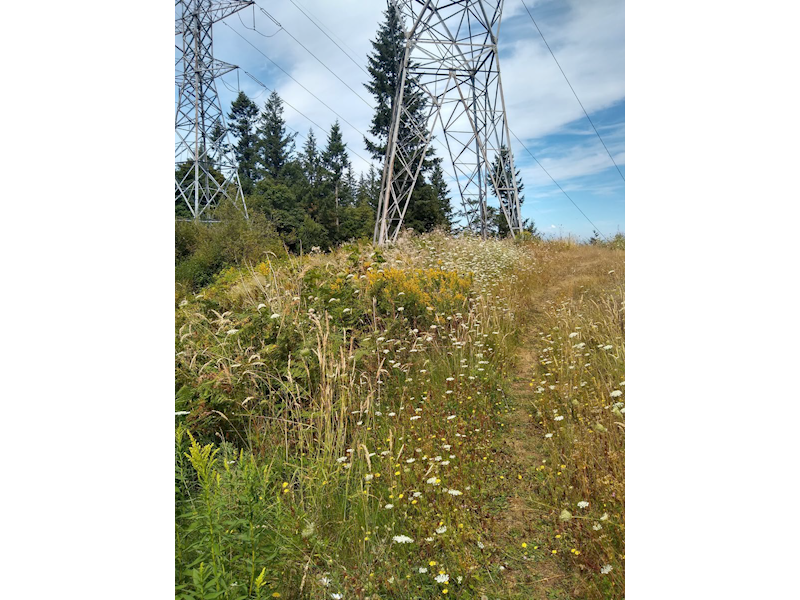
The North Forest Park Pollinator Powerline Project (P3 Project) came about in response to growing interest in ecological conservation and pollinator habitat restoration. The Bonneville Power Administration (BPA) saw opportunity in its rights-of-way to integrate pollinator-friendly practices into its vegetation management plans. Integrated vegetation management was used to promote low-growing native vegetation and to remove invasive species such as Scotch broom and Himalayan blackberry, thus reducing fire risk and improving ecological health. BPA collaborated with Portland Parks & Recreation (PP&R) and Metro to ensure compliance with permitting and vegetation clearance requirements while leveraging regional expertise in habitat restoration. The P3 Project shows that pollinator habitat can be established inside transmission corridors when sequencing, compliance, and communication are treated as integral parts of design. The project received national recognition in 2023 with the Pollinator Electric Power Award from the North American Pollinator Protection Campaign.
What are the Benefits of Integrated Vegetation Management?
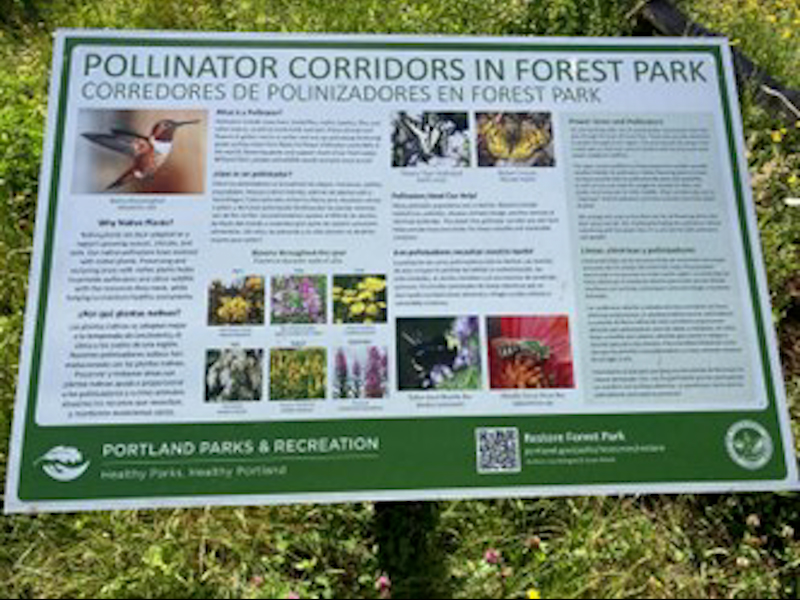
Bringing ecosystem services to the corridor reframes utility rights-of-way as “opportunity corridors” capable of supporting biodiversity while fulfilling their operational function and adhering to clearance standards. The project aimed to maximize ecological value by seeding 250 pounds of native wildflowers and grasses and planting 6,000 shrubs, creating a continuous low-profile mosaic that supports pollinators while keeping the corridor compatible with transmission operations.
Who Was Involved?
Bonneville Power Administration
BPA initiated and led the P3 Project to integrate pollinator-friendly practices into its transmission corridor while maintaining electrical safety and reliability. It managed site preparation, invasive species removal, and compliance with clearance and permitting requirements under federal standards. BPA also oversaw ongoing vegetation management cycles to ensure the corridor remained compatible with transmission operations.
Portland Parks & Recreation
As the land manager for Forest Park, PP&R coordinated restoration activities within the park’s boundaries. The agency contributed expertise in invasive species control and collaborated on planting native vegetation to enhance pollinator habitat. PP&R also supported public education efforts through signage and outreach to explain the ecological benefits of the project.
Metro
Metro, the regional government agency, financed and implemented much of the habitat restoration work using local tax funds. It brought specialized knowledge in pollinator habitat design and guided the selection of native species for seeding and planting. Metro’s involvement ensured that restoration efforts aligned with regional biodiversity goals and complemented Forest Park’s broader conservation objectives.
Key Project Takeaways
- Pollinator habitat can coexist with transmission corridors. Careful vegetation choices and sequencing allow biodiversity goals without compromising clearance and reliability standards.
- Habitat work should be integrated into routine operations. Aligning removal of invasive plants, restoration of native plants, and clearance rules within standard vegetation cycles makes restoration practical.
- Utility rights of way serve as “opportunity corridors." Transmission corridors can deliver ecological value when treated as multifunctional spaces rather than purely energy corridors.
- Success depends on alignment and communication. Collaboration among BPA, PP&R, and Metro, plus transparent public messaging, was critical for managing compliance and perception.
- Compliance is a design constraint, not a barrier. Regulatory requirements shaped schedules but did not prevent progress when incorporated into planning from the start.
- Public framing matters. Linking the project to national concerns over pollinator decline helped reduce pushback and build support.