
PNNL

  • About
  • News & Media
  • Careers
  • Events
  • Research
    • Scientific Discovery
      • Autonomous Science
      • Biology
        • Chemical Biology
        • Computational Biology
        • Ecosystem Science
        • Human Health
          • Cancer Biology
          • Exposure Science & Pathogen Biology
        • Integrative Omics
          • Advanced Metabolomics
          • Chemical Biology
          • Mass Spectrometry-Based Measurement Technologies
          • Spatial and Single-Cell Proteomics
          • Structural Biology
        • Microbiome Science
          • Biofuels & Bioproducts
          • Human Microbiome
          • Soil Microbiome
          • Synthetic Biology
        • Predictive Phenomics
      • Chemistry
        • Computational Chemistry
        • Chemical Separations
        • Chemical Physics
        • Catalysis
      • Earth & Coastal Sciences
        • Global Change
        • Atmospheric Science
          • Atmospheric Aerosols
          • Human-Earth System Interactions
          • Modeling Earth Systems
        • Coastal Science
        • Ecosystem Science
        • Subsurface Science
        • Terrestrial Aquatics
      • Materials Sciences
        • Materials in Extreme Environments
        • Nondestructive Examination
        • Precision Materials by Design
        • Science of Interfaces
        • Smart Advanced Manufacturing
          • Cold Spray
          • Friction Stir Welding & Processing
          • ShAPE
      • Nuclear & Particle Physics
        • Dark Matter
        • Fusion Energy Science
        • Neutrino Physics
      • Quantum Information Sciences
    • Energy Resiliency
      • Electric Grid Modernization
        • Emergency Response
        • Grid Analytics
          • AGM Program
          • Tools and Capabilities
        • Grid Architecture
        • Grid Cybersecurity
        • Grid Energy Storage
        • Transmission
        • Distribution
      • Energy Efficiency
        • Appliance and Equipment Standards
        • Building Energy Codes
        • Building Technologies
          • Advanced Building Controls
          • Advanced Lighting
          • Building-Grid Integration
        • Commercial Buildings
        • Federal Buildings
          • Federal Performance Optimization
          • Resilience and Security
        • Residential Buildings
          • Building America Solution Center
          • Energy Efficient Technology Integration
          • Home Energy Score
        • Energy Efficient Technology Integration
      • Energy Storage
        • Electrochemical Energy Storage
        • Flexible Loads and Generation
        • Grid Integration, Controls, and Architecture
        • Regulation, Policy, and Valuation
        • Science Supporting Energy Storage
        • Chemical Energy Storage
      • Environmental Management
        • Waste Processing
        • Radiation Measurement
        • Environmental Remediation
      • Fossil Energy
        • Subsurface Energy Systems
        • Advanced Hydrocarbon Conversion
      • Nuclear Energy
        • Fuel Cycle Research
        • Advanced Reactors
        • Reactor Operations
        • Reactor Licensing
        • Nondestructive Examination
      • Renewable Energy
        • Solar Energy
        • Wind Energy
          • Wind Resource Characterization
          • Wildlife and Wind
          • Wind Systems Integration
          • Wind Data Management
          • Distributed Wind
        • Marine Energy
          • Environmental Monitoring for Marine Energy
          • Marine Biofouling and Corrosion
          • Marine Energy Innovation
          • Marine Energy Resource Characterization
          • Testing for Marine Energy
        • Hydropower
          • Environmental Performance of Hydropower
          • Hydropower Cybersecurity and Digitalization
          • Hydropower and the Electric Grid
          • Materials Science for Hydropower
          • Pumped Storage Hydropower
          • Water + Hydropower Planning
        • Grid Integration of Renewable Energy
        • Geothermal Energy
      • Transportation
        • Bioenergy Technologies
          • Algal Biofuels
          • Aviation Biofuels
          • Waste-to-Energy and Products
        • Hydrogen & Fuel Cells
        • Vehicle Technologies
          • Emission Control
          • Energy-Efficient Mobility Systems
          • Lightweight Materials
          • Vehicle Electrification
          • Vehicle Grid Integration
    • National Security
      • Chemical & Biothreat Signatures
        • Contraband Detection
        • Pathogen Science & Detection
        • Explosives Detection
        • Threat-Agnostic Biodefense
      • Cybersecurity
        • Discovery and Insight
        • Proactive Defense
        • Trusted Systems
      • Nuclear Material Science
      • Nuclear Nonproliferation
        • Radiological & Nuclear Detection
        • Nuclear Forensics
        • Ultra-Sensitive Nuclear Measurements
        • Nuclear Explosion Monitoring
        • Global Nuclear & Radiological Security
      • Stakeholder Engagement
        • Disaster Recovery
        • Global Collaborations
        • Legislative and Regulatory Analysis
        • Technical Training
      • Systems Integration & Deployment
        • Additive Manufacturing
        • Deployed Technologies
        • Rapid Prototyping
        • Systems Engineering
      • Threat Analysis
        • Advanced Wireless Security
          • 5G Security
          • RF Signal Detection & Exploitation
        • Border Security
        • Internet of Things
        • Maritime Security
        • Millimeter Wave
        • Mission Risk and Resilience
    • Data Science & Computing
      • Artificial Intelligence
      • Graph and Data Analytics
      • Software Engineering
      • Computational Mathematics & Statistics
      • Future Computing Technologies
        • Adaptive Autonomous Systems
    • Lab Objectives
    • Publications & Reports
    • Featured Research
  • People
    • Inventors
    • Lab Leadership
    • Lab Fellows
    • Staff Accomplishments
  • Partner with PNNL
    • Education
      • Undergraduate Students
      • Graduate Students
      • Post-graduate Students
      • University Faculty
      • University Partnerships
      • K-12 Educators and Students
      • STEM Education
        • STEM Workforce Development
        • STEM Outreach
      • Internships
    • Community
      • Philanthropy
      • Volunteering
    • Industry
      • Why Partner with PNNL
      • Explore Types of Engagement
      • How to Partner with Us
      • Available Technologies
      • Procurement
      • Technology Ombuds
  • Facilities & Centers
    • All Facilities
      • Atmospheric Radiation Measurement User Facility
      • Electricity Infrastructure Operations Center
      • Energy Sciences Center
      • Environmental Molecular Sciences Laboratory
      • Grid Storage Launchpad
      • Institute for Integrated Catalysis
      • Interdiction Technology and Integration Laboratory
      • PNNL Portland Research Center
      • PNNL-Seattle
      • PNNL-Sequim (Marine and Coastal Research)
      • Radiochemical Processing Laboratory
      • Shallow Underground Laboratory

Connecting Transmission Corridors (ConCord) Initiative

  • Transmission Atlas
  • Events
  • Design Workshop
  • Resources
  • Case Studies
    • Albany-Hudson Electric Trail
    • American River Parkway Pollinator Partnership
    • North Forest Park Pollinator Powerline
    • Pine Hill Preserve
    • Route of the Badger

Breadcrumb

  1. Home
  2. Projects
  3. Connecting Transmission Corridors (ConCord) Initiative
  4. Case Studies

Albany-Hudson Electric Trail

Connecting a historic corridor with modern infrastructure, recreation, and transportation

Quick Facts

Albany Hudson Electric Trail Bike Path Photo
Bikers on the Kinderhook, NY section of the Albany-Hudson Electric Trail. (Image courtesy of Hudson River Valley Greenway).
  • Location: New York's Hudson Valley
  • Primary Function: Recreation
  • Key Outcome: When the AHET opened in 2020, it turned a corridor long closed to the public into a continuous 36-mile shared use path. The trail now links 14 municipalities, providing a safe, non-motorized route where none had existed before.

The Albany-Hudson Electric Trail (AHET) is a 36-mile shared-use path in New York’s Hudson Valley that transforms an active electric transmission corridor and former electric trolley line into a public recreation space. Built as part of the Empire State Trail initiative, the project cost about $46 million and includes six bridges, multiple road crossings, and a paved route through 14 municipalities. This innovative partnership between National Grid and the Hudson River Valley Greenway allows the corridor to maintain power infrastructure while providing a safe, continuous route for walkers, cyclists, and local travelers. Since opening in December 2020, the trail has become a popular link for communities, supported by interpretive panels and ecological features like pollinator gardens. 

What Are the Benefits of Recreation Services?

The Albany-Hudson Electric Trail saw immediate use, with walkers, runners, and cyclists enjoying it daily for recreation and local travel. Beyond recreation, the trail now hosts community programs and features about 15 interpretive panels highlighting its trolley history, local culture, and natural landmarks. Events and additions like a pollinator garden have strengthened its role as a cultural and ecological asset. The impacts of the project are visible on several levels: a corridor that now provides continuous access, communities adjusting to new patterns of daily use, interpretive features that situate the trail in its historical context, and a utility finding workable ground between infrastructure needs and public recreation.

Who Was Involved?
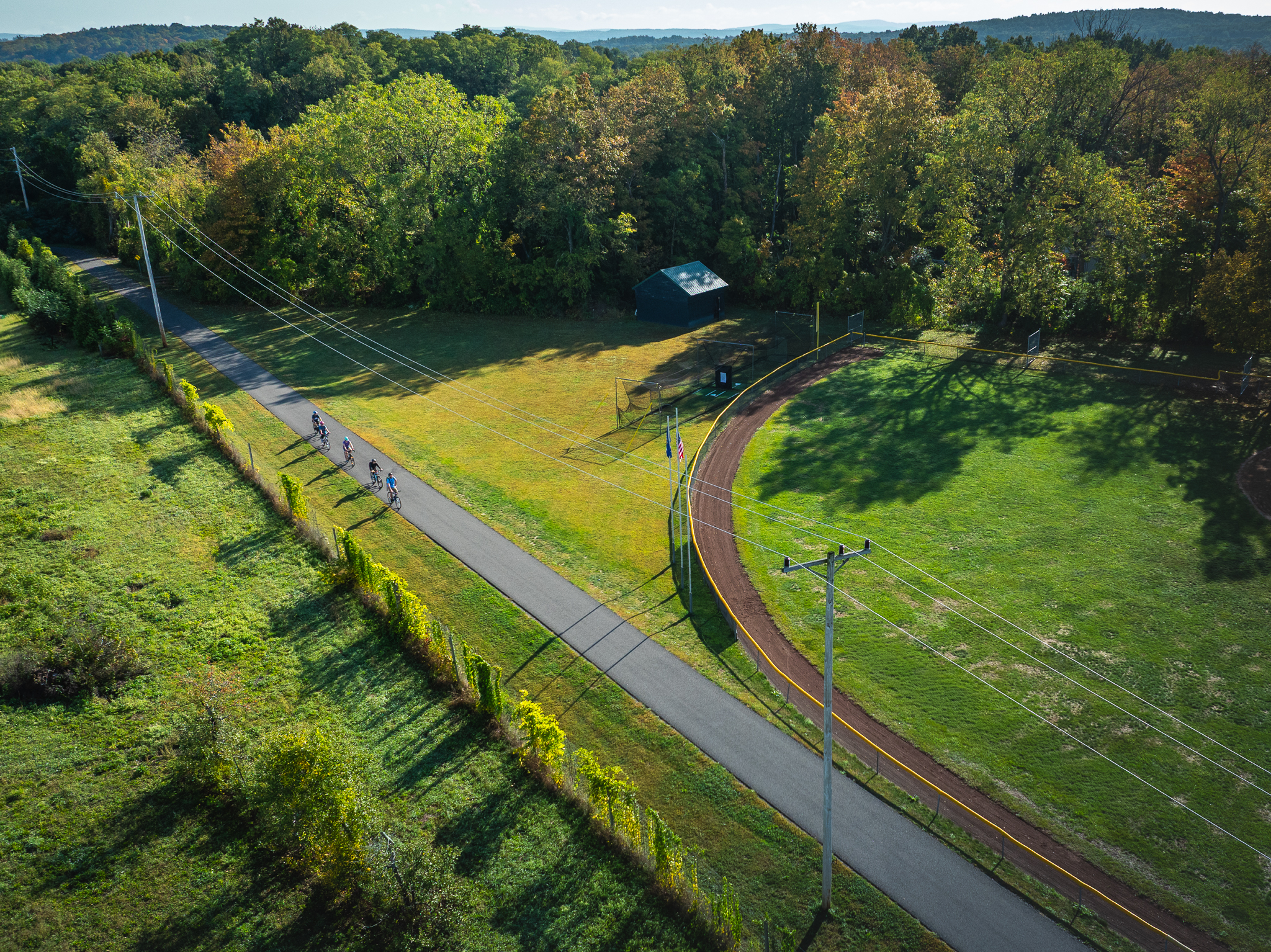
Albany Hudson Electric Trail Bike Path Photo 2
Biking through the Kinderhook area of the Albany-Hudson Electric Trail. (Image courtesy of Hudson River Valley Greenway).

Hudson River Valley Greenway

HRVG served as the coordinating body, securing funding, managing design and construction, and leading extensive community engagement across fourteen municipalities. Hudson River Valley Greenway also assumed responsibility for ongoing maintenance and safety closures under the license agreement.

National Grid

National Grid retained ownership of the transmission corridor and provided a no-cost license for trail development, while enforcing oversight to protect operational needs. The utility reviewed hundreds of pages of engineering plans, required independent electrical safety inspections, and relocated poles and wires as needed.

New York State (Empire State Trail Initiative)

New York State supplied critical political backing and approximately $200 million in statewide funding, reframing AHET as part of a 750-mile trail network. This support transformed the project from a local aspiration into a priority within the nation’s largest multi-use trail system.

Key Project Takeaways

  • Policy windows drive progress. Local feasibility studies kept the idea alive for years, but real momentum came when the Empire State Trail initiative provided state-level funding and political support, showing how higher-level policy can catalyze momentum.
  • Central coordination is essential. With fourteen municipalities along the 36-mile corridor, the Hudson River Valley Greenway’s role as a single coordinating entity prevented fragmented development and ensured a continuous, unified trail.
  • Utility oversight protects reliability. National Grid’s rigorous review of engineering plans and insistence on safety inspections added time but safeguarded the integrity of an active transmission corridor, illustrating the need for thorough risk management in shared-use projects.
  • Community concerns evolve. Early fears about privacy, liability, and safety were significant, but any skepticism largely subsided after the trail opened, demonstrating how real-world use can mitigate concerns when paired with responsive design measures and broad public engagement.
  • Shared spaces require patience and persistence. The AHET demonstrates that transforming infrastructure into public amenities is a gradual process involving years of studies, negotiations, and planning, but the payoff is a corridor that now serves both utility and community needs.
Download Case Study

PNNL

  • Get in Touch
    • Contact
    • Careers
    • Doing Business
    • Environmental Reports
    • Security & Privacy
    • Vulnerability Disclosure Policy
    • Notice to Applicants
  • Research
    • Scientific Discovery
    • Energy Resiliency
    • National Security
Subscribe to PNNL News
Department of Energy Logo Battelle Logo
Pacific Northwest National Laboratory (PNNL) is managed and operated by Battelle for the Department of Energy
  • YouTube
  • Facebook
  • X (formerly Twitter)
  • Instagram
  • LinkedIn