As COVID-19 was limiting in-person contact, halting travel, and creating additional barriers, researchers at PNNL were working to find solutions on how they could still get work done while establishing new safety protocols.
PNNL’s Fred Morris was awarded the National Nuclear Security Administration Administrator Lifetime Achievement and Distinguished Service Silver awards.
Rey Suarez was the keynote speaker at the Preparatory Commission of the Comprehensive Nuclear-Test-Ban Treaty Organization’s Specialized Technical Meeting on Preventive and Predicative Maintenance of the International Monitoring System.
PNNL researchers have shown an improved binarized neural network can deliver a low-cost and low-energy computation to help the performance of smart devices and the power grid.
The project received an Innovative and Novel Computational Impact on Theory and Experiment (INCITE) award, a highly competitive U.S. Department of Energy Office of Science program.
Pacific Northwest National Laboratory Global Security Technology and Policy group manager, Sarah Frazar, was named to the Board of Trustees for the World Affairs Council of Seattle.
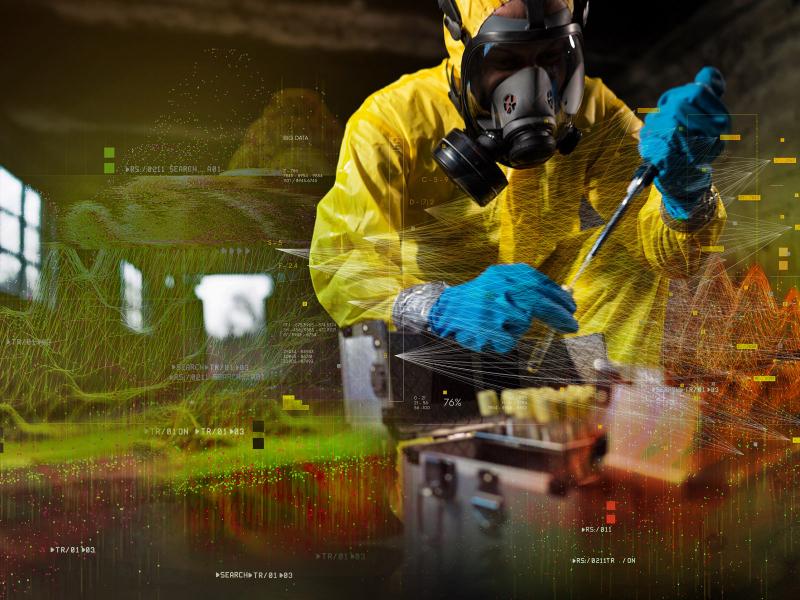
Researchers at PNNL have developed a bacteria testing system called OmniScreen that combines biological and synthetic chemistry with machine learning to hunt down pathogens before they strike.
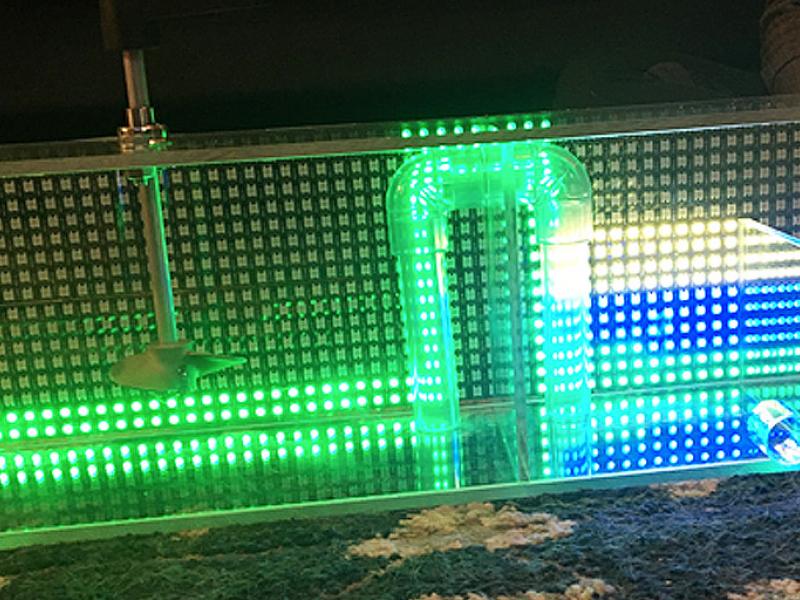
PNNL’s new Smart Power Grid Simulator, or Smart-PGSim, combines high-performance computing and artificial intelligence to optimize power grid simulations without sacrificing accuracy.
The MIT-sponsored competition encourages community approaches to developing new solutions for analyzing graphs and sparse data; PNNL has placed a winner in each year.
In a new video series, PNNL is highlighting six scientific and technical experts in the national security domain throughout the fall. Each was promoted to scientist and engineer level 5 earlier this year.
Brian Milbrath, a physicist in PNNL’s National Security Directorate, was named a senior member of the Institute of Electrical and Electronics Engineers (IEEE).
In a new video series this fall, PNNL is highlighting six scientific and technical experts in the national security domain. Each was promoted to Scientist and Engineer Level 5, one of PNNL’s most senior research roles.
James A. Ang, a PNNL computing expert, was recently invited to moderate a panel in a virtual workshop focused on federally funded research and development on software for heterogeneous computing.