September 9, 2026
News Release

New Interactive Map Helps States Navigate Wildfire-Energy Policy Activity

State policy makers can learn what worked—or didn’t work—from other states managing wildfire risk

Photograph shows two transmission towers against a sunset

State policymakers managing wildfire risk can now see a birds-eye view of proposed or enacted wildfire legislation around the United States. 

(Photograph by Haltham Moussa | Pexels)

RICHLAND, Wash. — Wildfires are rewriting the rules of America’s electric utilities. Grids now have to survive—and avoid igniting—wildfires, forcing states into high-stakes conversations about liability, planning, cost and how utilities should manage this risk.

Yet lawmakers don’t have an easy way to see how other states are tackling the problem. To make that information more accessible, the Department of Energy’s Pacific Northwest National Laboratory has teamed up with the Smart Electric Power Alliance on a new interactive map that provides a nationwide view of state-by-state wildfire legislation. 

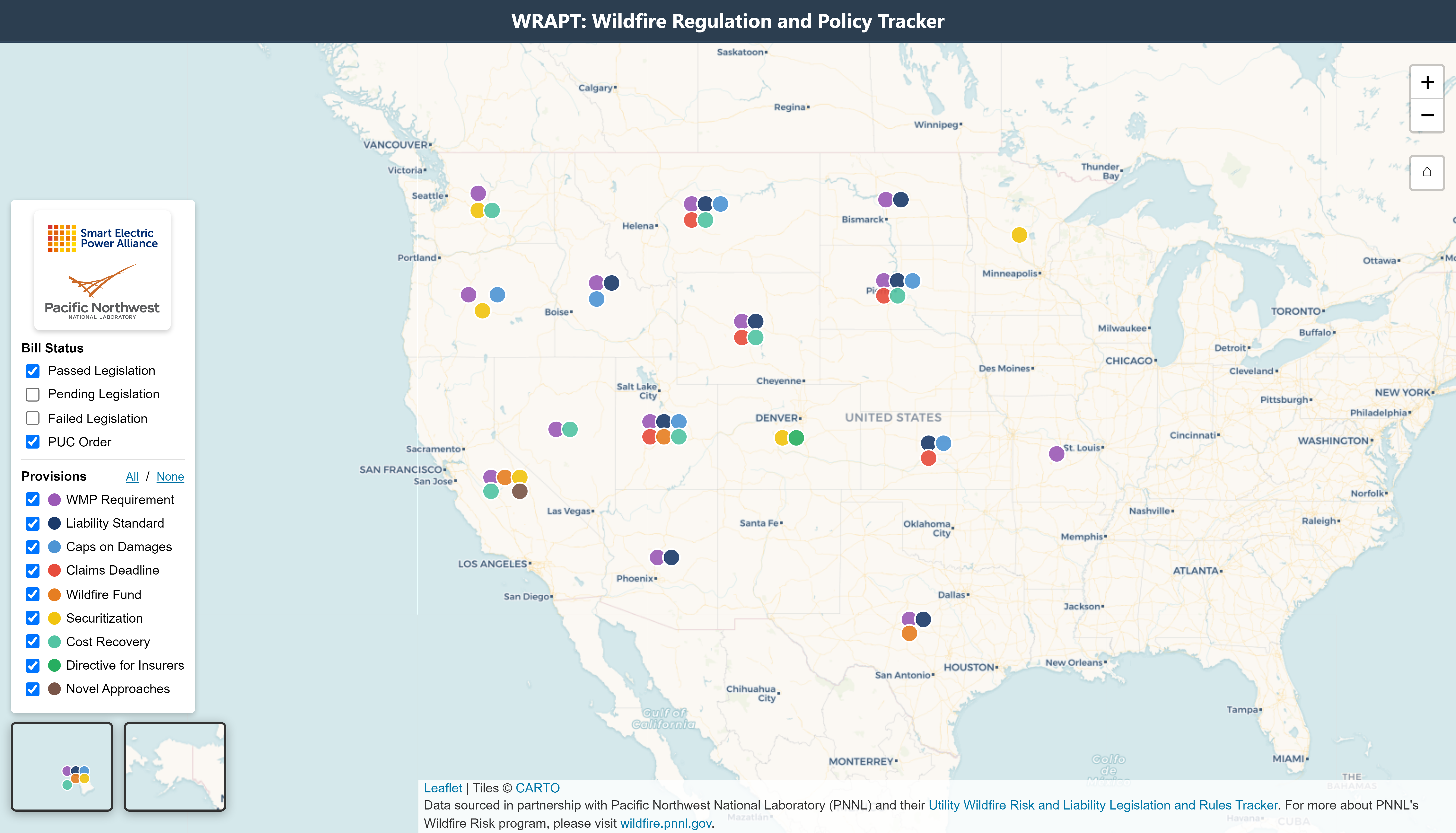
The Wildfire Regulation and Policy Tracker shows what topics are prioritized over time, which states are pursuing which wildfire mitigation strategies, which measures passed or failed and where an agency has stepped in to create a comparable statewide requirement.

“Wildfire risks for utilities were once a Western issue but are now a national issue and moving fast,” said Rebecca O’Neil, advisor for electricity infrastructure at PNNL. “States across the country can benefit from an interactive tool like WRAPT—from states in the West as they consider policy options and interactions, states in the Midwest as they consider best practices and get in front of this issue as it arrives and states in the East adapting this playbook as they balance utility investment against the threat of wildfire.”

Research shows that states considered more wildfire-related legislation in 2025 than they had during the previous 10 years combined. PNNL had already been tracking legislation data in a much simpler dataset over the last year. Many utility, state and industry stakeholders have used the tracker, O’Neil said.  

Last spring, SEPA launched its own review of state legislation for its Wildfire Technology Roadmap. After a chance encounter with the PNNL team at a conference and comparing notes, SEPA saw an opportunity to transform PNNL’s dataset into an interactive map.

WRAPT shows users a broader, more accessible view of state-by-state wildfire legislation. Currently, the map shows 44 legislative and regulatory actions across 18 states. PNNL and SEPA plan to update the map as new actions are introduced.

Image is a screen of the WRAPT tool, showing a map of the United States with certain kinds of legislation highlighted by circles in various states.
SEPA's new interactive map, which incorporates data from PNNL, shows what kinds of legislation has been proposed, enacted or failed in different states.

"SEPA has spent years helping the industry make sense of the policy shifts reshaping the grid, and wildfire governance is now one of the fastest-moving fronts," said Jared Leader, SEPA's Senior Director of Resilience and Global Initiatives. "WRAPT reflects the kind of work SEPA is built for: pairing PNNL's research with our sector perspective to translate policy developments across states into something decision-makers can act on.”

WRAPT also offers an alternative for those involved in wildfire mitigation planning who would otherwise have to search through hundreds of documents cast in state-specific contexts buried within bill management systems in state legislative sessions, O’Neil said. With WRAPT, users can select a state and quickly see what approaches it has considered.

The new map also helps states tackle practical questions: What have other states tried? Which bills became law? Which proposals failed? What issues are regulators addressing? What lessons can be applied directly state-to-state and what would need to be adapted?

“The partnership with SEPA is helping move wildfire risk research beyond the laboratory and into the hands of people making decisions,” O’Neil said. “The more that state officials and regulators can understand why different states are making different choices, the easier it is for them to interpret and make the right choice for themselves.”

The wildfire legislation tracker is part of PNNL’s broader effort to help state energy security officials improve wildfire planning, reduce risks and costs and coordinate more effectively with land management partners. Just last month, PNNL hosted a workshop on addressing wildfire risks across Virginia, the Carolinas and nearby Appalachian and Mid‑Atlantic states.

###

About PNNL

Pacific Northwest National Laboratory draws on its distinguishing strengths in chemistry, Earth sciences, biology and data science to advance scientific knowledge and address challenges in energy resiliency and national security. Founded in 1965, PNNL is operated by Battelle and supported by the Office of Science of the U.S. Department of Energy. The Office of Science is the single largest supporter of basic research in the physical sciences in the United States and is working to address some of the most pressing challenges of our time. For more information, visit the DOE Office of Science website. For more information on PNNL, visit PNNL's News Center. Follow us on Twitter, Facebook, LinkedIn and Instagram.

Published: September 9, 2026

Research topics