PNNL

  • About
  • News & Media
  • Careers
  • Events
  • Research
    • Scientific Discovery
      • Chemistry
        • Catalysis
        • Chemical Physics
      • Biology
        • Ecosystem Science
        • Human Health
          • Cancer Biology
        • Integrative Omics
          • Advanced Metabolomics
          • Instrument Development & Deployment
          • Nanoscale Proteomics
        • Microbiome Science
          • Human Microbiome
          • Soil Microbiome
      • Computational Research
        • Artificial Intelligence
        • Computational Mathematics & Statistics
        • Graph and Data Analytics
        • High-Performance Computing
        • Software Engineering
        • Visual Analytics
      • Earth & Coastal Sciences
        • Atmospheric Science
        • Coastal Science
        • Ecosystem Science
        • Plant Science
        • Subsurface Science
        • Terrestrial Aquatics
      • Materials Science
        • Solid Phase Processing
        • Science of Interfaces
        • Precision Materials by Design
        • Materials in Extreme Environments
      • Nuclear & Particle Physics
        • Dark Matter
        • Neutrino Physics
        • Flavor Physics
        • Fusion Energy Science
      • Quantum Information Science
    • Energy Resiliency
      • Electric Grid Modernization
        • Distribution
        • Transmission
        • Grid Architecture
        • Grid Analytics
          • AGM Program
        • Grid Cybersecurity
        • Emergency Response
      • Energy Efficiency
        • Building Technologies
          • Advanced Building Controls
          • Building-Grid Integration
          • Advanced Lighting
        • Residential Buildings
          • Energy Efficient Technology Integration
          • Home Energy Score
          • Building America Solution Center
        • Commercial Buildings
        • Federal Buildings
          • Federal Performance Optimization
          • Resilience and Security
        • Building Energy Codes
        • Appliance and Equipment Standards
      • Energy Storage
        • Grid Energy Storage
        • Vehicle Energy Storage
      • Environmental Management
        • Environmental Remediation
        • Waste Processing
        • Radiation Measurement
      • Fossil Energy
        • Carbon Management
          • Carbon Capture
          • Carbon Storage
          • Carbon Utilization
        • Subsurface Energy Systems
        • Advanced Hydrocarbon Conversion
      • Nuclear Energy
        • Reactor Licensing
        • Reactor Operations
        • Fuel Cycle Research
        • Advanced Reactors
      • Renewable Energy
        • Hydropower
          • Environmental Performance of Hydropower
          • Hydropower and the Electric Grid
          • Hydropower Cybersecurity and Digitalization
          • Materials Science for Hydropower
          • Water + Hydropower Planning
        • Marine Energy
          • Environmental Monitoring for Marine Energy
          • Marine Biofouling and Corrosion
          • Marine Energy Resource Characterization
          • Testing for Marine Energy
          • The Blue Economy
        • Wind Energy
          • Distributed Wind
          • Offshore Wind
          • Uncertainty Quantification
          • Wildlife and Wind
          • Wind Data Archive and Portal
          • Wind Resource Characterization
        • Geothermal Energy
        • Solar Energy
      • Transportation
        • Vehicle Technologies
          • Emission Control
          • Energy-Efficient Mobility Systems
          • Lightweight Materials
          • Vehicle Electrification
        • Bioenergy Technologies
          • Algal Biofuels
          • Aviation Biofuels
          • Waste-to-Energy and Products
        • Hydrogen & Fuel Cells
    • National Security
      • Computing & Analytics
        • Artificial Intelligence
        • Computational Mathematics & Statistics
        • Graph and Data Analytics
        • High-Performance Computing
        • Software Engineering
        • Visual Analytics
      • Cybersecurity
        • Discovery and Insight
        • Proactive Defense
        • Trusted Systems
      • Nuclear Nonproliferation
        • Stakeholder Engagement
        • Technical Training
      • Weapons of Mass Effect
        • Explosives Detection
        • Chemical & Biological Signatures Science
        • Radiological & Nuclear Detection
    • Publications & Reports
    • S&T Capabilities
  • People
    • Inventors
    • Diversity
    • Lab Leadership
    • Lab Fellows
    • Staff Accomplishments
  • Partner with PNNL
    • Academia
      • Distinguished Graduate Research Programs
      • Internships
      • Visiting Faculty Program
      • Joint Appointments
      • Joint Institutes
      • Linus Pauling Distinguished Postdoctoral Fellowship
    • Community
      • STEM Education
        • Resources
        • STEM Ambassadors in the Classroom
      • Philanthropy
      • Volunteering
      • Economic Impact
    • Industry
      • Available Technologies
      • Industry
      • Industry Partnerships
      • Licensing & Technology Transfer
      • Entrepreneurial Leave
  • Facilities & Centers
    • All Facilities
      • Atmospheric Radiation Measurement User Facility
      • Bioproducts, Sciences, and Engineering Lab
      • Environmental Molecular Sciences Laboratory
      • Institute for Integrated Catalysis
      • Marine and Coastal Research Laboratory
      • Radiochemical Processing Laboratory
      • Shallow Underground Laboratory
      • Systems Engineering Building
      • Wasteform Development Laboratory
      • PNNL Seattle Research Center
      • PNNL 5G Innovation Studio

Breadcrumb

  1. Research
  2. Scientific Discovery
  3. Biology
  4. Integrative Omics
  5. Nanoscale Proteomics

Nanoscale
Proteomics

Analyzing protein
patterns in single cells

  • Ecosystem Science
  • Human Health
  • Integrative Omics
    • Advanced Metabolomics
    • Instrument Development & Deployment
    • Nanoscale Proteomics
  • Microbiome Science

Organs and tissues contain many different cell types and subtypes—each with a unique function mediated mainly by proteins and their post translational modifications. Researchers use proteomic measurements to analyze an entire set of cellular proteins expressed at a given time. Most methods for these measurements require samples containing millions of cells, which means that information about localized function is lost.

To enable proteomic studies on single cells, PNNL researchers developed the Nanodroplet Processing in One Pot for Trace Samples, or nanoPOTS, platform. NanoPOTS enhances the efficiency and recovery of sample processing and minimizes surface losses by downscaling processing volumes to less than 200 nL. 

When combined with ultrasensitive liquid chromatography-mass spectrometry analysis, the nanoPOTS platform provides in-depth proteomics analyses of biological samples as small as single cells.

We are making many of these first-of-their kind measurements to study unique features of cell populations, including functions, differentiation, and rare subpopulations of cells. Our researchers have tracked the development of sensory hair cells from the inner ear at single cell resolution, identified protein markers of different cell populations from individual human lung cells, profiled proteins in single circulating tumor cells pulled from blood samples, and looked at proteins from pancreatic cells involved in the development of type I diabetes. We can identify protein post-translational modifications in samples with less than 800 cells.

Imaging the proteome

The location of different cell types in a biological tissue varies in complex ways that direct tissue function. However, the current extraction processes needed to capture thousands of cells for proteomic analysis blur the crucial spatial information that helps scientists understand how tissues work together for body functions.

We are combining the sensitivity of the nanoPOTS platform with laser capture microdissection to create an automated method for imaging tissue proteomes. This approach allows us to study tissue substructures and cellular microenvironments at a nanoscale resolution not possible before.

Precise and localized analysis of proteins in tissue revealed interconnected molecular networks involved in lung development. We identified protein signatures of a heart attack in fluid pulled from tiny tissues in the kidneys.

Click to view our team of experts who focus on proteomics research in the Biology Division and the Environmental Molecular Sciences Division.

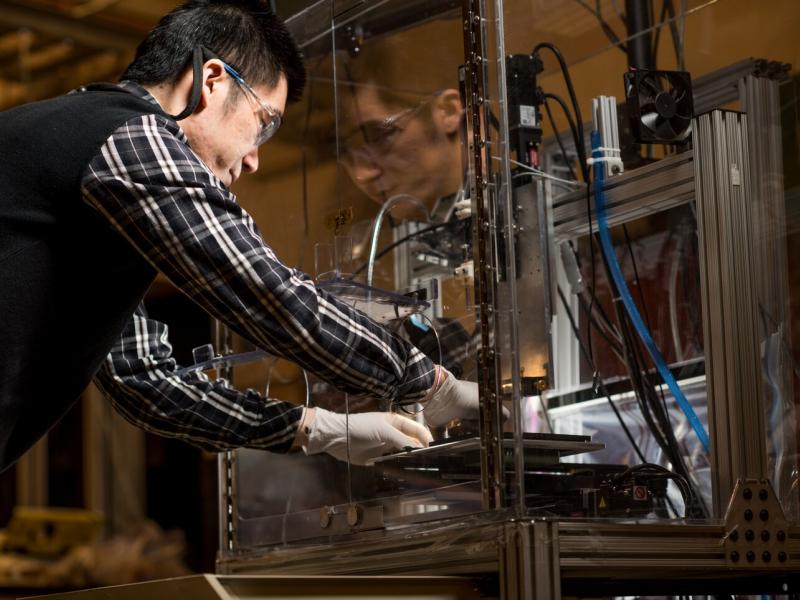
Ying Zhu using NanoPOTS
(Photo by Andrea Starr | Pacific Northwest National Laboratory)

Contacts

Paul Piehowski
Chemist
paul.piehowski@pnnl.gov
(509) 371-6569
Ying Zhu
Chemist
ying.zhu@pnnl.gov
(509) 375-4523

Related Links

Cancer BiologyEnvironmental Molecular Sciences Laboratory

PNNL

  • Get in Touch
    • Contact
    • Careers
    • Doing Business
    • Environmental Reports
    • Security & Privacy
  • Research
    • Scientific Discovery
    • Energy Resiliency
    • National Security
Subscribe to PNNL News
Department of Energy Logo Battelle Logo
Pacific Northwest National Laboratory (PNNL) is managed and operated by Battelle for the Department of Energy
  • YouTube
  • Facebook
  • Twitter
  • Instagram
  • LinkedIn