Kate Doty was invited to lend her expertise as guest editor for the International Journal of Nuclear Security on a special issue on women in nuclear security.
Nonproliferation Policy and Law Analyst, Chanel Chauvet, served as the legal expert in the International Atomic Energy Agency's effort to update Uzbekistan's Integrated Nuclear Security Support Plan.
John VerWey, East Asia national security advisor, delivered remarks on competition in global supply chains at a U.S.-China Economic Security Review Commission hearing in June 2022.
PNNL's Tegan Emerson was invited to be one of two plenary speakers at the inaugural AIM 2022 congress. The Minerals, Metals & Materials Society organized AIM 2022 to connect materials and manufacturing researchers from around the world.
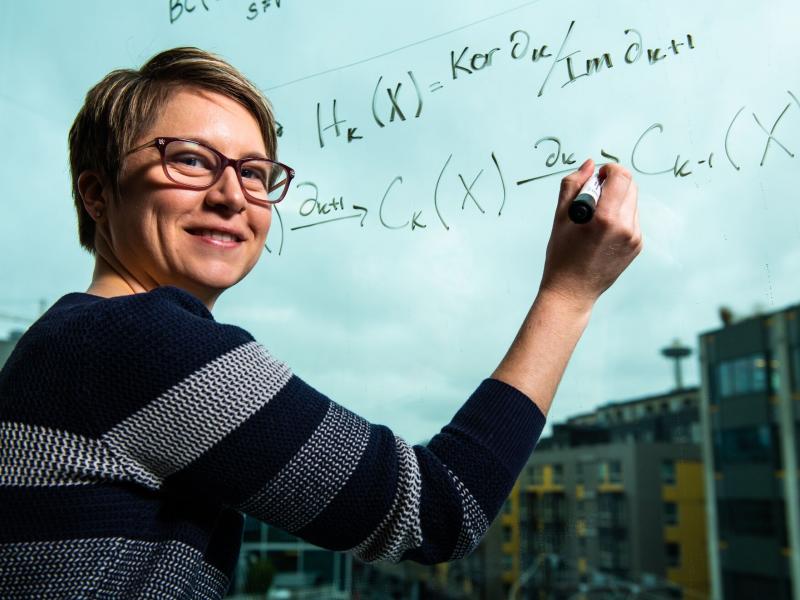
Working on puzzles with her grandpa helped instill Emilie Purvine’s interest in math from an early age. That interest later turned to being co-captain for her high school math team, a degree in mathematics, and eventually a career at PNNL.
Four research staff from PNNL are part of an international team that earned top honors for a journal paper focused on a new algorithm-evaluation approach for buildings.
Anika Halappanavar’s research into COVID-19 misinformation earned her recognition by the Washington State Academy of Sciences as one of the state’s top high school researchers.
PNNL engages in expert panels to address emerging policy issues surrounding deep space exploration; forms new partnership with University of Washington Space Policy and Research Center.
PNNL data scientist was invited to give the first big-picture talk about autonomous control systems at the Autonomous Discovery in Science and Engineering Workshop.
As a member of the NAM board of directors, Brett Jefferson, PNNL data scientist, will help lead the professional association’s mission to advance mathematical excellence of underrepresented minorities.
The partnership to apply artificial intelligence to improve complex systems is part of a U.S. Department of Energy Office of Science $4.2 million, three-year grant.
Red teaming for CPS, the process of challenging systems, involves a group of cybersecurity experts to emulate end-to-end cyberattacks following a set of realistic tactics, techniques, and procedures.