Powerline Pass Trail
Supporting recreational and economic opportunities by connecting trails and communities.
Quick Facts
- Location: Anchorage, Alaska
- Primary Function: Recreation
- Key Outcome: Expanding recreation infrastructure to generate economic activity, support public health, and improve quality of life for Alaskans
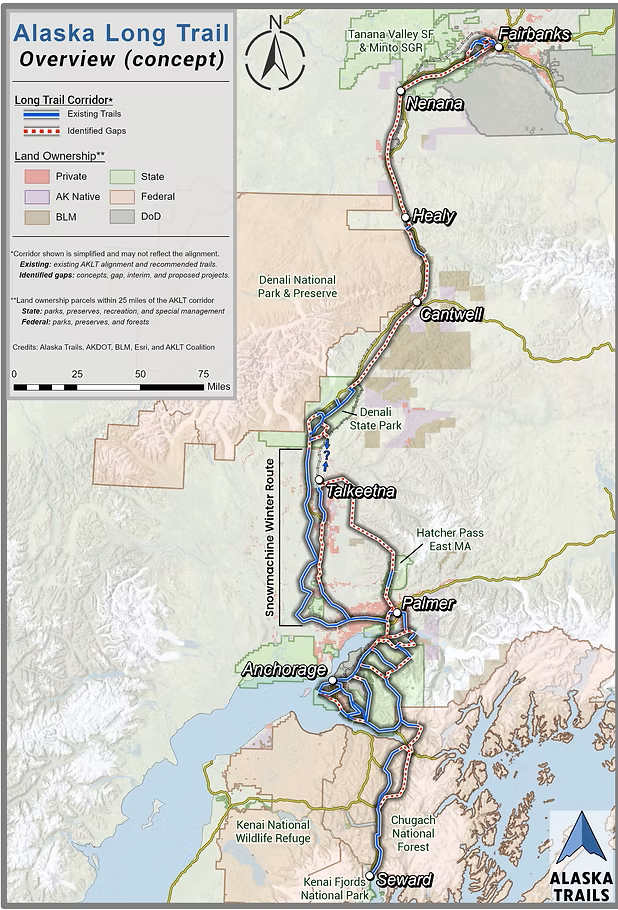
The Powerline Pass Trail, managed by Chugach Electric Association, is one of many trails stewarded by Alaska Trails, a nonprofit founded in 2003 by trail users, government agencies, and local communities to support outdoor recreation in Alaska. The organization’s goal is to centralize the planning and coordination of Alaskan trail projects toward a unified Alaskan Long Trail.
What Are the Benefits of Outdoor Recreation?
Outdoor recreation accounts for 3.6 percent of Alaska’s gross domestic product, and jobs in this sector have the third highest growth rate in the United States. Alaskans and tourists alike greatly value outdoor recreation opportunities; every dollar spent on outdoor public spaces provides a $5.31 return in value. Alaska Trails is working to expand and enhance Alaska’s trail network through the Alaska Long Trail, expected to connect over 500 miles of trail systems across the state. The Powerline Pass Trail in Chugach State Park is one of the most visited trails along the Alaskan Long Trail, rich in wildlife, mountain views, and trail connections and offering hiking, biking, snowshoeing, backpacking, and wildlife viewing opportunities. The Powerline Pass Trail is maintained by the largest utility in the state, Chugach Electric Association.
In 2015, Chugach Electric Association began transmission upgrades to a six-mile stretch along the Powerline Pass Trail. Closing the trail in sections to avoid disruptions, and then briefly fully closing the trail to bring in the new power poles, the cooperative worked hard to avoid disruptions to the park’s many trail goers. This work was part of a larger upgrade effort to replace 75 and 115 kV transmission lines built in the 1960s with modern 230 kV lines to increase capacity and improve reliability.
![]() | ![]() |
Who Was Involved?
Alaska Trails, 501(c)(3)
Alaska Trails provides funding ideas and sources as well as technical assistance for on-the-ground trail-related projects and programs such as those focused on development, maintenance, easement acquisition, safety, and education.
Chugach Electric Association
The cooperative maintains the powerline, easement, access roads, and trail of the 11-mile Powerline Pass Trail in Chugach State Park, near Anchorage.
Supporting Organizations
The Alaska Long Trail effort is supported by a broad group of trail, recreation, park, and public-land partners, including the following:
- Alaska Outdoor Alliance
- Alaska State Parks
- Anchorage Park Foundation
- Mat-Su Trails and Parks Foundation
- National Park Service Rivers, Trails, and Conservation Assistance
- Kenai Mountains-Turnagain Arm National Heritage Area
- U.S. Forest Service
- Denali Borough
These organizations help identify and advocate for shovel-ready or planning-ready projects along the Alaska Long Trail network of trails.
Key Project Takeaways
- Utility maintenance and improvement efforts are still possible in multiuse corridors. Chugach Electric Association worked alongside Alaska State Parks to minimize public disruptions while still completing the necessary transmission upgrades in a safe and timely manner.
- A National Scenic Trail feasibility study is being conducted by the Bureau of Land Management. A National Scenic Trail designation would allow the Alaska Long Trail to join 11 other trails across the country for increased visibility, visitation, and federal funding opportunities.
- Funding is being secured through a combination of federal programs and local opportunities. Alaska’s trails are supported by the Federal Highway Administration, the U.S. Fish and Wildlife Service, the Land and Water Conservation Fund, the National Park Service, the U.S. Forest Service, U.S. Environmental Protection Agency Brownfields Cleanup Grants, Alaska State funding opportunities like the Snowmachine Trails Program and State General Obligation Bonds, technical assistance programs, local governments, and foundations.

