Autonomous Control for Cyber Enabled Infrastructure
Pacific Northwest National Laboratory (PNNL) is advancing autonomous learning technologies to bolster U.S. critical infrastructure resilience.

Timothy Holland | Pacific Northwest National Laboratory
PNNL’s vision for autonomous control
PNNL leads the nation in autonomous research to reimagine U.S. critical infrastructure for better resilience against the realities of software-speed attacks and hazards.
With increased software-speed attacks and hazards, autonomous learning technologies are vital for the security of the nation and the safety of its citizens.
Our vision is to achieve resilience through revolutionary technologies based on autonomous learning and control—similar to how the human body coordinates its complex semi-autonomous subsystems.
PNNL’s objectives for autonomous control
- Develop a technology capability road map for PNNL, its partner institutions, and key decision-makers.
- Motivate a multidisciplinary call to arms for innovative, impactful research programs.
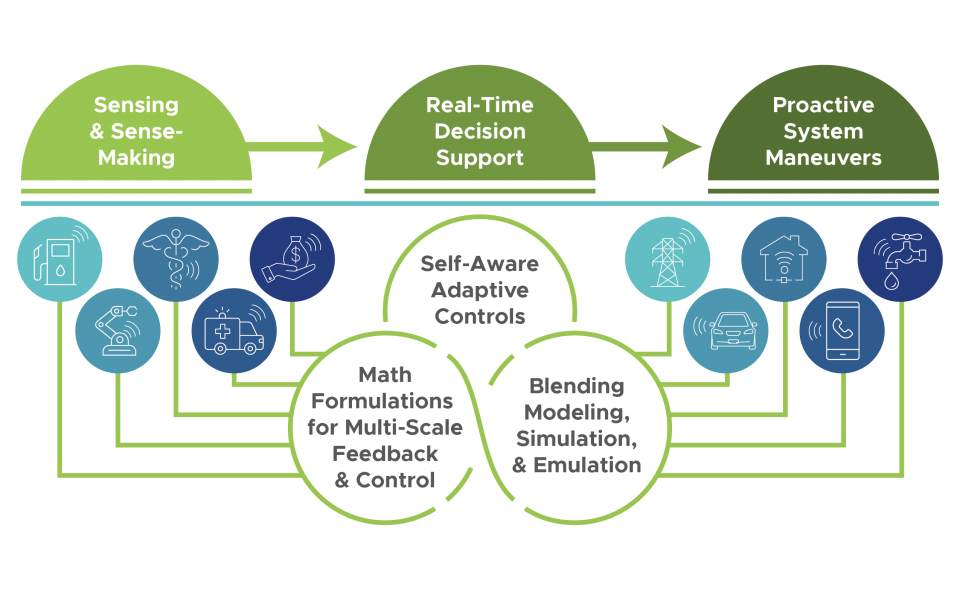
How PNNL will achieve resilience with autonomous control
To achieve resilience, PNNL will drive novel research and development (R&D) programs toward building innovative technologies that detect issues in infrastructure systems, support real-time decision-making, and allow the systems to respond independently.
This will include R&D investments to develop mathematical approaches for multiscale response by combining modeling, simulation, emulation, and self-aware controls. Together, these capabilities will pave the way for resilience in interdependent U.S. critical infrastructure systems, enabling them to detect, respond to, and adapt to threats in real time.