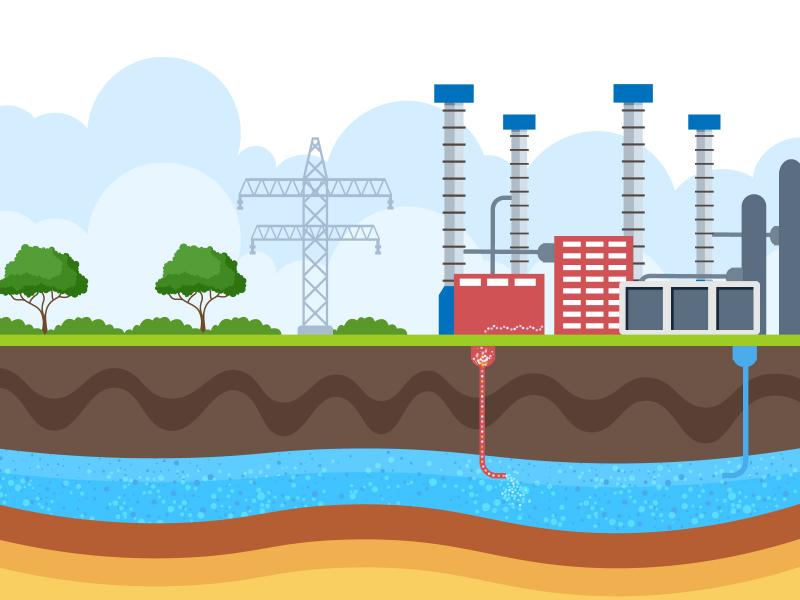
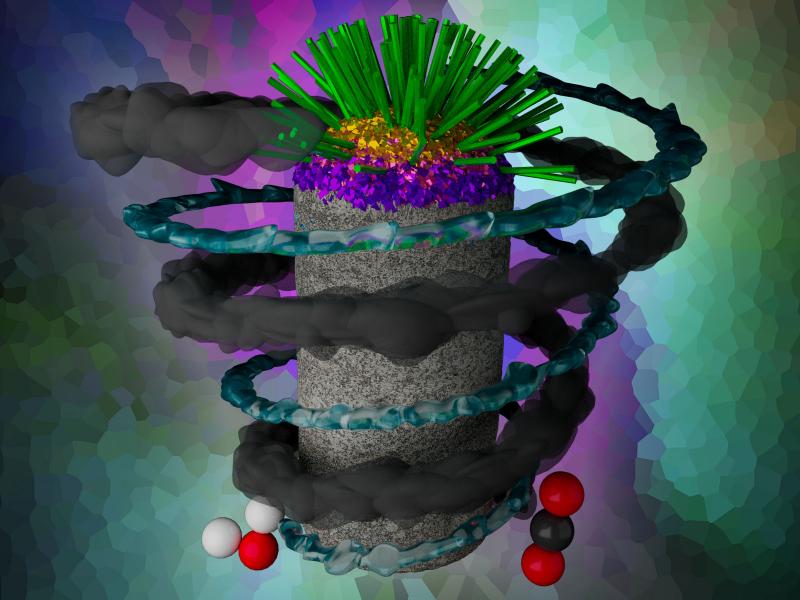
Some rocks can potentially convert injected carbon dioxide into more stable solid minerals. A new review article explores what scientists know about the atom-by-atom process.
Scientists are pioneering approaches in the branch of artificial intelligence known as machine learning to design and train computer software programs that guide the development of new manufacturing processes.
A new testbed facility capable of testing superconducting qubit fidelity in a controlled environment free of stray background radiation will benefit quantum information sciences and the development of quantum computing.
A new, simple, and efficient flow-based method allows researchers to pull a useful magnesium salt from natural seawater using easily available chemicals.
Tiffany Kaspar’s work has advanced the discovery and understanding of oxide materials, helping develop electronics, quantum computing, and energy production. She strives to communicate her science to the public.
PNNL researchers developed a new model to help power system operators and planners better evaluate how grid-forming, inverter-based resources could affect the system stability.
Top scientists and officials from government, academia, Alaskan Native communities, and industry are heading to Alaska to focus on driving energy technologies for a more sustainable Arctic region.