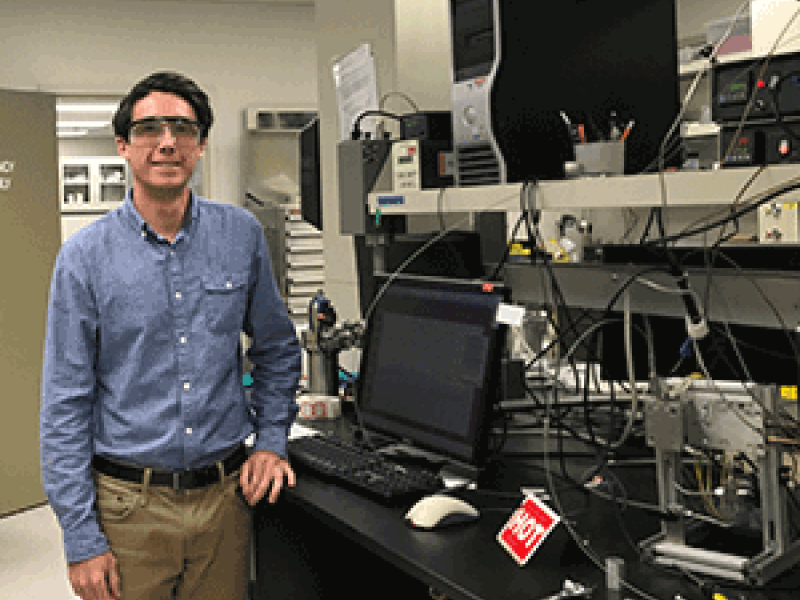
In 2020, virtual Washington State University teams successfully worked together in a program sponsored by the National Nuclear Security Administration’s (NNSA) Office of International Nuclear Safeguards.
A recent edition of the Infrastructure Resilience Research Group Journal featured an article written by PNNL researchers Rob Siefken and Jake Burns about “Design Basis Threat and the Low Threat Environment.”
As a physicist at PNNL, Jon Burnett’s work is about developing instruments to detect ultra-trace radionuclide signatures, analyze samples from around the world to look for evidence of nuclear explosions, and then interpret that information.
A new review paper led by senior research scientist Chun-Long Chen and featured on the cover of Accounts of Chemical Research summarizes advances by PNNL scientists in developing sequence-defined peptoids.
A research team from Pacific Northwest National Laboratory developed an apparatus that evaluates the performance of high-temperature fluids in hydraulic fracturing for enhanced geothermal systems.
In a new video series, PNNL is highlighting six scientific and technical experts in the national security domain throughout the fall. Each was promoted to scientist and engineer Level 5, one of PNNL’s most senior research roles.
In a new video series this fall, PNNL is highlighting six scientific and technical experts in the national security domain. Each was promoted to Scientist and Engineer Level 5, one of PNNL’s most senior research roles.
In a new review, PNNL researchers outline how to convert stranded biomass to sustainable fuel using electrochemical reduction reactions in mini-refineries powered by renewable energy.
Deepika Malhotra, an organic chemist at PNNL, will lend her expertise to help shape the content and quality of Pollutants a new, interdisciplinary, open access, journal focusing on a range of environmental science research.