September 8, 2026
Feature

25 Years after 9/11, PNNL Continues to Protect Against Threats in Ever-Changing Landscape

This is a composite image illustrating many components of PNNL's research. A scientist holds a test tube to a mass spectrometer; a person is walking through a body scanner; there are transmission lines, a satellite, and imagery of electronics that illustrate security technology.

The illustration depicts some of the technologies developed by scientists at Pacific Northwest National Laboratory since 9/11: detection of illicit substances, scanners to protect airline passengers, technology to fight wildfires, and new methods to keep the electric grid secure.

(Illustration by Melanie Hess-Robinson | Pacific Northwest National Laboratory)

The 25th remembrance of 9/11 brings a range of emotions: sorrow at what occurred, pride at how our nation and its citizens responded, and determination to never let such an attack happen again.

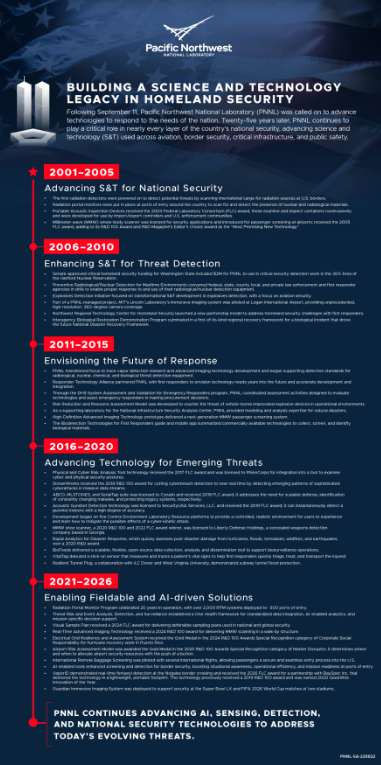
Homeland Security Timeline
Click the image above to view full-size of a timeline of Pacific Northwest National Laboratory contributions to homeland security since 2001. (Illustration by Donald Jorgensen | Pacific Northwest National Laboratory)

At Pacific Northwest National Laboratory (PNNL), the events of that day expanded PNNL’s focus on national security and safety, which has continued for the 25 years since. With the leadership of Mike Kluse, then associate laboratory director for national security, PNNL responded to the disaster immediately, mapping out ways to draw upon strengths in areas like imaging and radiation detection to stem a variety of threats.

Since then, the Laboratory has pivoted repeatedly to meet ever-evolving challenges around safety and security. Dozens of projects developed by PNNL researchers in the post-9/11 world keep citizens safe—in the air, on the road, on the rails, in their workplaces, and at their computers, with more ideas unfolding every year.

The power and the relevance of the work are hidden behind an alphabet soup of acronyms that describe the projects: RPMP, RIFT, CELR, TREADS, OASIS, ALOHA, MMW, ARAM, and many others. While every acronym carries great meaning for researchers—for the USA, they spell safety.

The most-recognized innovation is millimeter-wave technology, the underlying technology in airport scanners that compels millions of people every day to stand tall, reach upward, and give what is known in PNNL parlance as “the PNNL salute.” The technology that detects weapons and other illicit substances has protected billions of people since it was first licensed in 2003. Subsequent research led to defenses against so-called “underwear bombers” and to the development of a shoe scanner to detect weapons in footwear. Today, PNNL researchers are finalizing technologies for what is known as “screening at speed,” enabling people to walk through a portal while being scanned without stopping.

A host of other technologies have been created at the Laboratory to keep travelers in airports and others in large public spaces safe. Many passengers who arrive in the United States from Europe or Asia now disembark to find that their baggage has been screened during the trans-oceanic flight, allowing them to proceed to another U.S. destination more quickly, thanks to International Remote Baggage Screening. A risk assessment model has helped airport officials determine how to deploy security resources more effectively. And Guardian-iiS (pronounced “Guardian Eyes”) has improved security teams’ ability to keep tabs on objects or people in dynamic environments like airports.

Two million airline passengers every day make the PNNL salute—and newer technology is on the way. (Video by Eric Francavilla | Pacific Northwest National Laboratory)

Not all threats are so visible. For more than 20 years, PNNL has helped steward a program known as the Radiation Portal Monitoring Program (RPMP). The program detects radiation, even at minuscule levels, as thousands of vehicles and cargo containers are scanned every day. Everyday items with some radioactivity, such as bananas, kitty litter, and porcelain toilets, pass through while other materials call for closer inspection. Laboratory scientists provided technical assistance and helped implement the detectors at more than 2,000 border crossings and seaports around the country.

Of course, radioactive items aren’t the only illicit articles that approach our borders. One of PNNL’s most successful programs has involved “ultra-trace detection”—detecting substances from just a wisp of vapor. Robert Ewing, Elizabeth Denis, and colleagues have shown that VaporID can detect trace amounts of fentanyl, cocaine, explosives, and other harmful substances through the air with no need for a physical swipe. The sniff test is remarkably sensitive; it’s like being able to pick out a single pine needle from all the pine trees in the state of Washington. The system successfully detected fentanyl and other common narcotics in a demonstration at a U.S. border crossing between Mexico and the United States.

In the years since 9/11, other types of threats have grown in tandem with PNNL’s commitment to address them. Devastating wildfires have ravished thousands of square miles and homes in recent years. The wildfire portion of PNNL’s Rapid Analytics for Disaster Response (RADR) program helps firefighters around the nation fight fires by using AI to extract and interpret information captured by planes, satellites, and drones, assess the information, and provide responders with immediate direction. The system supported efforts when more than 900 homes were destroyed in Spokane, a 2.5-hour drive north of the Laboratory’s main campus, just one month ago. Other tools, like the Electrical Grid Resilience and Assessment System (EGRASS), have advanced the ability of emergency managers and power planners to anticipate and prepare for storm impacts during severe weather events.

Another growing threat space is cyberspace, where danger seems to lurk in every direction. Dozens of PNNL projects aim to keep ahead of hackers and adversaries. PNNL is front and center in the fight against attacks on infrastructure, managing several Control Environment Laboratory Resource platforms where defenders are trained to stop cyberattacks against railways, dams, and water treatment plants—attacks happening today.

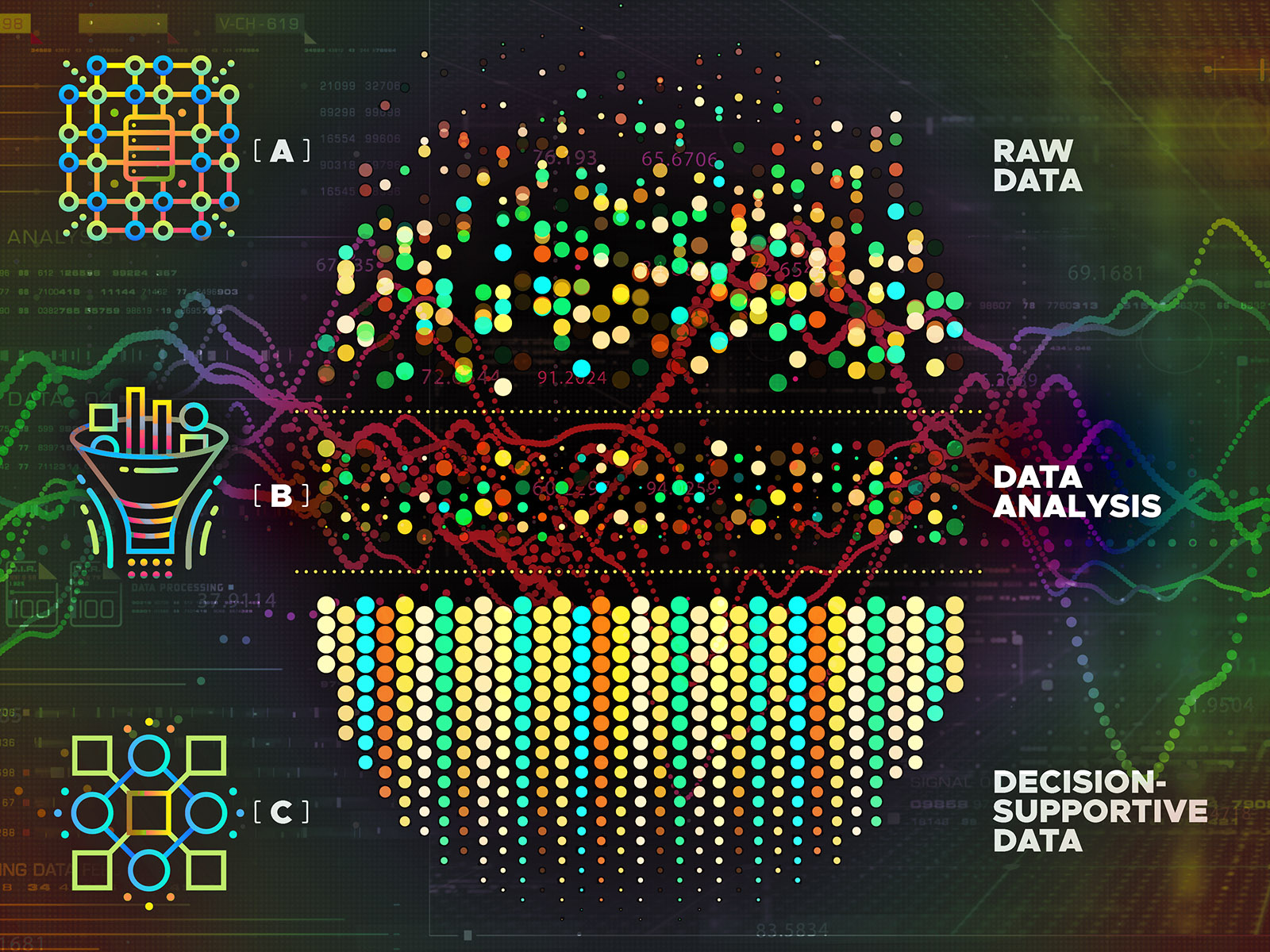
Illustration that includes many small colorful circles that illustrate different data points, with the raw data points near the top, decision-supportive data at the bottom, and data analysis in between.
Pacific Northwest National Laboratory combines AI, data analytics, and other techniques to understand evolving threats and to make informed, data-driven decisions to protect our nation. (Illustration by Timothy Holland | Pacific Northwest National Laboratory)

PNNL’s ability to respond rapidly is rooted in its long-standing basic science mission. Just as it did 25 years ago, PNNL continues to draw on its strengths in new ways to rapidly create, adapt, and deliver solutions as threats evolve. As AI research and usage booms, PNNL is at the forefront, leading more projects linked to the Department of Energy’s Genesis Mission than any other institution. Many fall squarely in areas that PNNL has staked out as key to the future: quantum systems, biology, resilient materials in extreme environments, and energy system security. Autonomous science and AI are infused throughout. 

The Laboratory continues to adapt to a rapidly changing world and put its resources toward the most important challenges, whether it’s drawing its expertise in fundamental science into its applied solutions, designing generative AI approaches to stay ahead of adversaries, or establishing new capabilities to protect the nation’s energy security and critical infrastructure.

“PNNL continues to evolve its science to new problems, as we have throughout our history,” said PNNL Director Deb Gracio. “Deep expertise in areas like physics, chemistry, and materials science allow our researchers to turn foundational discoveries into applied technologies at unprecedented speed. Reflecting on events like 9/11 provides a reminder and motivation to continue to develop new science and technology to keep Americans safe.”

###

About PNNL

Pacific Northwest National Laboratory draws on its distinguishing strengths in chemistry, Earth sciences, biology and data science to advance scientific knowledge and address challenges in energy resiliency and national security. Founded in 1965, PNNL is operated by Battelle and supported by the Office of Science of the U.S. Department of Energy. The Office of Science is the single largest supporter of basic research in the physical sciences in the United States and is working to address some of the most pressing challenges of our time. For more information, visit the DOE Office of Science website. For more information on PNNL, visit PNNL's News Center. Follow us on Twitter, Facebook, LinkedIn and Instagram.