(ISC)², the world’s largest nonprofit association of cybersecurity professionals, elected PNNL cybersecurity expert Lori Ross O’Neil as vice chairperson of the board of directors.
As a member of the NAM board of directors, Brett Jefferson, PNNL data scientist, will help lead the professional association’s mission to advance mathematical excellence of underrepresented minorities.
Ann Lesperance, national security advisor, joins the National Academies of Sciences, Engineering, and Medicine Committee on Applied Research Topics for Hazard Mitigation and Resilience.
The partnership to apply artificial intelligence to improve complex systems is part of a U.S. Department of Energy Office of Science $4.2 million, three-year grant.
Red teaming for CPS, the process of challenging systems, involves a group of cybersecurity experts to emulate end-to-end cyberattacks following a set of realistic tactics, techniques, and procedures.
A recent edition of the Infrastructure Resilience Research Group Journal featured an article written by PNNL researchers Rob Siefken and Jake Burns about “Design Basis Threat and the Low Threat Environment.”
The MIT-sponsored competition encourages community approaches to developing new solutions for analyzing graphs and sparse data; PNNL has placed a winner in each year.
In a new video series, PNNL is highlighting six scientific and technical experts in the national security domain throughout the fall. Each was promoted to scientist and engineer level 5 earlier this year.
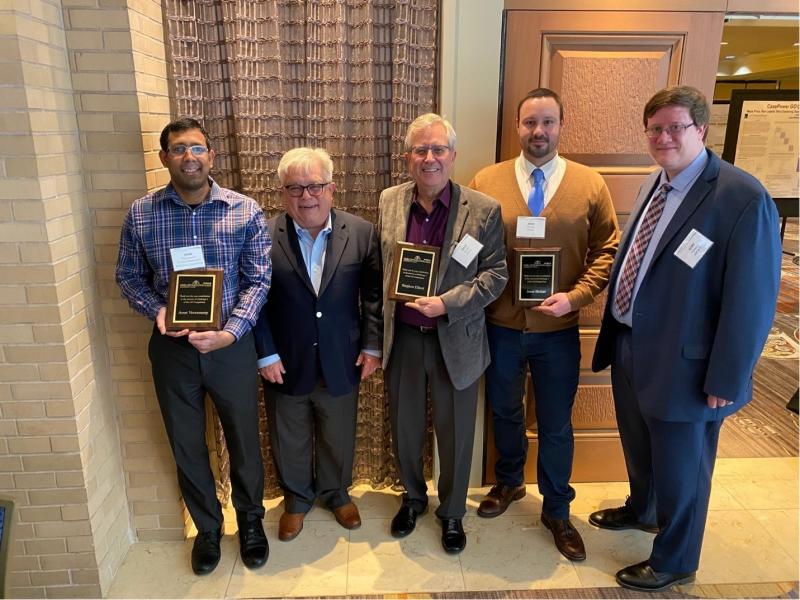
The American Society for Quality (ASQ) has recognized Laboratory Fellow and Pacific Northwest National Laboratory (PNNL) Statistician Greg Piepel with the William G. Hunter Award.
PNNL and Oklahoma State University join forces to understand the chemistry of sodium-ion and potassium-ion batteries thanks to an award from the U.S. Department of Energy's Established Program to Stimulate Competitive Research (EPSCoR).
Sam Chatterjee, a senior operations research scientist at PNNL, was recently appointed as associate editor for the specialty section, “Water and the Built Environment” at the peer-reviewed, open access journal Frontiers in Water.
Ten staff members from PNNL were invited to attend and lead the various breakout sessions at the Department of Energy Office of Science 5G Enabled Energy Innovation Workshop (5GEEIW), which was held in early March.
Two PNNL researchers are helping define the future of transparency and accountability for public and private use of autonomous and intelligent systems.
PNNL researchers Lisa Bramer and Sarah Reehl were on a team that received a patent for its work with electron microscopy. Electron microscopy allows scientists to make nanoscale observations of materials.