Understanding How Trace Impurities in Nuclear Waste Change the Hydrogen Yield of Irradiated Gibbsite
Impurities affect the structure of gibbsite crystals, leading to changes in the hydrogen yield

IDREAM researchers probed the structure of gibbsite with specialized techniques to better understand the fundamental science needed for nuclear waste management.
(Illustration by Nathan Johnson | Pacific Northwest National Laboratory)
Legacy nuclear waste is a complex mixture, with radiation leading to products and other processes that can be difficult to anticipate. When water and minerals are exposed to radiation, they can form hydrogen gas—a potential challenge for safe and effective waste management.
Researchers have observed that for gibbsite, a common aluminum-containing mineral found in Hanford Site tank waste, trace elements are found in the mineral matter. When gibbsite includes traces of nitrogen, it produces less hydrogen gas than gibbsite with traces of chlorine. Researchers in the Ion Dynamics in Radioactive Environments and Materials (IDREAM) Energy Frontier Research Center gained a deeper understanding of why through a pair of studies, which each used a highly specialized technique — dynamic nuclear polarization nuclear magnetic resonance (DNP-NMR) spectroscopy and muon spectroscopy — to probe the trace elements and radiation-generated species within gibbsite.
Previous measurements showed that despite these impurities, the bulk of these materials appeared almost the same. The researchers used aluminum NMR to perform detailed examinations of the crystal structure of the gibbsite. They found that gibbsite with nitrogen impurities has a broader range of aluminum environments, indicating a higher level of atomic-scale disorder within the material than in the chlorine-containing gibbsite.
But where exactly is that disorder and is it associated with other structural phenomena? One example is that aluminum-based defects are hypothesized to influence hydrogen yield. To identify the location, the team used DNP-NMR to effectively knock in and knock out the detectability of the defects at the surface and in the bulk of the material, looking for the signal to either disappear or be enhanced.
They found that, not only were the defects within the bulk of the material, but the signal stayed relatively similar for gibbsite with both nitrogen and chlorine impurities. These data enabled the team to tell that the mere presence of these structural defects is not the source of the differences in hydrogen yield, but that the early time events upon irradiation might be playing a role.
To understand if fast electron processes affect the hydrogen yield differences, the team took its samples to TRIUMF, Canada’s national particle accelerator and one of only a handful of places in the world set up for muon spectroscopy measurements. The muon is a hydrogen-like species, and muon spectroscopy allows researchers to simulate the very earliest timepoints in radiation processes found in tank waste.
“Our DNP-NMR experiments were crucial in helping us narrow down the potential mechanisms we needed to study during our muon experiments,” said Trent Graham, an IDREAM scientist and lead author on both papers. “Given the constraints of beam time, we had to be extremely thoughtful about the samples we took.”
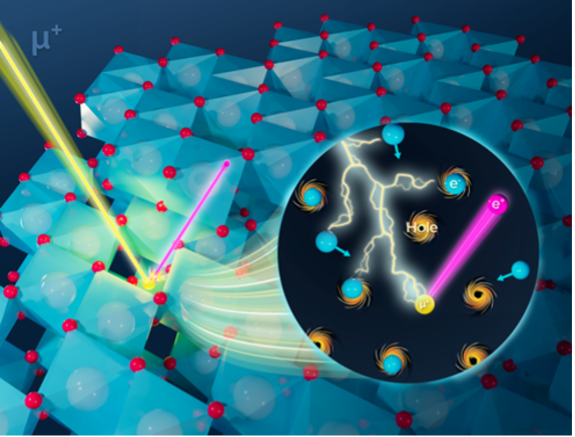
Using muon spectroscopy, the researchers were able to determine whether electrons generated by irradiation survive long enough to impact hydrogen yield by forming hydrogen-associated bound states. They saw clear differences in the behavior of the gibbsite samples with different impurities. The nitrogen impurities trap electrons on sub-nanosecond timescales and suppress hydrogen production; chloride impurities do not suppress electron availability. These results highlight the importance of early time electron availability at longer-lived structural disorder in the gibbsite for hydrogen production.
Identifying factors that are important for hydrogen generation provides the scientific basis for the models that are used in processing legacy tank waste. This work provides a new observable to inform these models.
The IDREAM research was published in:
Published: August 26, 2026