E3SM version 3 expanded aerosol physics and chemistry capabilities, resulting in improved simulations of organic particles, dust, volcanic sulfate, nitrate, and ammonium.
Flux of ocean-emitted particles to the cloud layer diminishes during decoupling, while free-tropospheric entrainment remains effective in supplying aerosol.
A graph-theoretic microstate analysis enabled researchers to identify ion aggregate macro-states and microstates in single and mixed electrolyte solutions.
Scientists combined detailed images and coordinated time-series multiomics data to show how protein complexes regulate carbon fixation as light conditions change.
Researchers discovered that frustrated electric forces drive a novel precipitation pathway called microphase separation and identified a precursor intermediate state of ordered ion networks.
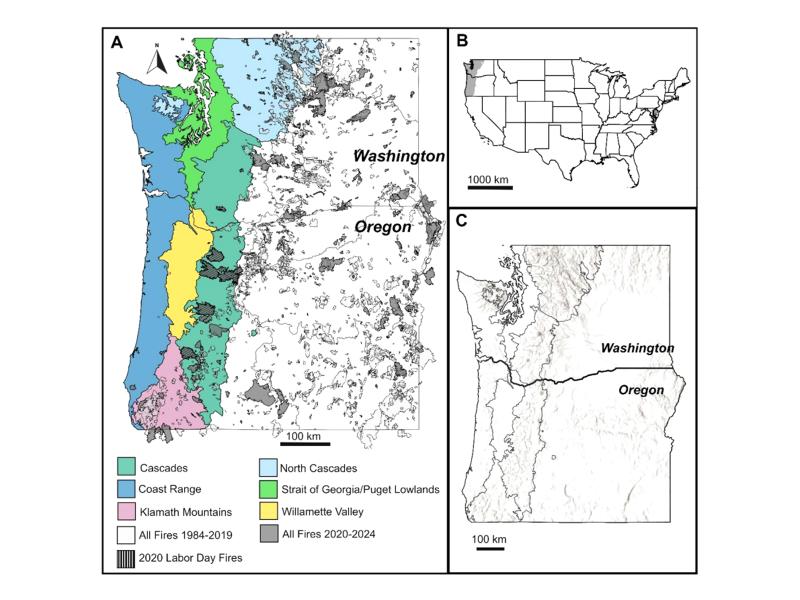
A new modeling approach uses burn severity maps to test how reduced infiltration shifts surface water from soil penetration into streams after wildfire.
Model simulations in humid and semi-arid basins revealed distinct thresholds where wildfires begin to significantly alter river water flows and dissolved nutrient transport.
Researchers developed a new technique that combined mass spectrometry and label-free optical imaging to map molecular and structural changes in healthy and diseased lung tissue, providing new insight into bronchopulmonary dysplasia.