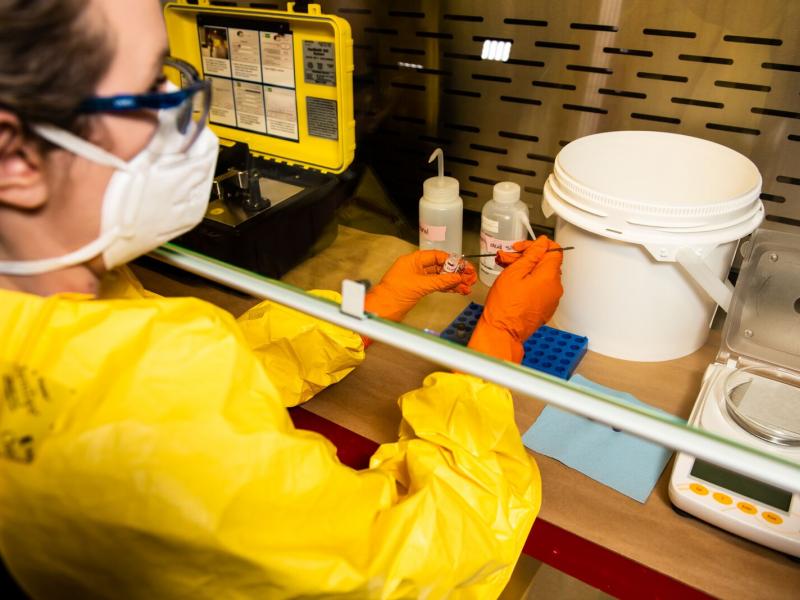
PNNL's Rich Ozanich, project manager of opioids standards and equipment testing, served on an expert panel about opioid detection as part of a Department of Homeland Security S&T research and development showcase.
In 2020, virtual Washington State University teams successfully worked together in a program sponsored by the National Nuclear Security Administration’s (NNSA) Office of International Nuclear Safeguards.
A recent edition of the Infrastructure Resilience Research Group Journal featured an article written by PNNL researchers Rob Siefken and Jake Burns about “Design Basis Threat and the Low Threat Environment.”
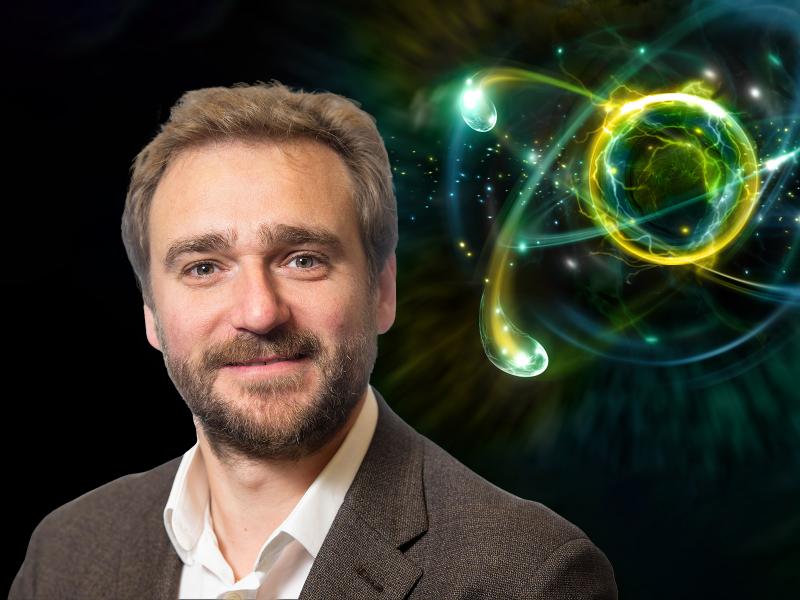
As a physicist at PNNL, Jon Burnett’s work is about developing instruments to detect ultra-trace radionuclide signatures, analyze samples from around the world to look for evidence of nuclear explosions, and then interpret that information.
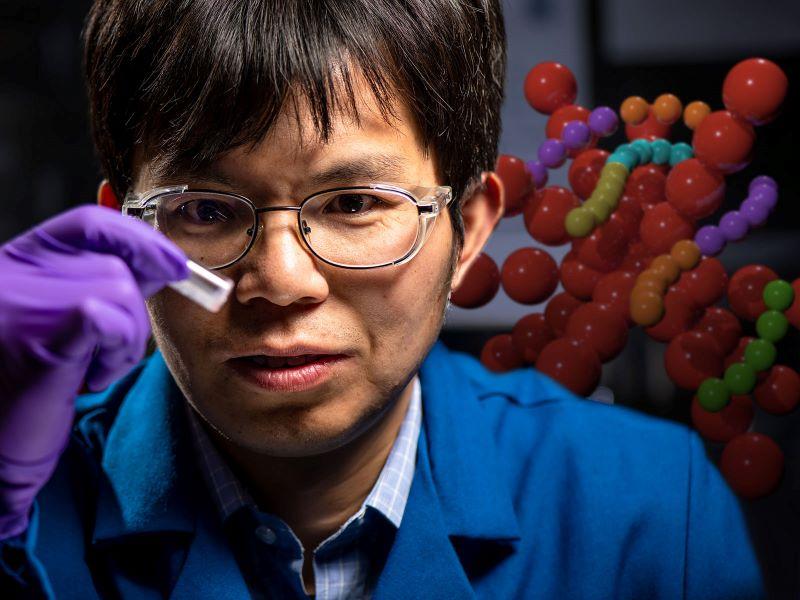
A new review paper led by senior research scientist Chun-Long Chen and featured on the cover of Accounts of Chemical Research summarizes advances by PNNL scientists in developing sequence-defined peptoids.
In a new video series, PNNL is highlighting six scientific and technical experts in the national security domain throughout the fall. Each was promoted to scientist and engineer Level 5, one of PNNL’s most senior research roles.
In a new video series this fall, PNNL is highlighting six scientific and technical experts in the national security domain. Each was promoted to Scientist and Engineer Level 5, one of PNNL’s most senior research roles.
Biomedical scientist Brian Thrall co-edited the issue published in the journal NanoImpact. Three of the articles in the issue include multiple PNNL authors.
PNNL computational biologist Bobbie-Jo Webb-Robertson was recently awarded the “Spirit of nPOD award” to acknowledge her hard work in building, coordinating, and leading the Data Science Working Group.
After 50 years in science and on the eve of retirement, Laboratory Fellow Karin Rodland, a cancer cell biologist at PNNL, is working on experiments she has dreamed about for decades.
PNNL biomedical scientist Ernesto Nakayasu brings expertise in host-pathogen interactions and the interconnection between the immune response and cellular metabolism to provide constructive review for submitted manuscripts.
The first phase, which started in 2014, generated foundational data from developing mouse and human lungs, created a web portal for public data sharing, and established a repository of human lung tissues.