
PNNL

  • About
  • News & Media
  • Careers
  • Events
  • Research
    • Scientific Discovery
      • Biology
        • Chemical Biology
        • Computational Biology
        • Ecosystem Science
        • Human Health
          • Cancer Biology
          • Exposure Science & Pathogen Biology
        • Integrative Omics
          • Advanced Metabolomics
          • Chemical Biology
          • Mass Spectrometry-Based Measurement Technologies
          • Spatial and Single-Cell Proteomics
          • Structural Biology
        • Microbiome Science
          • Biofuels & Bioproducts
          • Human Microbiome
          • Soil Microbiome
          • Synthetic Biology
        • Predictive Phenomics
      • Chemistry
        • Computational Chemistry
        • Chemical Separations
        • Chemical Physics
        • Catalysis
      • Earth & Coastal Sciences
        • Global Change
        • Atmospheric Science
          • Atmospheric Aerosols
          • Human-Earth System Interactions
          • Modeling Earth Systems
        • Coastal Science
        • Ecosystem Science
        • Subsurface Science
        • Terrestrial Aquatics
      • Materials Sciences
        • Materials in Extreme Environments
        • Nondestructive Examination
        • Precision Materials by Design
        • Science of Interfaces
        • Smart Advanced Manufacturing
          • Cold Spray
          • Friction Stir Welding & Processing
          • ShAPE
      • Nuclear & Particle Physics
        • Dark Matter
        • Fusion Energy Science
        • Neutrino Physics
      • Quantum Information Sciences
    • Energy Resiliency
      • Electric Grid Modernization
        • Emergency Response
        • Grid Analytics
          • AGM Program
          • Tools and Capabilities
        • Grid Architecture
        • Grid Cybersecurity
        • Grid Energy Storage
        • Transmission
        • Distribution
      • Energy Efficiency
        • Appliance and Equipment Standards
        • Building Energy Codes
        • Building Technologies
          • Advanced Building Controls
          • Advanced Lighting
          • Building-Grid Integration
        • Commercial Buildings
        • Federal Buildings
          • Federal Performance Optimization
          • Resilience and Security
        • Residential Buildings
          • Building America Solution Center
          • Energy Efficient Technology Integration
          • Home Energy Score
        • Energy Efficient Technology Integration
      • Energy Storage
        • Electrochemical Energy Storage
        • Flexible Loads and Generation
        • Grid Integration, Controls, and Architecture
        • Regulation, Policy, and Valuation
        • Science Supporting Energy Storage
        • Chemical Energy Storage
      • Environmental Management
        • Waste Processing
        • Radiation Measurement
        • Environmental Remediation
      • Fossil Energy
        • Subsurface Energy Systems
        • Advanced Hydrocarbon Conversion
      • Nuclear Energy
        • Fuel Cycle Research
        • Advanced Reactors
        • Reactor Operations
        • Reactor Licensing
      • Renewable Energy
        • Solar Energy
        • Wind Energy
          • Wind Resource Characterization
          • Wildlife and Wind
          • Wind Systems Integration
          • Wind Data Management
          • Distributed Wind
        • Marine Energy
          • Environmental Monitoring for Marine Energy
          • Marine Biofouling and Corrosion
          • Marine Energy Resource Characterization
          • Testing for Marine Energy
          • The Blue Economy
        • Hydropower
          • Environmental Performance of Hydropower
          • Hydropower Cybersecurity and Digitalization
          • Hydropower and the Electric Grid
          • Materials Science for Hydropower
          • Pumped Storage Hydropower
          • Water + Hydropower Planning
        • Grid Integration of Renewable Energy
        • Geothermal Energy
      • Transportation
        • Bioenergy Technologies
          • Algal Biofuels
          • Aviation Biofuels
          • Waste-to-Energy and Products
        • Hydrogen & Fuel Cells
        • Vehicle Technologies
          • Emission Control
          • Energy-Efficient Mobility Systems
          • Lightweight Materials
          • Vehicle Electrification
          • Vehicle Grid Integration
    • National Security
      • Chemical & Biothreat Signatures
        • Contraband Detection
        • Pathogen Science & Detection
        • Explosives Detection
        • Threat-Agnostic Biodefense
      • Cybersecurity
        • Discovery and Insight
        • Proactive Defense
        • Trusted Systems
      • Nuclear Material Science
      • Nuclear Nonproliferation
        • Radiological & Nuclear Detection
        • Nuclear Forensics
        • Ultra-Sensitive Nuclear Measurements
        • Nuclear Explosion Monitoring
        • Global Nuclear & Radiological Security
      • Stakeholder Engagement
        • Disaster Recovery
        • Global Collaborations
        • Legislative and Regulatory Analysis
        • Technical Training
      • Systems Integration & Deployment
        • Additive Manufacturing
        • Deployed Technologies
        • Rapid Prototyping
        • Systems Engineering
      • Threat Analysis
        • Advanced Wireless Security
          • 5G Security
          • RF Signal Detection & Exploitation
        • Border Security
        • Internet of Things
        • Maritime Security
        • Millimeter Wave
        • Mission Risk and Resilience
    • Data Science & Computing
      • Artificial Intelligence
      • Graph and Data Analytics
      • Software Engineering
      • Computational Mathematics & Statistics
      • Future Computing Technologies
        • Adaptive Autonomous Systems
    • Lab Objectives
    • Publications & Reports
    • Featured Research
  • People
    • Inventors
    • Lab Leadership
    • Lab Fellows
    • Staff Accomplishments
  • Partner with PNNL
    • Education
      • Undergraduate Students
      • Graduate Students
      • Post-graduate Students
      • University Faculty
      • University Partnerships
      • K-12 Educators and Students
      • STEM Education
        • STEM Workforce Development
        • STEM Outreach
      • Internships
    • Community
      • Regional Impact
      • Philanthropy
      • Volunteering
    • Industry
      • Why Partner with PNNL
      • Explore Types of Engagement
      • How to Partner with Us
      • Available Technologies
      • Procurement
  • Facilities & Centers
    • All Facilities
      • Atmospheric Radiation Measurement User Facility
      • Electricity Infrastructure Operations Center
      • Energy Sciences Center
      • Environmental Molecular Sciences Laboratory
      • Grid Storage Launchpad
      • Institute for Integrated Catalysis
      • Interdiction Technology and Integration Laboratory
      • PNNL Portland Research Center
      • PNNL Seattle Research Center
      • PNNL-Sequim (Marine and Coastal Research)
      • Radiochemical Processing Laboratory
      • Shallow Underground Laboratory

Grid Storage Launchpad

  • About GSL
    • Labs and Amenities
  • What can GSL do for you?
  • News and Events
  • Apply to Test
    • Online Application
    • Testing and Validation Room 1
    • Testing and Validation Room 2
    • FAQs on GSL Testing
    • Agreements and Processes

Breadcrumb

  1. Home
  2. Projects
  3. Grid Storage Launchpad

Apply to Test Battery Technology

As demand for an efficient and reliable grid infrastructure grows, new energy storage technologies enter the market to improve operations and interface with existing infrastructure. As a U.S. Department of Energy facility, the Grid Storage Launchpad (GSL) plays a critical role in accelerating the development and validation of these next-generation grid and transportation energy storage technologies to support a reliable, affordable, secure, and resilient electrical grid.

For energy storage systems meant for 20–25-year lifespans, we want to know how these technologies work, why they would degrade, and what fundamental science research can help us find solutions. After prototyping, we can test newly built battery systems or have companies validate their equipment under specific grid duty cycles and operating conditions using 10,000 square feet of specialized testing space.

The GSL brings all phases of the battery development and deployment cycle under one roof to help product developers, grid operators, industry, and others in a new era of grid energy storage innovation. 

How to Apply

We encourage you to review the information on this page carefully before applying. When you're ready, you can apply via our online form. You will be able to include any necessary agreements and documentation in your submission.

Apply Online

Questions? Review our FAQ or reach out to our team for assistance.

What can GSL testing do for you?

We invite all vendors with battery technology to use the GSL to test and validate the performance of their systems under grid-scale conditions. This service does not fulfill certifications or test to failure states, but it helps verify operational performance by the specifications in the system’s design. GSL testing informs: 

  • Battery OEM (Original Equipment Manufacturer), system integrators, and developers wanting third-party validation of system performance, 
  • Utility owners/operators, and grid managers who need to validate deployment of new technology and lessen the risk of asset performance,
  • Grid planners who manage industry specifications,
  • Researchers investigating new battery materials and their grid contribution, 
  • Anyone with an eye on U.S. grid resiliency. 

GSL’s Testing and Validation Capability 

Companies with systems in production or pre-commercial phases can apply to test their technologies at the facility in Richland, Washington, using two Testing and Validation (T&V) environments designed specifically for battery technologies from cells to systems.
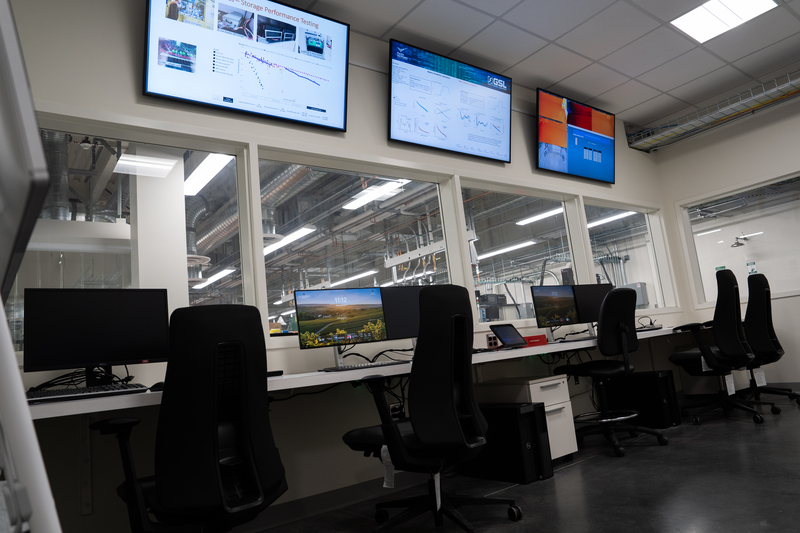
GSL Testing Lab Observation Room
GSL’s Testing and Validation observation room offers a safe environment where experts can control and evaluate battery performance throughout the entire testing process.

Lab 1 (T&V1) – testing cells and modules
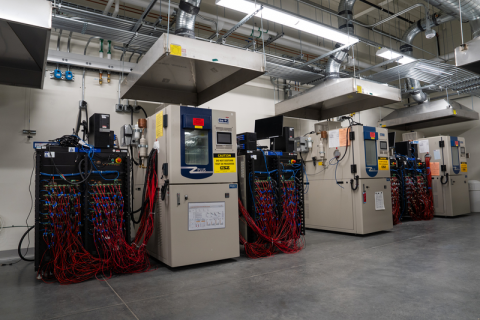
GSL Testing Lab 1 Setups

T&V1 is designed specifically for testing cells and modules.

This environment offers an expansive space for 16 test stands to handle systems of different chemistries—flow batteries, sodium batteries, zinc-based, lithium ion, lead acid—at 10 kilowatt (kW) and up to 40 kilowatt hours (kWh) for pre-commercial systems. 

While this space is not currently accepting testing applications, you can review specifications and contact our team for more information regarding testing conducted in this room.

Lab 2 (T&V2) – testing grid-scale systems
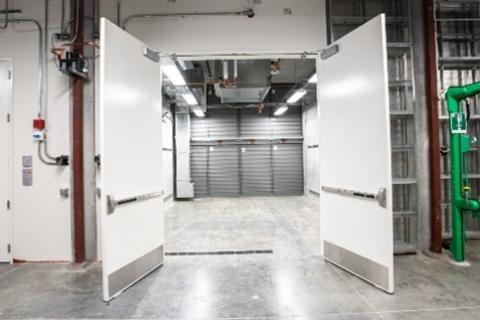
T&V2

T&V2 is designed to test larger-scale systems’ performance under designer specifications—prototypes and unit-level systems—with dedicated test rooms that can accommodate battery systems up to 100 kW and 400 kWh for validation of equipment at scales relevant to grid storage.

Safety is a priority with the design of these testing rooms. They are equipped with a highly engineered safety system and cameras that monitor for events such as thermal run-away or off-gassing of the battery. We do not test to failure (i.e., destructive testing) in T&V2.

Refer to our test room guidance for information on doorway access, floor space allowance, and terminal connections.

Your Path to Testing in T&V2

You can apply to have your technology tested for optimal performance, security, and reliability. The application you will complete answers key questions that help us determine if GSL testing will work for your system. GSL T&V2 spaces are designed for energy storage technology that performs differently and at varying sizes. Your application will enable us to plan for the appropriate environment and how to work with your system.

Equipment testing can be scheduled upon confirmation of project funding through various financing mechanisms (e.g., DOE Voucher and private funds or another federal funding source) and after we perform a safety review.

Application and Testing Process:
  1. Prepare and Apply
    1. Gather all necessary agreements and documentation
    2. Submit application, agreements and documentation via the online application form
  2. Application Review
    1. Technical review of application conducted
    2. Review of necessary agreements conducted
    3. Approval notice sent to applicant
    4. Scheduling of testing procedure(s)
  3. Testing and Reporting
    1. Equipment delivered to GSL
    2. Testing period
    3. Performance report delivered to owner
    4. Equipment returned to owner

FAQs

Review our frequently asked questions to learn more about qualifications and the tests performed in this environment.


Get Connected

Subscribe to Our Newsletter

Sign up to be among the first to receive updates on GSL developments, projects, new opportunities, and industry highlights.

( Subscribe Online )

Contact Our Team

Learn more about what the GSL can do for you! Email us at GSLtesting@pnnl.gov and tell us what technology you have, where in the development process you are, and if you anticipate testing someday at the GSL. 

( Send us an email )

Research topics

Electric Grid Modernization
Electrochemical Energy Storage
Emergency Response
Energy Efficiency
Energy Storage
Grid Energy Storage
Grid Integration, Controls, and Architecture
Grid Integration of Renewable Energy
Regulation, Policy, and Valuation
Renewable Energy
Stakeholder Engagement
Energy Resiliency
Transportation

Lab-Level Communications Priority Topics

Grid

PNNL

  • Get in Touch
    • Contact
    • Careers
    • Doing Business
    • Environmental Reports
    • Security & Privacy
    • Vulnerability Disclosure Policy
    • Notice to Applicants
  • Research
    • Scientific Discovery
    • Energy Resiliency
    • National Security
Subscribe to PNNL News
Department of Energy Logo Battelle Logo
Pacific Northwest National Laboratory (PNNL) is managed and operated by Battelle for the Department of Energy
  • YouTube
  • Facebook
  • X (formerly Twitter)
  • Instagram
  • LinkedIn