October 27, 2026
Feature

From the Periodic Table to New Nuclear Energy Materials

PNNL researchers are helping design new materials that can withstand the extreme conditions inside advanced nuclear reactors

Pacific Northwest National Laboratory materials scientists Mohan Nartu (left) and Osman El Atwani (right) stand beside an arc melter inside in the Materials Science and Technology Laboratory, where they are fabricating a new alloy called V555 using an approach called robust alloy design (RAD) developed at Pacific Northwest National Laboratory.

Pacific Northwest National Laboratory materials scientists Mohan Nartu (left) and Osman El Atwani (right) stand beside an arc melter inside the Materials Science and Technology Laboratory, where they are fabricating a new alloy called V555 using an approach called robust alloy design (RAD) developed at Pacific Northwest National Laboratory.

(Photo by Eddie Pablo | Pacific Northwest National Laboratory)

The periodic table contains more than 100 elements. Combine them in different ways, and the possibilities quickly multiply. For researchers designing materials for advanced nuclear reactors, the abundance presents an opportunity: Could entirely new combinations of elements produce stronger alloys capable of withstanding the extreme heat, radiation, and mechanical stress inside a nuclear reactor?

At Pacific Northwest National Laboratory (PNNL), materials scientist Osman El Atwani and his colleagues are exploring that question by designing new alloys from the ground up. Rather than starting with an existing commercial alloy and making incremental changes, his team is investigating combinations of elements that could provide the properties needed for future nuclear energy systems.

One result is V555, an experimental alloy identified through this approach and selected for initial laboratory evaluation. Researchers selected V555 from hundreds of compositions identified through a computational approach called robust alloy design (RAD), which PNNL developed to help systematically search for materials that meet multiple nuclear requirements.

“As we looked more into this, we began to understand how different material possibilities correlated with the design criteria,” El Atwani said. “The work has developed into a pathway for the nuclear materials community to explore and evaluate a broader range of materials for future nuclear systems.”

A new way to search

The work is described in the team’s recent paper in Materials & Design, “A Robust Alloy Design (RAD) Strategy for Next-Generation (IV) Nuclear Fission Reactors.” The paper describes RAD, an eight-step approach for identifying and evaluating new alloys on the basis of the demands of their intended nuclear environment.

RAD Materials
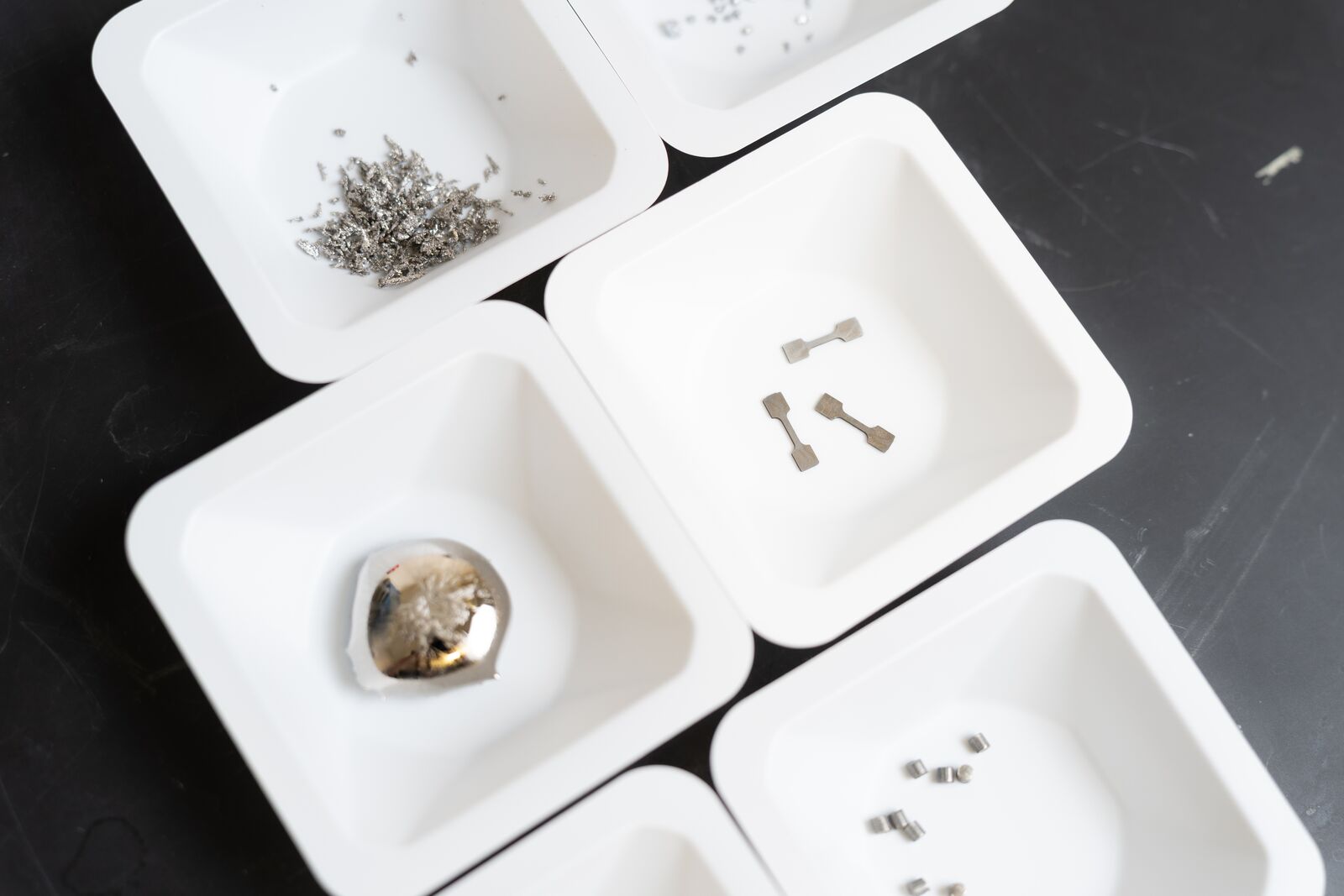
Samples of materials used to create new alloys by Pacific Northwest National Laboratory scientists: titanium (top left), chromium (top right), a V555 medallion and V555 tensile specimens (middle), and zirconium (bottom right). (Photo by Eddie Pablo | Pacific Northwest National Laboratory)

El Atwani, the project’s principal investigator, and his PNNL colleagues developed the approach to help narrow the search by evaluating potential alloys against nuclear requirements, including radiation resistance and manufacturability, before researchers commit time and resources to fabrication and testing.

Using the RAD approach, the team’s initial computational screening identified 724 predicted alloy compositions with promising characteristics, then it narrowed the field and identified candidates for experimental evaluation.

That search led the team to select V555 to validate the RAD approach, giving researchers an opportunity to bring one of the computationally identified compositions from the computer into the laboratory.

Starting with the building blocks

Mohan Nartu, a PNNL materials scientist who worked closely with El Atwani on the project, acknowledged PNNL’s specialized research capabilities allow it to fabricate and test hundreds of potential alloys. To address that challenge, the team developed a holistic scoring framework (RAD Score) that combines multiple nuclear-relevant criteria into a single score for comparing and downselecting alloy candidates prior to experimental evaluation.

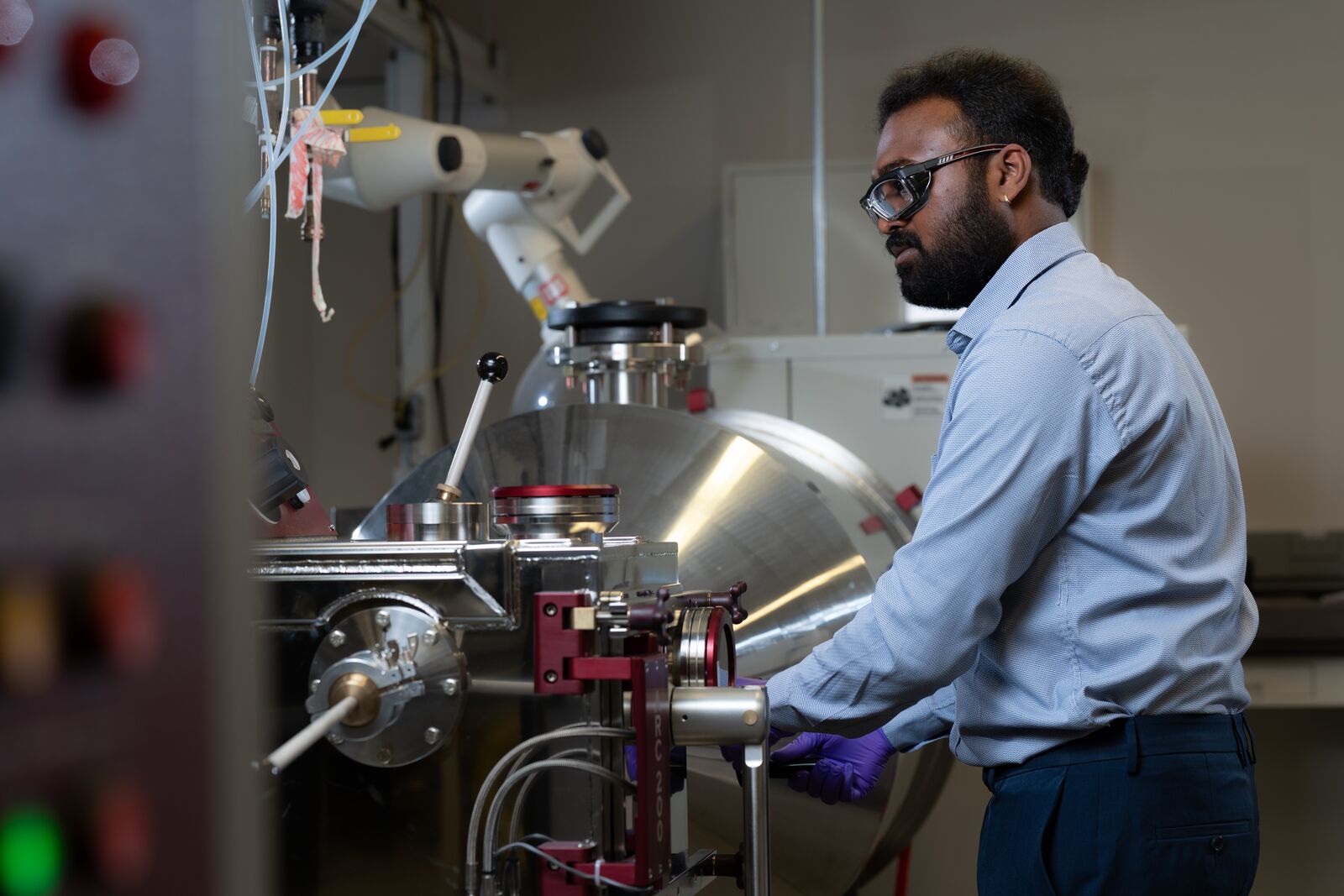
Pacific Northwest National Laboratory materials scientists Mohan Nartu using an arc melter to make a new alloy sample called V555.
Pacific Northwest National Laboratory materials scientists Mohan Nartu using an arc melter to make a new alloy sample called V555. (Photo by Eddie Pablo | Pacific Northwest National Laboratory)

“The standard practice is swapping this element with that, and that element with this,” Nartu said. “While that technically gives you a new material, you didn’t change the broth, so the soup is still old. You’re still going to be somewhat limited.”

This approach also helps make experimental work more efficient, as V555 material that is not used during sample testing can be recycled and used to make additional samples without any compromise in quality.

“Conventional nuclear cladding materials, including steels and zirconium-based alloys such as Zircaloy, represent decades of research and development in nuclear metallurgy,” said El Atwani. “Building on this foundation, multi-principal element alloy design provides a pathway to develop new classes of materials whose properties can be tailored and enhanced through deliberate changes in composition.”

Opening up the search

V555 gave researchers a way to bring the computational process into the laboratory. The team fabricated the alloy and examined its structure and mechanical properties as an initial step in evaluating the computational approach.

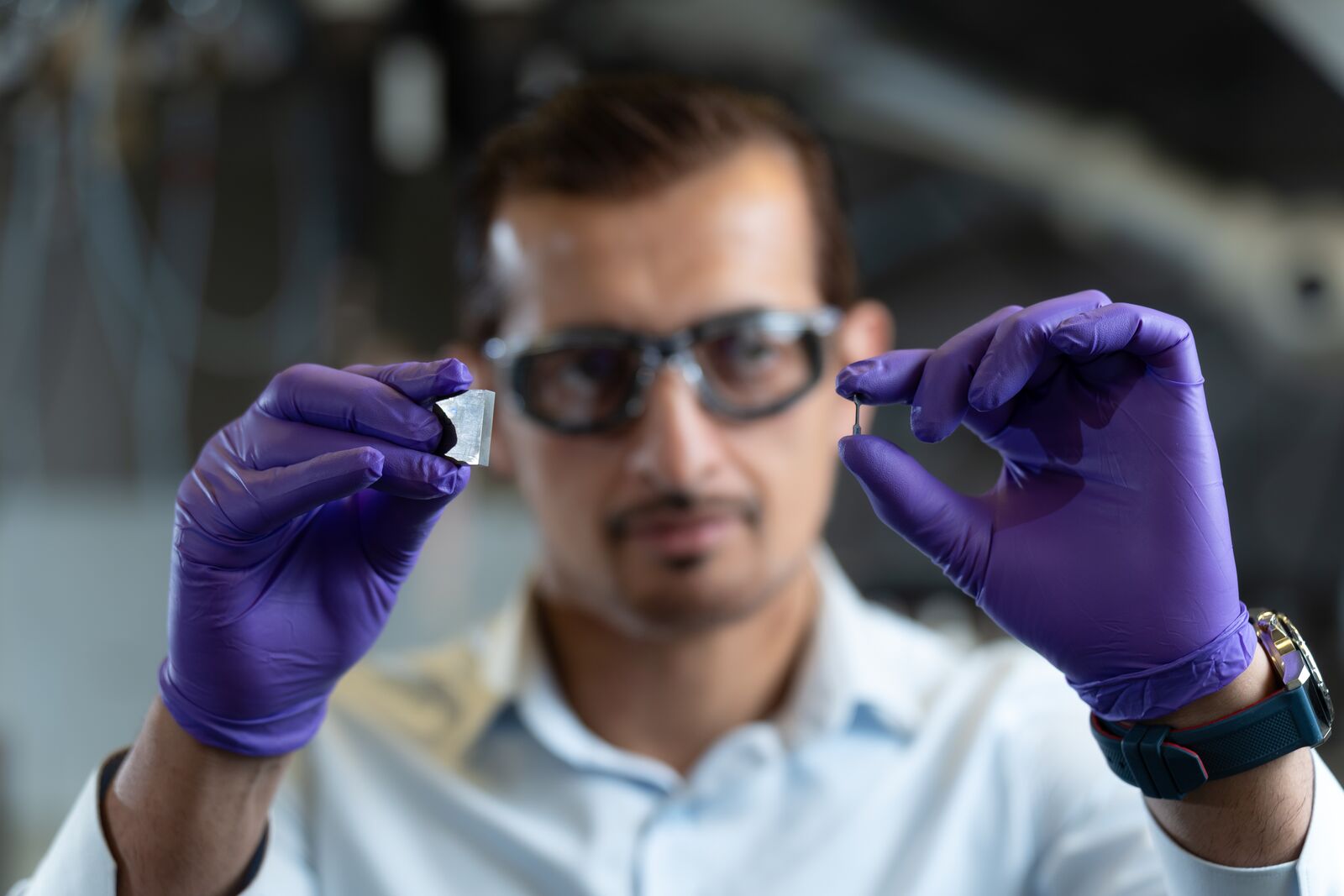
Pacific Northwest National Laboratory materials scientist Osman El Atwani holds a flat sample of a new alloy called V555 (left) that will be cut into a smaller sample (right) for strength testing.
Pacific Northwest National Laboratory materials scientist Osman El Atwani holds a flat sample of a new alloy called V555 (left) that will be cut into a smaller sample (right) for strength testing. (Photo by Eddie Pablo | Pacific Northwest National Laboratory)

At room temperature, tests indicated an estimated yield strength (i.e., the amount of stress a material can withstand before it begins to permanently change shape) of about 500 to 600 megapascals. This provides an initial measure of the alloy’s mechanical properties under laboratory conditions.

In the near future, the team plans to evaluate how the alloy responds to radiation, high temperatures, and other conditions expected in nuclear systems.

Researchers are also examining other compositions identified through the RAD process, expanding the range of potential materials that could eventually be considered for advanced nuclear applications.

“We wanted to show that you can actually choose elements from scratch, if you have the right criteria in mind, and can systematically design a material for nuclear applications,” said Nartu.

The V555 study provides an initial demonstration of that process, while further testing will help researchers evaluate the properties of candidate materials under conditions relevant to advanced nuclear energy systems.

The research was supported by the Department of Energy Office of Nuclear Energy’s Innovative Nuclear Materials program. The PNNL RAD team includes materials scientists Shalini Tripathi and Skye Supakul with postdoctoral research associate Ishtiaque K. Robin, all based in PNNL’s Nuclear Sciences Division.

###

About PNNL

Pacific Northwest National Laboratory draws on its distinguishing strengths in chemistry, Earth sciences, biology and data science to advance scientific knowledge and address challenges in energy resiliency and national security. Founded in 1965, PNNL is operated by Battelle and supported by the Office of Science of the U.S. Department of Energy. The Office of Science is the single largest supporter of basic research in the physical sciences in the United States and is working to address some of the most pressing challenges of our time. For more information, visit the DOE Office of Science website. For more information on PNNL, visit PNNL's News Center. Follow us on LinkedIn, Facebook, YouTube, Instagram and X.