June 15, 2026
Feature

PNNL Prepares for Quantum Advantage

As practical quantum computing edges closer, global leaders begin making plans to demonstrate its advantages 

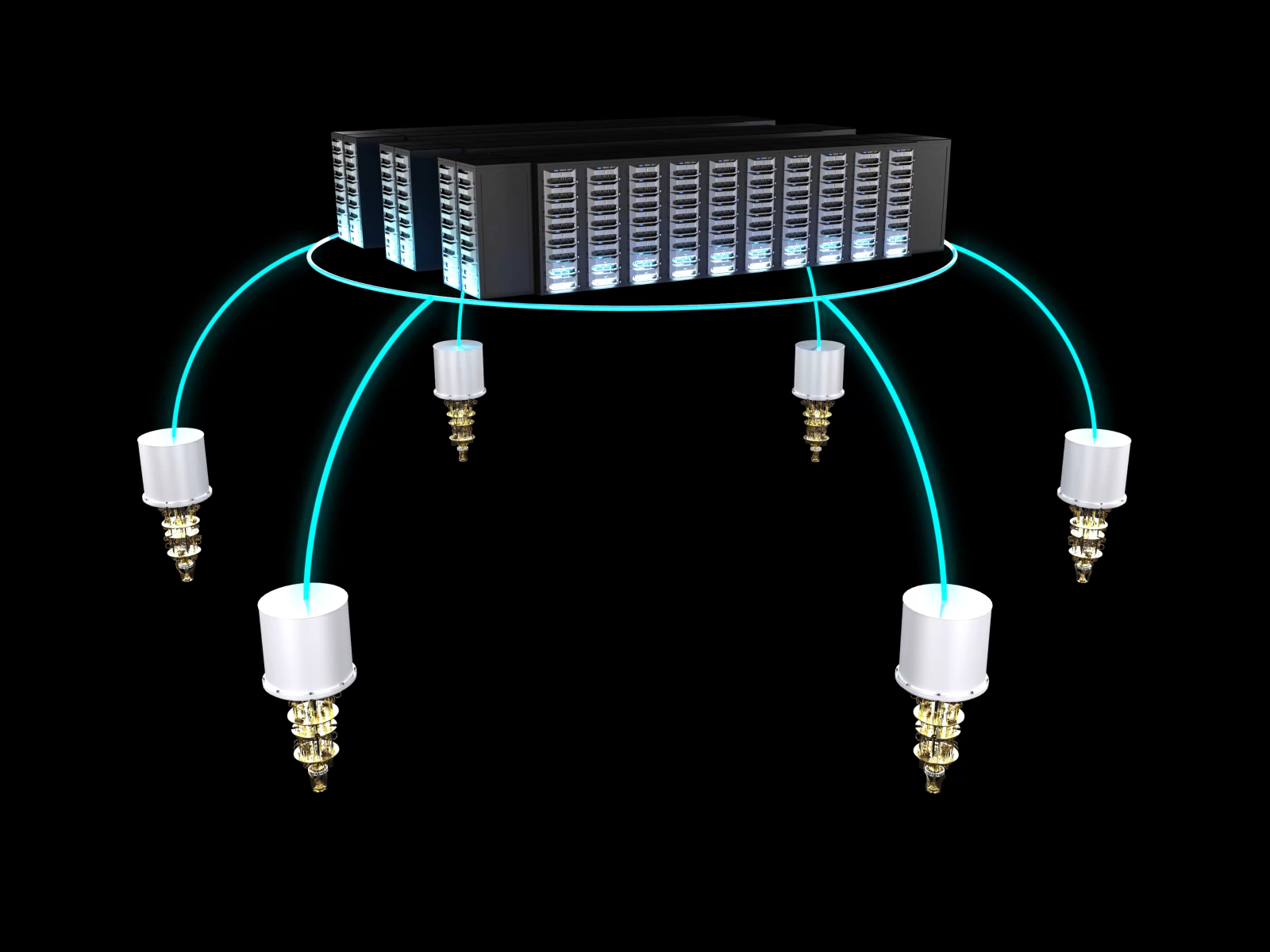
Illustration of a high-performance computer connected to a series of individual quantum computers

Quantum computing leaders gathered this spring to discuss how near-term quantum computing and hybrid quantum-classical computing can deliver early demonstrations of utility for solving complex chemistry and materials science problems. 

(Image by Ben Watson | Pacific Northwest National Laboratory)

With the first practical quantum computers expected to arrive in about two years’ time, global quantum computing leaders are thinking about how these systems should first be deployed for the largest scientific impact. 

This spring, the Department of Energy’s Pacific Northwest National Laboratory brought together quantum computing leaders for the second annual Quantum Computing for Chemistry workshop, organized by the PNNL Quantum Algorithms and Architecture for Domain Science (QuAADS) initiative.

Karol Kowalski, director of QuAADs and an expert in advanced computational chemistry, opened the event with a challenge to the assembled group: identify scalable and adaptive algorithms capable of operating across varying system sizes and qubit counts to solve practical problems. 

Participants explored how near-term quantum computing and hybrid quantum-classical computing can deliver early demonstrations of utility for solving complex chemistry and materials science problems. 

Bindu Nair, Associate Director of DOE’s Office of Science Basic Energy Sciences program, addressed the role of DOE in supporting quantum computing and driving its advancement globally. Quoting DOE Undersecretary for Science Dario Gil, she said that “we are at an inflection point in computing and because of that we are going to be able to do science in ways that have never been done before.”

“The charge to you,” she added, “is to come up with what the parameters need to be to make a quantum computer useful to this community so that you can demonstrate something useful in quantum chemistry.”

Marvin Warner, PNNL's chief scientist for quantum, discusses the search for quantum computing's most impactful applications. (Video by Graham Bourque | Pacific Northwest National Laboratory)

DOE has made a large investment in quantum computing through the National Quantum Initiative and its Quantum Centers, she added. Now that it is coming close to paying off, the hard part begins.

Up next for quantum chemistry

Meeting participants spent two days investigating how and when a quantum calculation could solve complex problems in chemical conversions, materials science, energy storage and other pressing needs.

The participants stressed the importance of running quantum chemical simulations that cannot be done with classical computing alone. Further, they stressed the need to choose chemical systems that can also validate simulations through laboratory experiments. 

Speakers from Microsoft, IBM, IONQ and Xanadu presented case studies from their research organizations.  

From these discussions, several participants noted the potential for further acceleration of quantum computing through computing code developed by AI. 

Marwa Farag, a quantum algorithm engineer at NVIDIA, discussed the use of AI to design better quantum algorithms. The approach involves using AI models to demonstrate significant speedup and improved accuracy when designing quantum algorithms for modeling chemical systems. 

She also pointed to NVIDIA’s work in hybrid quantum-classical computing with the NVIDIA CUDA-Q platform. A recent collaboration between PNNL, academic and industry partners demonstrated the utility of such an approach.  

Victor Batista from Yale presented applications of quantum machine learning for chemistry, including predicting chemical reactivity, binding affinity and molecular properties. The work involves using quantum circuits and variational algorithms to achieve accurate predictions and optimize molecular designs.

Similarly, Daniel Claudino from Oak Ridge National Laboratory presented a hybrid software framework for integrating classical high-performance computing with quantum computing. The framework manages resources and enables efficient communication between quantum and classical systems, he said.

Francesco Evangelista of Emory University and Nick Mayhall of Indiana University, Bloomington, among others, discussed strategies for enabling realistic quantum computing simulations to predict the energy and properties of complex chemical structures. 

After two days of discussion, Kowalski, who is also a Laboratory Fellow at PNNL, summarized the key outcomes of the meeting, emphasizing that there will also be a formal workshop report published in a peer-reviewed journal, similar to the report from the first workshop held in 2025

How many qubits?

Kowalski stressed the need for more than 100 logical qubits to achieve meaningful quantum utility. He reiterated the need for identifying problems that are both conceptually interesting and not easily solvable by current classical methods, as well as the role of experimental validation in supporting quantum computing results. 

And he noted that AI, an emerging tool to quantum computing, may help speed initial insights into chemical systems and predictions, as well as serve as an accelerator for quantum algorithm development. 

“This workshop demonstrates PNNL’s commitment to support DOE’s goal of elevating quantum computing into a trusted, mission-relevant tool to advance science,” said Marvin Warner, PNNL’s Chief Scientist for Quantum. “Practical quantum computing requires sustained commitment to working collaboratively across industry, academia and our national laboratory partners. At PNNL, we have invested in doing what’s needed to advance the state-of-the-art quantum computing workflows and outcomes.”

Learn more about PNNL’s commitment to using quantum computing to address a range of science challenges. 

###

About PNNL

Pacific Northwest National Laboratory draws on its distinguishing strengths in chemistry, Earth sciences, biology and data science to advance scientific knowledge and address challenges in energy resiliency and national security. Founded in 1965, PNNL is operated by Battelle and supported by the Office of Science of the U.S. Department of Energy. The Office of Science is the single largest supporter of basic research in the physical sciences in the United States and is working to address some of the most pressing challenges of our time. For more information, visit the DOE Office of Science website. For more information on PNNL, visit PNNL's News Center. Follow us on Twitter, Facebook, LinkedIn and Instagram.