Storm-Driven Rain Can Fuel Later Rainfall
A new tracer model tracked how May 2015 storm water re-entered the atmosphere and contributed to later rainfall

The Science
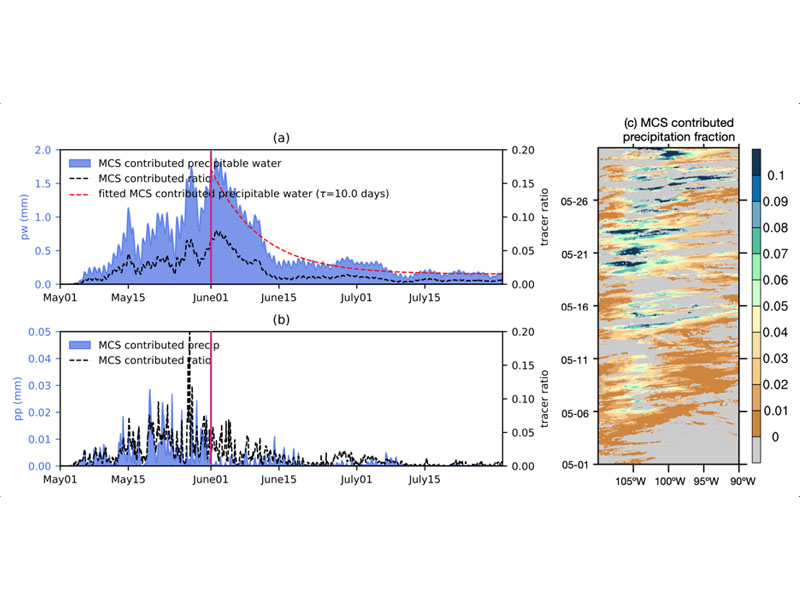
Extreme rainstorms can rapidly affect how water moves between land and the atmosphere, but their impacts over weeks to months are not well understood. Researchers studied a sequence of extreme mesoscale convective systems (organized thunderstorm complexes) that produced record-breaking rainfall in May 2015 over the southern Great Plains. They used a land–atmosphere coupled water tracer tool within the Weather Research and Forecasting model to “tag” storm-produced precipitation and track its post-precipitation pathways. They found that water from earlier storms contributed about 20%–50% of total evapotranspiration later in May and supplied about 10% of local precipitation for later storms. After May, the tagged storm water contributed the most to moisture recycling during the first five days of June, then declined rapidly.
The Impact
This study showed that extreme spring storms can influence the water cycle beyond the rainfall period by feeding evapotranspiration and supporting later precipitation. The researchers implemented a new tracer method that connected water movement in soils with atmospheric transport, allowing event water to be tracked from precipitation into evapotranspiration and back into precipitation within one recycling cycle. Results indicated rapid turnover of tagged storm water in shrubland and grassland areas, driven mainly by direct soil evaporation, while forested areas supplied a small but persistent moisture contribution through transpiration. The tagged moisture plume extended 500–700 km downstream between May and July, showing that storm water can affect recycling well beyond the storm source region. This process-based framework provides a way to study land–atmosphere coupling and subseasonal moisture recycling in storm-active regions.
Summary
Researchers examined how precipitation from a series of extreme mesoscale convective systems in May 2015 over the southern Great Plains influenced subseasonal moisture recycling into June and July. They developed and applied a land–atmosphere coupled water tracer capability embedded in the Weather Research and Forecasting model that tagged storm precipitation when it fell over land, tracked its storage in canopy water and soils, and followed its return to the atmosphere through evapotranspiration. The tagged moisture was then transported through the atmosphere and could contribute to later precipitation.
In May, precipitation from earlier storms contributed 20%–50% of total evapotranspiration later in the month and accounted for about 10% of local precipitation during later storms. After May, tagged storm water contributed most to moisture recycling in early June and then decreased rapidly, indicating a turnover that may reflect the dominant shrubland and grassland land cover, where direct soil evaporation was strong. In forested areas, transpiration provided a smaller but more constant contribution that persisted through June and July. Tagged moisture could extend 500–700 km downstream, indicating a pathway for storm-driven impacts on moisture recycling across regions and over subseasonal timescales.
Text was initially generated using artificial intelligence and subsequently reviewed, refined, and validated by experts at Pacific Northwest National Laboratory.
Contact
Renu Joseph, Regional and Global Model Analysis program area, renu.joseph@science.doe.gov
L. Ruby Leung, Pacific Northwest National Laboratory, ruby.leung@pnnl.gov
Funding
This research is supported by the U.S. Department of Energy, Office of Science, Biological and Environmental Research (BER) program as part of the Regional and Global Model Analysis program area through the Water Cycle: Modeling of Circulation, Convection, and Earth System Mechanisms (WACCEM) scientific focus area. Computational resources are provided by the National Energy Research Scientific Computing Center (NERSC), a Department of Energy User Facility, using NERSC Award BER-ERCAP0032096.
Published: September 9, 2026
Hu, H., Leung, L. R., Feng, Z., Marquis, J. & Sakaguchi, K. Understanding subseasonal moisture recycling from extreme MCSs using a land–atmosphere coupled water tracer model. J. Hydrometeorol. (2026). DOI: 10.1175/JHM-D-25-0091.1