September 2, 2026
Article

New “Molecular Velcro” Cement Heals Cracks Within Hours—and Could Help Concrete Last Far Longer

Made with less than 0.15 percent polymer, the material quickly seals damage and restores strength across repeated cracking cycles
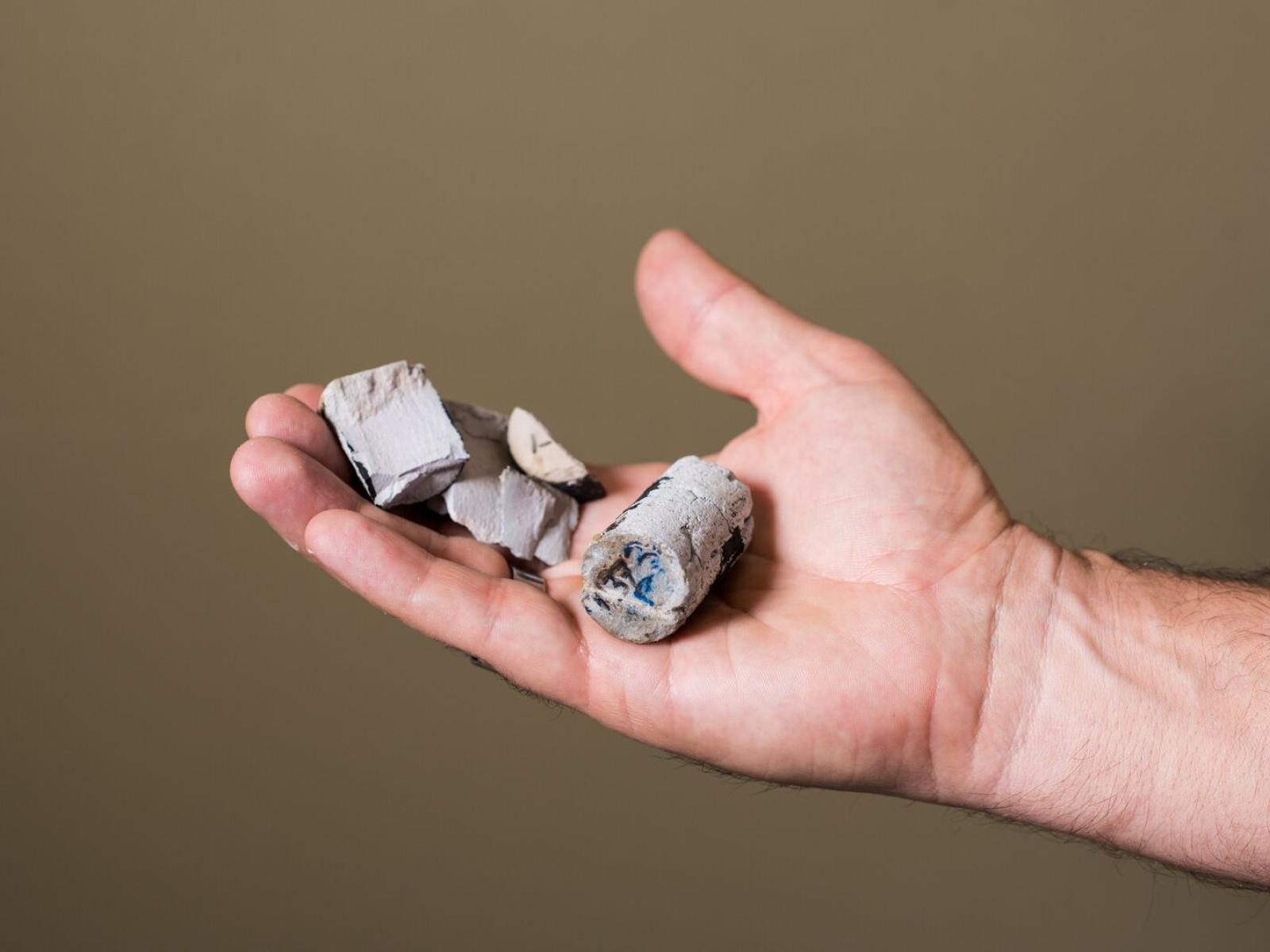
A hand holding blocks of cement

PNNL scientists are adding polymers to cement, creating self-healing and re-adhering properties that extend its lifetime and reduce the risk of failure.

(Photo by Andrea Starr | Pacific Northwest National Laboratory)

A small crack in a slab of concrete may seem harmless. But from critical civilian infrastructure (such as roads and bridges) to critical energy infrastructure (such as wellbores for geothermal energy and fossil fuel extraction), those tiny fractures can spread, let in water, accelerate damage, and lead to costly repairs.  

Now imagine a cement that can begin self-repairing small cracks within an hour—fast enough that a crack formed in the evening could be largely sealed by the next morning. 

Creating self-healing cement 

Researchers at the Department of Energy’s (DOE’s) Pacific Northwest National Laboratory (PNNL) have developed a self-healing cement that uses a tiny amount of polymer to seal cracks quickly and repeatedly. They describe the work in a Nature Communications paper published August 1, 2026. 

“We have designed this cement so that the healing material moves exactly where it is needed when a crack forms,” said Carlos Fernandez, a materials scientist at PNNL and coauthor of the paper. “With only a trace amount of polymer, we achieved rapid crack sealing and substantial strength recovery over repeated damage cycles, which could help concrete infrastructure last longer.” 

He noted that in laboratory studies, the material sealed a roughly 2-millimeter-deep fracture within about four hours—equivalent to a healing rate of about 10 mm per day. For comparison, human fingernails grow by about 3.5 mm per month.  

The team has also repeatedly damaged a test piece over five years and continues to observe the self-healing behavior. 

The cement works through a combination of rapid pore-scale transport and reversible chemical bonding. When a crack opens, polymer stored throughout the material redistributes at the fracture interface and re-bonds to the cement surface—a phenomenon the team describes as “molecular Velcro.” 

A game-changer for critical industries 

Concrete cracks form for many reasons: traffic loads, wind, ground settlement, shrinkage, and repeated swings between hot and cold weather. Even when tiny cracks do not pose an immediate safety risk, they can widen over time, admit water and salts, and shorten the service life of infrastructure, Fernandez said.   

The potential impact can extend far beyond repair costs. Aging and deteriorating concrete infrastructure poses significant safety risks and drives a multibillion-dollar industry dedicated to inspection, maintenance, and repair. By enabling concrete to autonomously heal cracks before they propagate into critical damage, this technology could reduce the frequency of inspections and interventions, enhance structural reliability, and lower the long-term costs associated with maintaining safe and resilient infrastructure. 

In particular, the team—which is supported by the Department of Energy’s Office of Critical Minerals and Energy Innovation, Geothermal Technologies Office, and Office of Fossil Energy and Carbon Management—is looking to provide solutions for cement used in critical domestic energy infrastructure. 

“Cement is used across the energy sector, from dams to wellbores,” Fernandez said. “And when that cement fails, it makes our energy more expensive and less reliable.” 

For instance, Fernandez explained, nearly seven percent of geothermal wells experience wellbore failure, largely stemming from issues with the integrity of the cement under extreme conditions. Those failures lead to exorbitant repair costs and often shorten the lives of the wells. 

“Solving that problem for geothermal wells was our impetus for developing the self-healing cement,” Fernandez added. 

Bringing self-healing cement into the real world 

Fernandez and the team have two granted and two pending patents covering the self-healing cement technology. PNNL is working with research and potential commercialization partners to advance the technology toward market readiness and real-world deployment.  

“Commercialization is the critical step in translating this innovation from a promising laboratory technology into a solution that can make a meaningful impact in the built environment,” said Sara Hunt, senior commercialization manager at PNNL, “We are focused on working with industry partners to validate the technology, address scale-up challenges, and create a pathway to market adoption.”  

Published: September 2, 2026

Research topics