Fusion and Innovation Take Center Stage at PNNL
Attendees of both Fusion Week and the 13th annual Innovation Showcase united at PNNL to chart the milestones leading to a new energy landscape, from boosting the nation’s tritium supply to building commercial-scale fusion reactors.

Networking represented a significant component of both Fusion Week and the Innovation Showcase. Attendees of both events joined in the rooms and corridors of Discovery Hall between workshops and presentations, all with the aim to better develop and deploy burgeoning energy technology.
(Photo by Eddie Pablo | Pacific Northwest National Laboratory)
Researchers and industry leaders gathered in September at the Pacific Northwest National Laboratory (PNNL)-Richland campus to discuss the path toward realizing commercial-scale fusion energy: the process of combining two small atoms to make a larger one, which releases an incredible amount of energy.
Attendees packed the rooms and corridors of Discovery Hall to participate in both Fusion Week and the 13th annual Innovation Showcase, a series of events designed to unite scientists, engineers, and private sector innovators so they may better develop and deploy burgeoning energy technologies like advanced nuclear and fusion reactors, geothermal power facilities, and more. The two events were hosted by PNNL and organized by the CleanTech Alliance: a group of over 1,100 member organizations focused on the widespread adoption of energy technology.
In her opening remarks, Laboratory Director Deb Gracio noted this year marks the first time Fusion Week and the Innovation Summit were held in the Tri-Cities.
“Our region has had an impactful energy history and we stand to play an important role in shaping the country's energy future,” said Gracio. “Scientific discovery has created promising technologies that are only the beginning of where we will go. The real impact comes from moving ideas to demonstration, deployment and use. And that's why we've gathered here today—to help move from innovation to impact.”

The Future of Fusion
The day began with Washington-based fusion companies sharing recently cleared technical milestones. Robin Langtry, the CEO of Avalanche Energy, a growing Richland-based company focused on building compact fusion reactors, spoke first.
“Access to tritium handling and D-T fusion testing infrastructure is a critical step in moving fusion from the laboratory toward commercialization,” said Langtry. “Our Tritium Handling System at FusionWERX will safely store and precisely deliver tritium fuel to fusion machines while recovering, purifying, and recycling unused tritium through a closed-loop fuel cycle. These capabilities will give researchers and industry partners access to specialized infrastructure for testing, validating, and advancing the next generation of fusion technologies.”
A few doors down, another discussion focused on tritium: the rare but essential fusion fuel source valued for its low operating temperature. Stemming from a research investment made decades ago, PNNL is the lead design authority for tritium-producing burnable absorbing rods (TPBARs). Staff at PNNL have designed, fabricated, and evaluated TPBARs for over 25 years for national defense purposes.
TPBARs resemble nuclear fuel rods. Imagine long, thin, metallic tubes. When fed into a reactor, the rods absorb neutrons, which, in turn, transform lithium into tritium. Realizing commercial-scale fusion requires boosting tritium production, and that requires a firm understanding of the degradation mechanisms TPBARs may face inside such reactors. Radiation and high temperatures can alter the microstructure of the components that make up fusion reactors.
That’s where PNNL’s Radiochemical Processing Laboratory—a hazard category 2 nonreactor nuclear research facility—is an essential component of bolstering the nation’s tritium supply chain. RPL is uniquely equipped to allow researchers to explore research questions that inform how best to manage tritium production. In addition to studying the material behavior of TPBARs, PNNL specializes in studying the transport of tritium and hosts the annual Tritium Science Technical Exchange, bringing together collaborators from the national laboratory system and industry.
Other challenges loom on the horizon, such as finding economic materials that can stand up to the task of housing fusion reactions at scale. That’s where PNNL researchers aimed to fill the gap, by applying the unique facilities and capabilities of a national laboratory where they’re needed, so milestones can continue to be cleared and tomorrow’s energy-producing technology can come to full fruition.
In another conference room, PNNL materials scientists led a discussion on which materials could be used to build fusion reactors on a national scale. Staff from Zap Energy, whose focus is on developing modular, fusion-fission hybrid reactors, joined the conversation on compatible materials, noting the nuclear industry once faced and surmounted a similar challenge when building out nuclear reactors decades earlier.
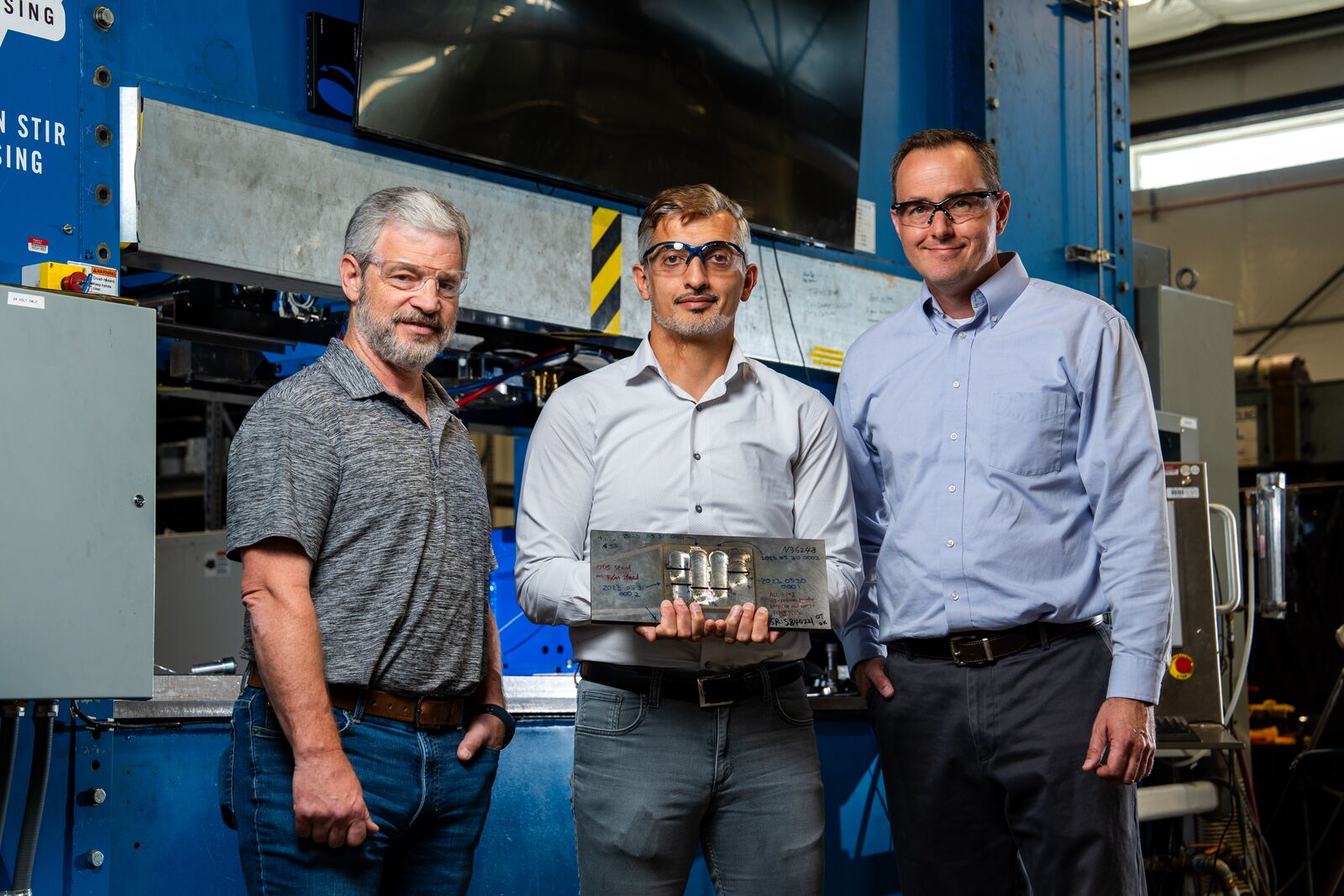
Conversation turned to demonstration later in the day when participants were invited to see PNNL’s ShAPETM machine in action. About the size of a large utility van, a few keystrokes brought the machine whirring to life as it extruded unique blends of alloys, each with distinct properties fit for different tasks. Some end up in the very cars we drive as lightweight auto parts. Others are destined for national security applications.
A PNNL-designed innovation, ShAPE machines can produce such alloys without melting their starting materials—saving energy costs—through a technique known as solid phase processing. The technology could help to identify candidate materials for tomorrow’s fusion reactors.
“If you need a novel alloy that is not available through traditional methods,” said nuclear engineer and Laboratory Fellow Eric Smith in a later presentation, “solid phase processing could be the answer.”
Innovation Lights the Way
Other workshops and discussions during the Innovation Showcase explored a range of technologies, their advantages, and the challenges associated with deploying them. PNNL Earth scientist Hunter Knox, for example, spoke of recent advancements in geothermal power.
“Modern drilling technology has evolved in a way that has unlocked enormous subsurface potential,” said Knox, noting that the cost of drilling was once the top barrier to unlocking geothermal power. “That is now no longer the case,” she added. Reduced costs of subsurface sensors, improved modeling, and an expanded knowledge of subsurface science add to the growing promise of geothermal power production, she added.
Chief geophysicist and Laboratory Fellow Fred Day-Lewis discussed a somewhat hidden aspect of everyday technology: critical minerals. Describing them as the “hidden inputs behind energy, infrastructure, computing, and advanced manufacturing,” Day-Lewis noted the ubiquity of critical minerals in daily life, from the cars we drive to the phones in our pockets. PNNL’s relevant capabilities are equally widespread throughout the critical mineral supply chain, he added, from finding and characterizing the Earth-bound minerals to retrieving them from unconventional sources like waste rock.
Director of Nuclear Energy Programs Mark Nutt touched on PNNL’s long history in sustaining the nation’s nuclear fleet and in accelerating the deployment of advanced nuclear reactors. Much of the underlying technology that allowed the latest generation of reactors to move toward commercialization was developed within the national laboratory system, Nutt added.
Today, PNNL scientists and engineers work a broad range of projects that aid the nuclear industry. Examples include facilitating the restart of shuttered power plants, studying stress corrosion cracking, and developing technologies to reprocess and recycle spent nuclear fuel. In addition to identifying materials to be manufactured for tomorrow’s fusion reactors, PNNL scientists are using ShAPE machines to search for materials that could withstand the extreme environments within nuclear reactors as well.
Laboratory tours included PNNL’s Grid Storage Launchpad, where next-generation energy storage technologies are developed and validated, and the Environmental Molecular Sciences Laboratory, a Department of Energy Office of Science user facility at PNNL where researchers explore how microbes can aid the development of new fuels, medicines, and materials for energy sources, among other facilities. Rounding out two days of involved discussion, networking and planning for the future, those who participated in the event left with new connections to chart the course toward a new energy landscape.
Published: October 22, 2026