DOE Electricity Leader Explores PNNL Innovation
Jereza sees research delivering a secure, reliable U.S. grid

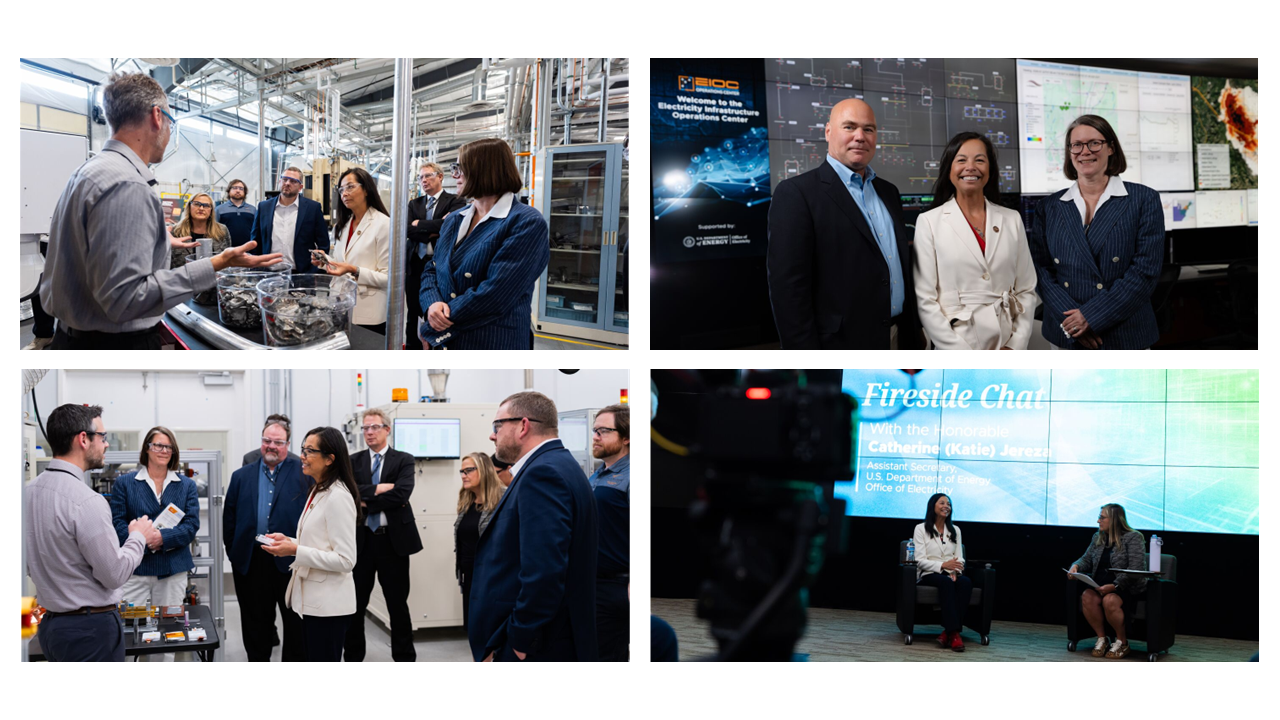
The Honorable Catherine (Katie) Jereza, Assistant Secretary for the U.S. Department of Energy (DOE) Office of Electricity visited Pacific Northwest National Laboratory (PNNL) to see the latest tools and innovations advancing the U.S. electric grid. She and Acting Chief of Staff David Denton explored practical technologies and technical assistance PNNL is leading for utilities, industry, states, and communities.
(Eddie Pablo | Pacific Northwest National Laboratory)
The Honorable Catherine (Katie) Jereza, Assistant Secretary for the U.S. Department of Energy (DOE) Office of Electricity visited Pacific Northwest National Laboratory (PNNL) to see the latest tools and innovations advancing the U.S. electric grid. She and Acting Chief of Staff David Denton explored practical technologies and technical assistance PNNL is leading for utilities, industry, states, and communities.
“This visit reinforced the importance of connecting research to operational needs. PNNL’s testbeds, modeling capabilities, and industry partnerships help move promising technologies beyond pilots and toward utility-grade solutions that perform reliably in the field,” said Kevin Schneider, manager of PNNL’s Office of Electricity Subsector.
Touring PNNL facilities that are making grid impacts
One of the stops on the visit was PNNL’s Applied Engineering Laboratory, where researchers demonstrated ShAPE: Shear Assisted Processing and Extrusion technology, specifically, how to extrude an ultra-conductor wire that will then be used to build a power transformer. This award-winning advanced manufacturing technique uses frictional heating and deformation to make higher-performance components more efficiently than conventional extrusion. Its ability to use lower-cost, domestically sourced materials could also help strengthen U.S. supply chains.
At the Electricity Infrastructure Operations Center, Assistant Secretary Jereza saw how PNNL combines real-time data, system modeling, and operational expertise to help the electrical power industry address the evolving grid conditions. The conversations focused on wildfire resilience, cooperation with the Bonneville Power Administration and other industry partners, large-load dynamics, next-generation AI-enhanced operations, and improved information sharing.
Then, at the Grid Storage Launchpad, she toured laboratories supporting battery development, cell manufacturing, and rigorous testing and validation of fundamental materials and system prototyping. The visit highlighted how PNNL helps build confidence in emerging battery technologies and supports their transition from research to domestic manufacturing.
Concluding the tour, Assistant Secretary Jereza commented that PNNL’s strength lies not only in developing innovative technologies but also in testing and validating them so utilities can deploy them with confidence.
“From ideation [and] material science, to how we manufacture and then how we validate that performance so that when utilities need to adopt it, they have the confidence they need that it will perform in a reliable, affordable way,” said Assistant Secretary Jereza.
The visit reinforced alignment between DOE and PNNL while highlighting opportunities to turn laboratory innovations into tangible benefits for the nation’s electric grid.
Published: October 1, 2026