Critical Minerals and Materials Replacement
What is critical minerals and materials replacement?
Replacement of critical minerals and materials (CMMs) describes efforts to reduce, avoid, or even eliminate reliance on CMMs. In the context of the energy sector, CMM replacement encompasses a wide range of diverse approaches, from fabricating new materials that can substitute CMMs in existing applications to developing new technologies that require little to no CMMs.
Pacific Northwest National Laboratory (PNNL) is advancing this mission by tackling this challenge from all angles—through strategic research in materials sciences, advanced manufacturing, energy storage, and more.
What are critical minerals and materials?
CMMs are minerals, elements, or substances that are important to the economy or national security because of their essential role in one or more major sectors and are also vulnerable to supply chain changes and disruptions. CMMs are used in a wide range of industries, including energy storage, grids, electronics, medicine, and aerospace.
Different sectors may vary in terms of which minerals and materials they assign critical status. The U.S. Department of the Interior, through the U.S. Geological Survey, maintains a list identifying which minerals and materials are considered critical. Most recently, its 2025 List of Critical Minerals identifies 60 minerals deemed “vital to the U.S. economy and national security that face potential risks from disrupted supply chains.” Similarly, in 2023, the Department of Energy published its own assessment of 38 raw minerals and fabricated materials that it deems critical to the energy sector. Aluminum, copper, cobalt, lithium, nickel, and uranium are a few examples of the major CMMs that underpin some of the most valuable and prevalent U.S. technologies.
Note that CMMs are not the same as rare minerals or rare earth elements. A mineral or material can be in abundant supply but still be classed as “critical” because of factors like the scope and importance of the applications that require that material, the extent of reliance on global supply chains, the diversity of sources relied upon, relationships with exporting countries, and how difficult the mineral or material is to substitute.
CMM replacement strategies
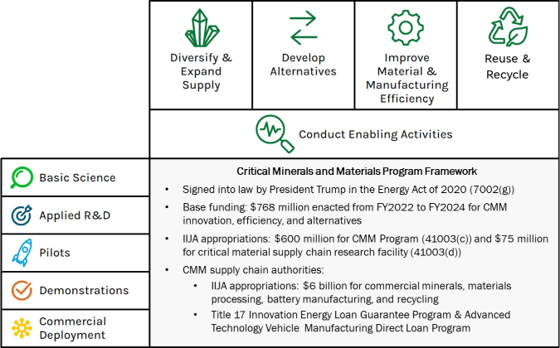
In many cases, CMM replacement involves redesigning existing technologies so that they require less of a given material, finding ways to recycle CMMs to minimize the need for new supplies, or developing new technologies altogether, like advanced manufacturing technologies, that rely on a different material that is more abundant, lower cost, or locally sourced.

Beyond CMM replacement, the Department of Energy is also exploring other strategies for reducing reliance on critical materials. One is supply diversification , which aims to expand the nation’s sources of CMMs to reduce the risk of supply chain disruptions. Another is reusing critical materials or sourcing them from waste.
Why should we replace CMMs?
Relying heavily on other countries or a small number of suppliers to provide, process, or refine CMMs for use in high-impact technologies increases economic and national security risks. Moreover, the demand for CMMs is continually increasing, which exacerbates this issue. Finding ways to reduce this reliance helps bolster U.S. supply chain resilience.
To understand how important it is to replace CMMs, take a look at lithium batteries, which are essential for powering a vast array of technologies, from smartphones and computers to large-scale energy storage systems that keep the power grid stable. As the name suggests, lithium batteries require lithium. They also often require graphite for their anodes and other critical minerals for their cathodes, such as cobalt, nickel, or manganese, depending on their chemistry.
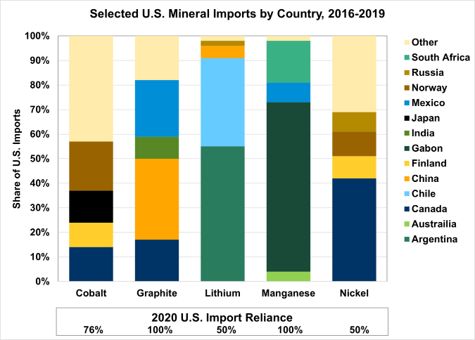
According to a 2022 analysis by the Department of Energy, in 2020, the United States relied on imports for 100% of its graphite and manganese, 76% of its cobalt, and around 50% of its lithium, often from a select few countries (over 90% of the lithium imports came from Argentina and Chile alone during 2016–2019). Considering that the same assessment projected that U.S. demand for lithium batteries would increase by 6× from 2023 to 2030, this reliance could lead to higher costs and deployment risks for energy storage devices and renewable energy technologies in the United States.
Can all CMMs be replaced?
No, not all CMMs can be replaced. Many minerals have physical and chemical properties that make them incredibly technically challenging, labor-intensive, and cost-intensive to completely substitute at adequate performance and scale. Whether a CMM can be replaced depends on the specific technology or application it’s used for. Tungsten, for example, has the highest melting point of all pure metals, meaning it is particularly valuable and difficult to replace in applications involving extremely high temperatures, such as furnaces and rocket engine parts.
However, some minerals share very similar chemical structures, enabling substitution with relatively straightforward modifications to the product design, operation, or manufacturing process. A good example is lithium-ion batteries vs. sodium-ion batteries. Charged ions pass between electrodes in the battery in a similar way whether lithium or sodium is used. While the manufacturing requirements and performance of these two battery types may vary somewhat, this is one of the simpler examples of CMM substitution.
Challenges of replacing CMMs
CMM replacement is an ongoing effort requiring immense resources. And even when researchers develop solutions, obstacles can stand in the way of making the replacement a reality.
- Time required: One of the biggest challenges for CMM replacement is the time required; it can take several years to develop new technologies or manufacturing methods, build industry confidence in them, and validate their long-term performance under real operating conditions.
- Updates to policy and infrastructure: Even when new mineral processing or refining technologies are developed, progress can be stalled by the need for updates to existing infrastructure or national policy to facilitate widespread adoption, such as the implementation of new certification and permitting requirements, adoption incentives, or new manufacturing or refinement facilities.
- Costs: Developing new manufacturing methods, materials, and technologies requires substantial investment, especially at the large scale required to address national demand for CMMs.
- Dependency on new materials: For solutions involving CMM substitution or reduction, analysis is necessary to determine whether new supply chain risks exist for the replacement materials.
How PNNL is advancing CMM replacement
PNNL is making valuable contributions to the nation’s mission to replace CMMs with more abundant and easily accessible minerals and materials through research in materials sciences and several other key areas.
- Precision material design: Researchers at PNNL combine theoretical knowledge with advanced computational and experimental capabilities to synthesize new materials for applications in various industries, which can include suitable materials for replacing CMMs.
- Material processing research: In contrast to making chemically unique materials from scratch to replace CMMs, material processing research at PNNL seeks new ways to process existing non-critical materials so that they can be used as substitutes for CMMs.
- Smart Advanced Manufacturing (SAM) program: The aim of this PNNL program is to develop new manufacturing techniques that can use low-cost, abundant materials rather than CMMs.
- Shear Assisted Processing and Extrusion (ShAPE): This innovative manufacturing technique was developed by PNNL researchers as part of the SAM program.
- New battery designs: PNNL has recently made great strides in reducing or eliminating the need for CMMs in batteries. The Department of Energy’s Transportation Technologies Office awarded Dongping Lu a Distinguished Achievement Award for advancing high-performance lithium-sulfur batteries and granted a Team Award to a cross-institution team involving PNNL researchers for their work in reducing the need for rhodium in catalytic converters.
- Grid Storage Launchpad (GSL): The GSL is a $75 million research facility funded by the Department of Energy Office of Electricity that provides a testing ground for the latest large-scale energy storage technologies. Battery technologies are a major source of demand for CMMs in the United States, and the GSL helps accelerate the deployment of new energy storage devices that are made with low-CMM alternative materials.
