Transition zones shape coastal soil chemistry and ecosystem change
Exploring how shifting boundaries between upland and wetland areas influence soil processes and signal early ecosystem transformations

The Science
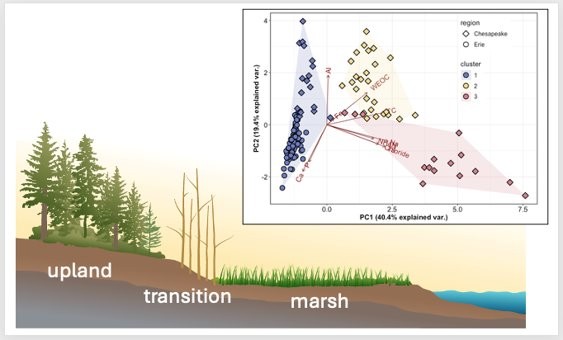
Coastal soils are important for storing and cycling nutrients like carbon, phosphorus, and iron, but because of rapid changes in water level and salinity, these soils are not well understood. We studied coastal soils in Lake Erie and Chesapeake Bay, focusing on the “transition” soils that occur between wetland marshes and dry, upland forests. Salt-related factors like sodium and chloride content strongly influenced soils in both regions, which is surprising for the freshwater soils in Lake Erie. Transition zones between forests and marshes did not behave as expected, showing surprising and complex patterns for nutrients. These transition soils may act as hotspots for chemical change, which may be precursors to changes in entire ecosystems.
The Impact
Our findings highlight where ecosystems are most affected by changing salinity and water levels. We show that soils in transition zones are not just a middle ground between marsh and forest, but unique hotspots that affect how carbon and other nutrients move through the ecosystem. This is the first detailed, multi-region comparison of soils across upland, transition, and marsh zones. Our work highlights a small set of key elements, like carbon, phosphorus, iron, and aluminum, that future studies should measure. These insights will improve ecosystem monitoring and modeling, and guide conservation and restoration planning.
Summary
Coastal soils are highly dynamic and play an outsized role in global biogeochemical cycles. We investigated soil chemistry across upland–transition–marsh transects in two contrasting systems: freshwater Lake Erie and estuarine Chesapeake Bay. Multivariate analysis showed that region explained the greatest variability in soil chemistry, with salinity-related analytes driving patterns in both freshwater and saltwater systems. Contrary to expectations, transition zones were not always intermediate between endmembers. Instead, certain analytes such as phosphorus, iron, and water-extractable carbon peaked in transition soils, identifying them as hotspots of chemical activity.
Our results reveal that transition zones cannot be assumed to behave like simple blends of uplands and wetlands. Identifying priority analytes such as carbon, phosphorus, iron, and aluminum provides a framework for transferable indicators across coastal regions. These findings underscore the need to explicitly include transition zones in ecological models, as they represent early signals of ecosystem shifts like ghost forest formation and marsh migration. This work advances predictive understanding of coastal terrestrial–aquatic interfaces and informs future monitoring, modeling, and management strategies.
Contact
Kaizad Patel, Pacific Northwest National Laboratory, kaizad.patel@pnnl.gov; (509) 372-4242
Vanessa Bailey, Pacific Northwest National Laboratory, vanessa.bailey@pnnl.gov
Daniel Stover, Environmental System Science, Daniel.Stover@science.doe.gov
Funding
This research was supported by the Coastal Observations, Mechanisms, and Predictions Across Systems and Scales, Field, Measurements, and Experiments multi-institutional project. COMPASS-FME is supported by the Department of Energy (DOE), Office of Science, Biological and Environmental Research program as part of the Environmental System Science program, and by the Smithsonian Environmental Research Center. The Pacific Northwest National Laboratory is operated for DOE by Battelle Memorial Institute.
Related Links
Published: September 4, 2026
Patel, K. F., Malhotra, A., Norris, C. G., McKever, S. A., Fields, D. M., Musci, J. I., et al. (2025). Transition zones at the changing coastal terrestrial-aquatic interface. Journal of Geophysical Research: Biogeosciences, 130, e2025JG008978. DOI: 10.1029/2025JG008978