Gaining Research Insights Beyond the Classroom
Interns are supporting nuclear security mission with their diverse backgrounds
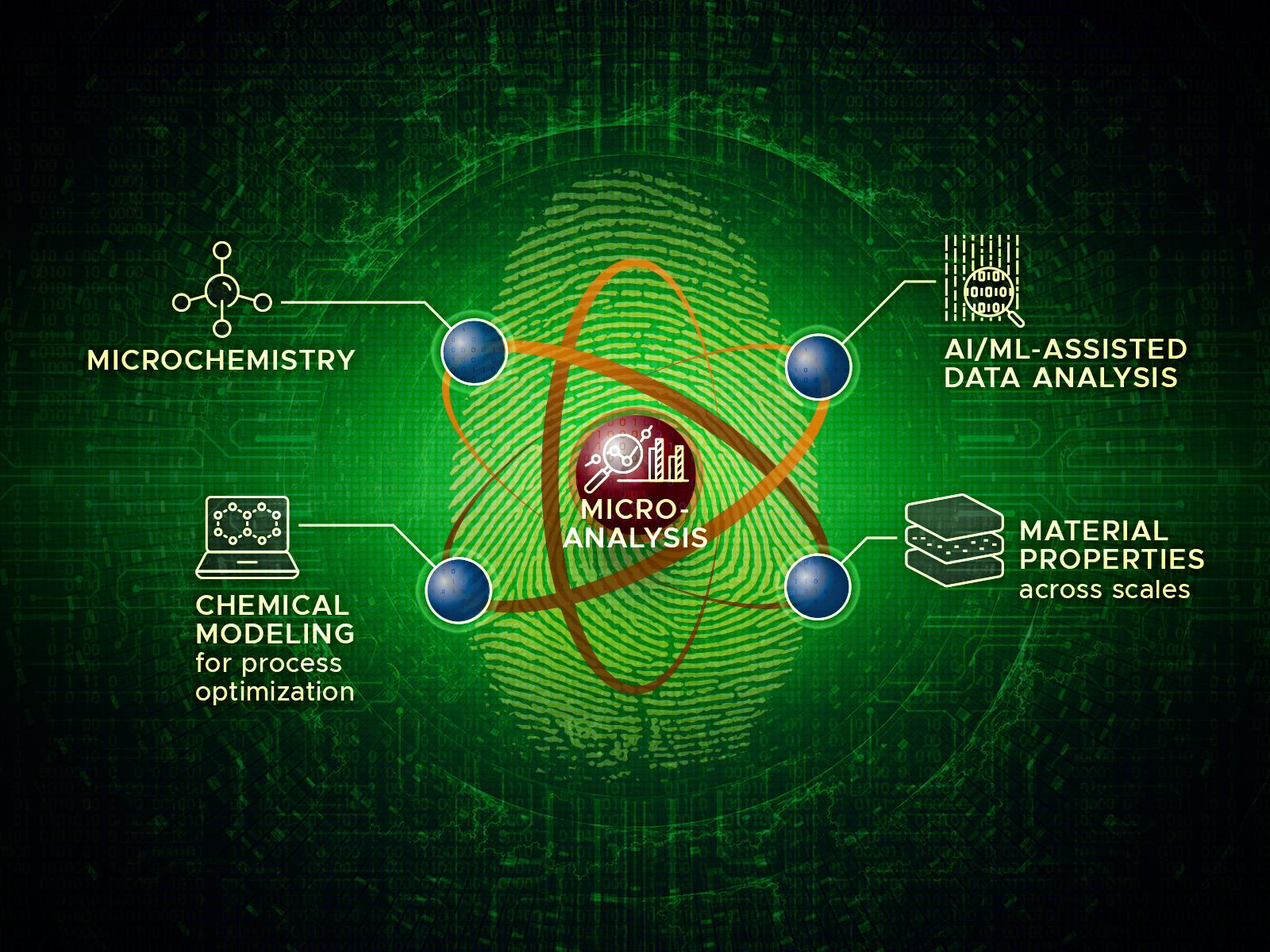
Interns are important members of the Nuclear Forensics Transformational Innovation (NFTI) Initiative team.
(Graphic by Chris DeGraaf | Pacific Northwest National Laboratory)
Every summer, interns are seamlessly weaved into hundreds of research projects across Pacific Northwest National Laboratory (PNNL). This year, the Nuclear Forensics Transformational Innovation (NFTI) Initiative tapped into the passion and dedication of seven interns, four of whom are doctoral students.
Thomas Komay, Ian Parzyszek, Hannah Patz, and Michael Romero are leveraging their backgrounds in radiochemistry, math, and nuclear engineering to advance NFTI projects. As PhD interns, they gained a deeper understanding of nuclear forensics and expanded their mindsets on potential career paths.
University partnerships

The Consortium for Nuclear Forensics is a collaboration with 17 universities and seven national laboratories, including PNNL. Both Komay (University of Nevada, Las Vegas) and Patz (University of Florida) became interns through the consortium and have spent the past two and three summers, respectively, at PNNL.
Each year, Patz has delved deeper into the Microsample Identification with advanced digital autoRAdiography (MIRA) project, publishing a journal article on advances in autoradiography systems. Three years in, she describes to her non-technical family and friends that she’s “taking pictures of things you can’t see with your eyes but with a camera that can, using a flash of light, so we can see if the samples are radioactive.”
“I’ve always wanted to be a scientist,” said Patz, who believes her curiosity and questions blend perfectly with her career path. “Anything related to nuclear national security, I love because it’s so multidisciplinary.”
Komay has supported two NFTI projects during the past two years, working on measuring trace isotopes using a triple quadrupole and time-of-flight mass spectrometer while also analyzing data for the plasma team.

Unlike Patz, who is planning a career at a national laboratory, Komay is unsure where his future lies, but the benefits of his internships have been rewarding.
“The best part is getting to work with the best equipment and the best people who work with that equipment, essentially the best minds working on the best equipment,” he said. “To be a part of the conversations and projects, just experiencing that has been the most important learning experience.”
Komay and Patz continue collaborating with PNNL during the academic year through the Consortium for Nuclear Forensics.
PNNL connections
Both Parzyszek (Iowa State University) and Romero (Pennsylvania State University) came to PNNL through their university advisors, who have collaborated with PNNL researchers.
Not intensely familiar with nuclear forensics, Parzyszek used his background in math, statistics, and forensic evidence to build machine learning models for his NFTI project team. Having worked in industry, he quickly appreciated the culture at PNNL.
“Working in a PNNL environment, there is such a team focus and space to learn,” said Parzyszek. “I appreciate that there’s a lot of space for growth and time to learn here.”
Shortly after his internship started, Romero was helping analyze swipe samples using a mass spectrometer. He even had a chance to work on PNNL’s newest mass spectrometer, the Sapphire 1700.
With both parents as civil engineers, Romero knew he was destined to be an engineer too. Yet, his interest in nuclear engineering set him apart.
“I had heard about it [nuclear engineering], thought it sounded cool, and compared to a lot of other fields, it works on a whole different scale that was interesting,” he said. “When you look at forces inside a nucleus, there’s a magnitude of power that you can’t even imagine.”
For Romero, what made his internship unique is the size of the collaborative environment. At his university, there might be four people who work in his area, while at PNNL, “there are a lot more people you can talk to about problems” that you encounter in your research.
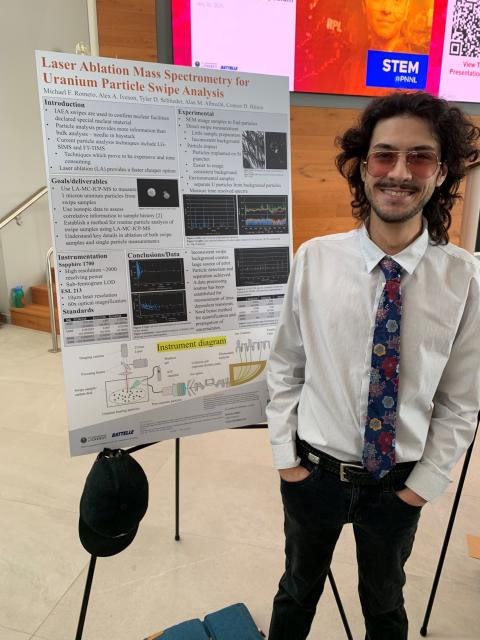
To culminate his internship, Romero presented his work during the Intern Research Symposium. His poster was titled “Laser Ablation Mass Spectrometry for Uranium Particle Swipe Analysis.”
Parzyszek continues his internship during the school year.
Throughout their internships, these interns worked closely with PNNL’s leading experts in nuclear forensics to support several NFTI goals:
- Update the material analysis process for nuclear forensics to decrease analysis timelines
- Create a larger, more robust, and more internationally recognized nuclear forensics capability
- Develop methods to identify and extract microsamples from bulk material and optimize chemical processing steps in real time
- Employ data processing and advanced analytics to identify and report data more quickly than previously available.
NFTI is funded internally through the Laboratory Directed Research and Development program.
Published: October 16, 2026