A First Appointment with Lasting Impact
Yong Wang’s joint appointment connects PNNL, WSU, and the next generation of scientists
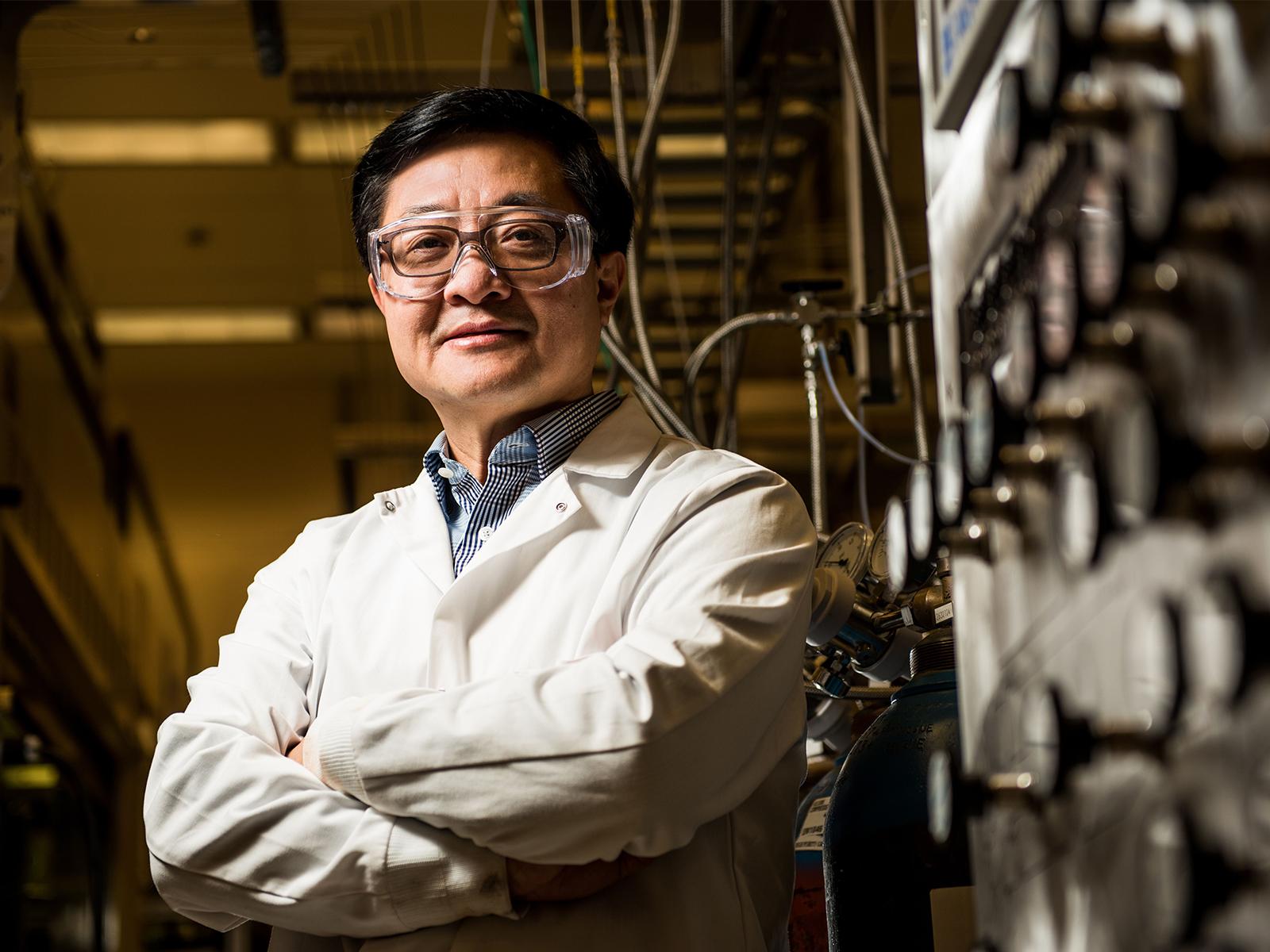
Yong Wang, director for the Institute for Integrated Catalysis at Pacific Northwest National Laboratory, was the first ever joint appointee at Pacific Northwest National Laboratory. Wang is retiring from the Lab on September 14, 2026.
(Photo by Andrea Starr | Pacific Northwest National Laboratory)
There was a plan for Yong Wang’s career, just not one he made himself.
Wang came to Washington State University (WSU) as a student largely because his cousin was already there. He arrived at Pacific Northwest National Laboratory (PNNL) because his PhD thesis advisor Bill Thomson spoke highly of his ambition. And he became the institution’s first joint appointee because both PNNL and WSU recognized the value of his expertise and saw an opportunity to benefit from his contributions to both institutions, working creatively together to make the arrangement possible.
Looking back, Wang sees a pattern in those turns—doors opened for him, often unexpectedly, and he was willing to walk through them.
“It was never that I wasn’t determined to pursue these opportunities,” Wang said. “I think the best way to describe it is that people chose me.”
That doesn’t mean that Wang’s career was coincidental. He brought ambition, persistence, and a willingness to make the most of every opportunity. But many of the moments that shaped his path began with someone else seeing something in him, and Wang turning that nudge into a career that would go beyond PNNL and WSU, with national and international awards in catalysis, reaction engineering, and applied chemistry; an elected membership at the National Academy of Engineering; and eventually leadership of PNNL’s Institute for Integrated Catalysis.
“I was very fortunate to benefit from the best part of both the university and the national lab,” Wang said.
Now, as he prepares to retire from PNNL, Wang leaves behind a career that has connected two institutions, advanced catalysis research, and mentored the next generation of scientists.
A fortunate choice
Wang knew very little about Pullman or WSU when he applied to graduate programs at universities in the United States. What he did know was that his cousin was studying at WSU and working as an assistant coach for the university’s track and field team.
Growing up in Kunming, China, the move was a culture shock. Wang arrived in January, coming from a place known as the “City of Eternal Spring.” Pullman was smaller, colder, and covered in snow.
But WSU became the place where Wang built his scientific foundation, earning his master’s and doctoral degrees in chemical engineering.
Years later, when people asked why he had chosen WSU for graduate school, Wang would give an answer that revealed how different he viewed his own career.
“I didn’t choose it,” he said. “I think it’s that I was fortunate that WSU chose me.”
A position that didn’t exist
After earning his PhD in 1993, Wang had multiple job offers, including positions in industry and consulting. However, Thomson saw a different path for him.
Thomson urged Wang to pursue research at PNNL, even though there was no position waiting for him, and contacted PNNL leadership to push the Lab to find a way to bring Wang onboard. Several principal investigators eventually pooled resources to create a postdoctoral position.
It was an unusual beginning, but it put Wang in the orbit of three scientists who would become important mentors: Jud Virden, Todd Warpe, and Bruce Bunker.
“I was probably one of the luckiest to work with those three brilliant people,” said Wang.
Virden, now the laboratory director and alliance president at National Laboratory of the Rockies, remembers early-career Wang well.
“I am so fortunate to have shared a career at PNNL with Yong, since the day he joined the Lab,” Virden said. “From day one he has been creative, thoughtful, and always kind to others.”
Wang became a staff member at PNNL in 1996 and went on to lead the Catalysis and Reaction Engineering team from 2000 to 2007, became a Laboratory Fellow in 2005, and built an Applied Catalysis team of more than 20 researchers. That work helped lay the foundation for what would become a core part of PNNL’s Institution for Integrated Catalysis.
The opportunity Wang almost didn’t take
For much of his early career, Wang did not imagine becoming a university professor. In fact, his PhD advisor had once advised him against it. That changed in 2009.
WSU received an unprecedented $17.5 million gift from Gene and Linda Voiland to transform its chemical engineering program. University leaders wanted to build a national reputation in catalysis, an area they saw as strategically important but underrepresented in chemical engineering programs.
Jim Petersen, a retired former leader in WSU’s chemical engineering program, saw an opportunity to build on the long-standing relationship between WSU and PNNL.
“Yong was the ideal candidate for the initial WSU and PNNL Joint Appointment and as the initial Voiland Distinguished Professor,” Petersen said. “He possessed a deep love for both PNNL and WSU, he worked in an area that PNNL had identified as strategically important for both institutions, the State and the National, and he was an outstanding scholar.”
WSU asked him to recommend internationally recognized researchers who could help elevate its chemical engineering program. When those candidates weren’t recruited, university leaders asked why he hadn’t included himself.
“No, I’m not good enough,” Wang told them.
There was another obstacle. Wang’s wife worked at PNNL, his two daughters were in school in the Tri-Cities, and they did not want to move to Pullman. Instead of ending the conversation, WSU leaders asked whether they could be creative. The answer became PNNL’s first joint appointment.
Petersen saw an opportunity to build on the long-standing relationship between WSU and PNNL, which had seen generations of WSU chemical engineering graduates go on to work at Hanford and PNNL. Both institutions agreed to try something new.

The best of both worlds
The arrangement was not easy. Wang describes the joint appointment as essentially turning one full-time job into two. At PNNL, he continued raising funding, writing proposals, and supporting colleagues. At WSU, he was responsible for students, research funding, safety, and the operation of a research group.
The two institutions also had to account for the distance between them. Wang remained based at PNNL, while WSU created a research faculty position to help manage the day-to-day operations of his group in Pullman.
But over time, Wang realized that the arrangement’s challenges were also its greatest strength.
At PNNL, he had access to scientists across disciplines, advanced instrumentation, and a collaborative environment. At WSU, he had students who could pursue questions in greater depth.
The results were substantial.
During his joint appointment, Wang coauthored more than 300 publications with PNNL researchers and helped create a pathway for sustained collaboration between the university and national laboratory. Twelve PhD students conducted research at PNNL under his guidance, gaining experience that combined university research with the capabilities of a national laboratory. The pathway he helped establish has continued to expand, supporting dozens of joint appointments and inbound researchers, as well as more than 100 staff at PNNL who have pursued collaborative research opportunities with universities. Through these connections, Wang’s impact has extended well beyond his own research, benefiting students, researchers, and programs across both institutions.
“Yong Wang has been highly successful at bridging catalysis capabilities between PNNL and WSU to advance developments in biochemicals and biofuels production, and vehicle emissions aftertreatment,” said Charles Freeman, PNNL group leader for Advanced Energy Systems and Wang’s line manager. “As a joint appointee, Yong has mentored many dozens of WSU graduate students and PNNL staff members—a number of which have gone on to become nationally recognized in the field of catalysis, with leadership positions that span academia, industry, and the national laboratories.”
Wang also helped extend the model he pioneers, successfully nominating three staff members at PNNL for joint appointments at WSU.

A career that took off
The joint appointment Wang expected to leave after three years became the period he credits with accelerating his career.
At WSU, he was promoted to a Regents Professor in 2022. At PNNL, he eventually became director of the Institute for Integrated Catalysis in 2025. His scientific record includes more than 480 peer-reviewed publications, 111 United States patents, and more than 300 invited lectures (plenary, keynote, etc.).
Yet Wang doesn’t describe that trajectory as the result of a master plan.
When he recently reflected on his career while updating his resume, he noticed something striking.
“In terms of productivity, after I took this joint appointment, my career just took off,” he said. “I think it was due to the fact that I was fortunate to benefit from the best part of both the university and the national lab.”
The arrangement lasted not three years but rather until his retirement in September of 2026.
Keeping the door open
Wang’s decision to retire from his PNNL role took more than two years of deliberation. As his parents’ only child, he ultimately decided to spend more time with them. He expects to remain based in Seattle, where his daughters live, while spending more time in China, where his parents still reside.
Wang describes his next chapter as a form of “pseudo retirement,” where he will continue working with his remaining PhD students and transition into a role as an Regents Professor Emeritus.
When he was asked what he will miss most, his answer was resolute.
“Absolutely the people,” he said. “I have been very fortunate to be working with great people, and they are the ones making me smarter and better than I am.”
Virden sees that quality as central to Wang’s legacy.
“He always cared deeply about the people around him, mentoring others, and distinguishing PNNL through outstanding science and innovations that have impacted the world,” Virden said.
That may be the clearest way to understand Wang’s career.
What looked from the outside like a remarkably purposeful career was built through a series of fortunate turns met with deliberate, competent, and brave scientific pursuit.
Again and again, when doors opened, Wang walked through them and built something positive for the people who came after him.
Wang’s last day at PNNL will be September 14, 2026.
Published: September 11, 2026