Expanding Fish-Tracking Possibilities by Shrinking Tag Technologies
PNNL’s miniaturized acoustic transmitter expands tracking to smaller fish, giving researchers data that can inform fish passage and hydropower operations

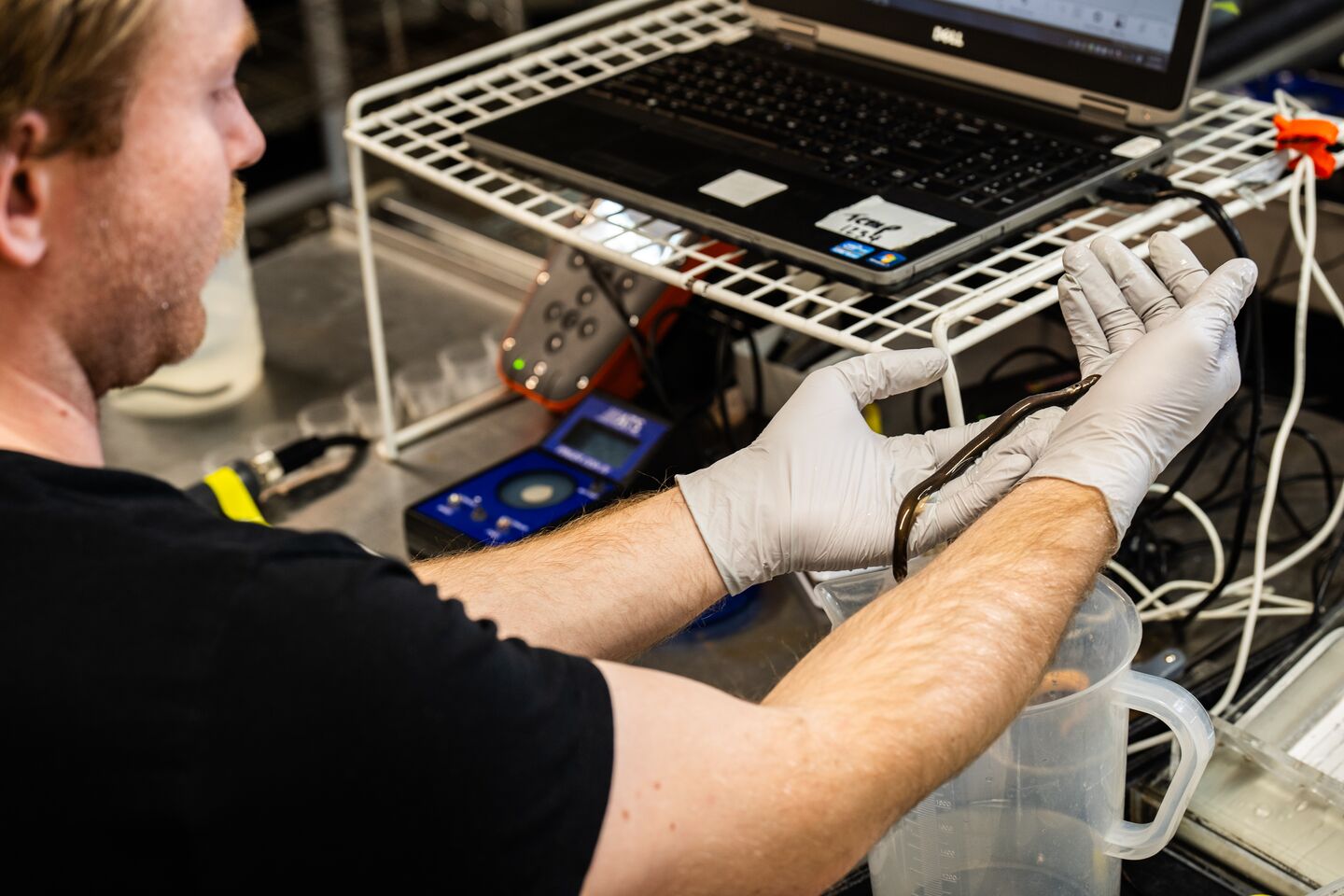
Daniel Deng holds a tiny eel/lamprey tag his team developed for the Army Corps of Engineers and the Department of Energy.
(Photo by Andrea Starr | Pacific Northwest National Laboratory)
For decades, researchers have used acoustic tags to understand where fish go, how they move, and how they pass through rivers, reservoirs, and hydropower systems. Tracking tagged fish can reveal more about their populations and life history and, at hydropower facilities, provide information about when and how fish move through dams and spillways. This data can inform decisions about water routing and spill operations, helping hydropower operators consider fish passage alongside power generation. Acoustic tracking has long come with a practical limitation: Many transmitters have simply been too large for some of the fish researchers want to study.
Researchers at Pacific Northwest National Laboratory (PNNL) developed the Eel/Lamprey Acoustic Transmitter (ELAT) to help close a research gap for important fish that have been difficult to study because of the large size of existing acoustic tags. The tag itself weighs less than a paper clip and is small enough to be implanted in juvenile lamprey, eels, and other small fish previously out of consideration for active acoustic tracking studies.
The small size and slender, snake-like body shape of juvenile eels and lamprey make conventional acoustic tags difficult to insert or attach. Standard tagging guidance generally suggests a tag be no more than 2 percent of a fish’s body weight, a threshold intended to protect fish welfare. For perspective, that standard paper clip mentioned earlier weighs only about 1 gram. Therefore, an acoustic tag of that weight generally requires a fish of at least 50 grams—a threshold that the fish targeted for this work may not always meet. For lamprey and other slender fish, weight is only part of the challenge. Body size and shape can be just as limiting. A smaller body circumference requires the transmitter to be smaller as well. The same challenge affects other small-bodied fish that have been difficult to study with acoustic telemetry because they cannot safely carry larger transmitters.

The Department of Energy (DOE) Hydropower and Hydrokinetic Office (H2O) and the U.S. Army Corps of Engineers co-funded PNNL’s development and demonstration of ELAT, supporting the research needed to miniaturize acoustic tag technology for juvenile lamprey and eels. The work focused on tracking juvenile lamprey and eels from the outset, and ELAT is now being adapted for other small fish.
PNNL researcher Daniel Deng said, “ELAT was not just a miniaturization challenge. Developing a tag this small required a highly multidisciplinary approach, bringing together expertise in battery development, electronics, underwater acoustics, piezoelectric transducers, packaging, implantation methods, laboratory testing, and field validation. We were fortunate to draw on PNNL’s broad engineering and scientific expertise to create a tag small enough for juvenile lamprey and other small fish while maintaining the reliability needed in real-world aquatic environments.”
National laboratories can advance early-stage technologies that require sustained, multidisciplinary research before they are ready for commercial adoption and broader use.
From technology development and demonstration to market adoption
PNNL collected laboratory and field data on ELAT’s performance as part of the technology demonstration. The next challenge was making it available beyond the laboratory.
PNNL also partnered with tracking industry manufacturer Advanced Telemetry Systems (ATS), which brought the customer base and field telemetry experience needed to help move ELAT into wider use by researchers, consultants, and hydropower-related owners and operators. ATS describes ELAT as having potential applications for safely tagging small fish and tracking a wide variety of species. ATS lists the injectable, Juvenile Salmon Acoustic Telemetry System (JSATS)-compatible tag at 0.08 grams, with more than 65,000 possible unique code IDs.
PNNL developed and demonstrated the technology and then granted ATS a commercial use license for ELAT to help move the capability toward larger-scale manufacturing and customer support and broader use across different species and aquatic systems.
A small tag with a big technology-transfer story
The development of ELAT shows how national laboratories and industry can play complementary roles in moving new technologies toward broader use. PNNL took on the technically intensive research and development needed to advance the technology and reduce technical risk. When laboratories fulfill this role, industry partners can then bring the manufacturing capabilities, customer support, and market experience needed to move demonstrated technologies into wider use. Licensing technologies like ELAT provides one pathway for federally funded research to move from the laboratory into practical application.
“Innovations like ELAT demonstrate how DOE-funded research can deliver real-world impact when paired with the right commercialization strategy. By partnering with industry, we help transition breakthrough technologies from the laboratory into practical tools that support environmental stewardship and strengthen our nation’s energy infrastructure,” said Sara Hunt, senior commercialization manager in the Office of Collaboration and Commercialization at PNNL.
The path from research on juvenile lamprey and eels to a commercially available ELAT tag is about more than making technology smaller. By extending acoustic tracking to juvenile lamprey, eels, and other small fish, ELAT gives researchers a way to study species that have been difficult to track with conventional transmitters. Moving the technology into commercial use can expand access to that capability, helping researchers collect information that can improve understanding of fish movement through rivers and hydropower systems.
ELAT development was funded by PNNL's Laboratory Directed Research and Development program, the U.S. Army Corps of Engineers, and the DOE H2O.
Published: October 16, 2026