September 10, 2026
Research Highlight

Evaluating Rossby Wave Dynamics in Dynamical Downscaling Over North America

Quasi-stationary Rossby waves shape North American temperature extremes, but higher model resolution does not always improve their modeled representation
Wave Dynamics highlight hero

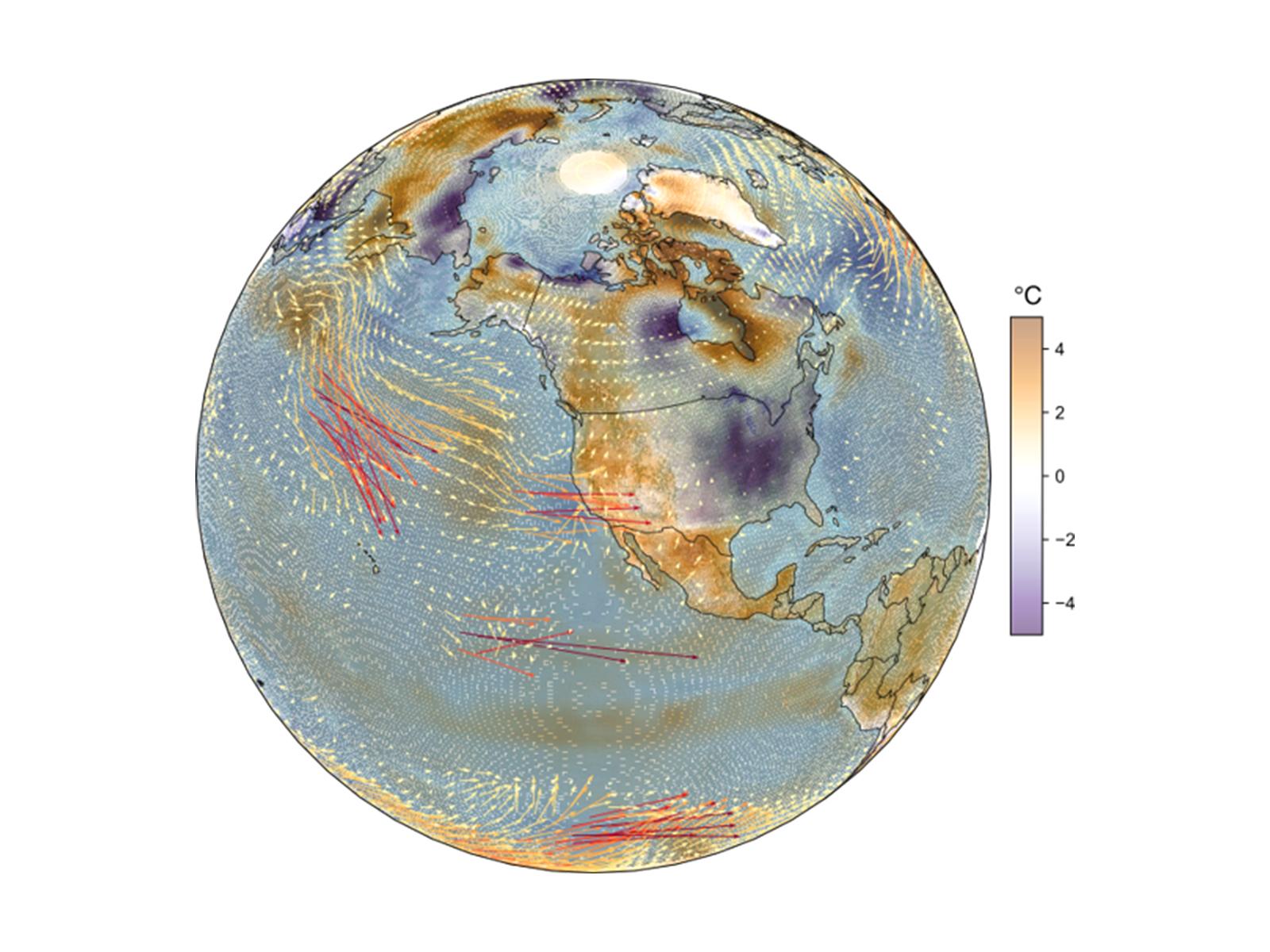
Wave energy/activity flux of Rossby waves (arrows) and daily-mean temperature anomaly (color shading) on July 24, 2009, during the Pacific Northwest heatwave (data: ERA-Interim)

The Science 

Quasi-stationary Rossby waves strongly influence summer atmospheric circulation and temperature extremes across North America, but these large-scale dynamics are rarely evaluated in regional downscaling simulations. Researchers evaluated three downscaling approaches: RegCM4 with lateral boundary forcing only, WRF with spectral nudging, and the global variable-resolution CAM-MPAS model. Using Rossby wave ray tracing and wave activity diagnostics, the team assessed how well each framework reproduced Rossby wave propagation pathways and how those pathways related to surface air temperature anomalies and heatwaves.

The Impact 

The study showed that biases in upper-level circulation patterns altered Rossby wave propagation into North America, weakening the simulated connection between large-scale atmospheric forcing and regional temperature extremes. The WRF simulation using spectral nudging to constrain the large-scale circulation most accurately reproduced observed Rossby wave pathways, wave activity convergence, and associated temperature responses. The results demonstrated that finer resolution alone was insufficient and that maintaining realistic large-scale atmospheric dynamics was also essential for credible regional downscaling simulations of temperature extremes.

Summary 

Researchers evaluated how three dynamical downscaling approaches simulated quasi-stationary Rossby waves and their influence on North American summer temperature extremes. The analysis compared three approaches with the ERA-Interim reanalysis: RegCM4, a regional model using only lateral boundary conditions; WRF, a regional model using spectral nudging to constrain the large-scale circulation; and CAM-MPAS, a global variable-resolution model constrained only by lower boundary conditions. Rossby wave diagnostics showed that RegCM4 and CAM-MPAS produced circulation biases that redirected Rossby waves toward higher latitudes and weakened relationships between wave activity and downstream temperature anomalies. WRF with spectral nudging more accurately reproduced observed Rossby wave propagation patterns and associated heatwave relationships. The findings demonstrated that a modeling framework that realistically represents large-scale atmospheric dynamics, such as through spectral nudging, is important for realistic simulation of regional temperature variability and extremes.

Contact 

Dr. Renu Joseph, Regional and Global Model Analysis program area, Renu.Joseph@science.doe.gov

L. Ruby Leung, Battelle Fellow, Pacific Northwest National Laboratory, Ruby.Leung@pnnl.gov

Funding 

This research was supported by the U.S. Department of Energy Office of Science, Biological and Environmental Research (BER) program through the HyperFACETS project, “A Framework for Improving Analysis and Modeling of Earth System and Intersectoral Dynamics at Regional Scales,” and the WACCEM Scientific Focus Area, “Water Cycle: Modeling of Circulation, Convection, and Earth System Mechanisms.”

This text was initially generated using artificial intelligence, and subsequently refined and validated for accuracy, tone, and context by experts at Pacific Northwest National Laboratory.

Published: September 10, 2026

Sakaguchi, K., McGinnis, S. A., Leung, L. R., Bukovsky, M. S., McCrary, R. R., Chen, Z., Chang, C.-C., & Li, Y. (2026). Process-oriented evaluation of quasi-stationary Rossby waves and their impact on surface air temperature extremes in dynamical downscaling over North America. Geoscientific Model Development, 19, 3643–3688. DOI: 10.5194/gmd-19-3643-2026