
PNNL

  • About
  • News & Media
  • Careers
  • Events
  • Research
    • Scientific Discovery
      • Autonomous Science
      • Biology
        • Chemical Biology
        • Computational Biology
        • Ecosystem Science
        • Human Health
          • Cancer Biology
          • Exposure Science & Pathogen Biology
        • Integrative Omics
          • Advanced Metabolomics
          • Chemical Biology
          • Mass Spectrometry-Based Measurement Technologies
          • Spatial and Single-Cell Proteomics
          • Structural Biology
        • Microbiome Science
          • Biofuels & Bioproducts
          • Human Microbiome
          • Soil Microbiome
          • Synthetic Biology
        • Predictive Phenomics
      • Earth & Coastal Sciences
        • Global Change
        • Atmospheric Science
          • Atmospheric Aerosols
          • Human-Earth System Interactions
          • Modeling Earth Systems
        • Coastal Science
        • Ecosystem Science
        • Subsurface Science
        • Terrestrial Aquatics
      • Materials Sciences
        • Materials in Extreme Environments
        • Nondestructive Examination
        • Precision Materials by Design
        • Science of Interfaces
        • Smart Advanced Manufacturing
          • Cold Spray
          • Friction Stir Welding & Processing
          • ShAPE
      • Nuclear & Particle Physics
        • Dark Matter
        • Neutrino Physics
        • Fusion Energy Science
      • Quantum Information Sciences
      • Chemistry
        • Computational Chemistry
        • Chemical Separations
        • Chemical Physics
        • Catalysis
      • Fusion Energy Science
    • Energy Resiliency
      • Electric Grid Modernization
        • Emergency Response
        • Grid Analytics
          • AGM Program
          • Tools and Capabilities
        • Grid Architecture
        • Grid Cybersecurity
        • Grid Energy Storage
        • Transmission
        • Distribution
      • Energy Efficiency
        • Appliance and Equipment Standards
        • Building Energy Codes
        • Building Technologies
          • Advanced Building Controls
          • Advanced Lighting
          • Building-Grid Integration
        • Commercial Buildings
        • Federal Buildings
          • Federal Performance Optimization
          • Resilience and Security
        • Residential Buildings
          • Building America Solution Center
          • Energy Efficient Technology Integration
          • Home Energy Score
        • Energy Efficient Technology Integration
      • Energy Storage
        • Electrochemical Energy Storage
        • Flexible Loads and Generation
        • Grid Integration, Controls, and Architecture
        • Regulation, Policy, and Valuation
        • Science Supporting Energy Storage
        • Chemical Energy Storage
      • Environmental Management
        • Waste Processing
        • Radiation Measurement
        • Environmental Remediation
      • Fossil Energy
        • Subsurface Energy Systems
        • Advanced Hydrocarbon Conversion
      • Nuclear Energy
        • Fuel Cycle Research
        • Advanced Reactors
        • Reactor Operations
        • Reactor Licensing
        • Nondestructive Examination
      • Renewable Energy
        • Solar Energy
        • Wind Energy
          • Wind Resource Characterization
          • Wildlife and Wind
          • Wind Systems Integration
          • Wind Data Management
          • Distributed Wind
        • Marine Energy
          • Environmental Monitoring for Marine Energy
          • Marine Biofouling and Corrosion
          • Marine Energy Innovation
          • Marine Energy Resource Characterization
          • Testing for Marine Energy
        • Hydropower
          • Environmental Performance of Hydropower
          • Hydropower Cybersecurity and Digitalization
          • Hydropower and the Electric Grid
          • Materials Science for Hydropower
          • Pumped Storage Hydropower
          • Water + Hydropower Planning
        • Grid Integration of Renewable Energy
        • Geothermal Energy
      • Transportation
        • Bioenergy Technologies
          • Algal Biofuels
          • Aviation Biofuels
          • Waste-to-Energy and Products
        • Hydrogen & Fuel Cells
        • Vehicle Technologies
          • Emission Control
          • Energy-Efficient Mobility Systems
          • Lightweight Materials
          • Vehicle Electrification
          • Vehicle Grid Integration
    • National Security
      • Chemical & Biothreat Signatures
        • Contraband Detection
        • Pathogen Science & Detection
        • Explosives Detection
        • Threat-Agnostic Biodefense
      • Cybersecurity
        • Discovery and Insight
        • Proactive Defense
        • Trusted Systems
      • Nuclear Material Science
      • Nuclear Nonproliferation
        • Radiological & Nuclear Detection
        • Nuclear Forensics
        • Ultra-Sensitive Nuclear Measurements
        • Nuclear Explosion Monitoring
        • Global Nuclear & Radiological Security
      • Stakeholder Engagement
        • Disaster Recovery
        • Global Collaborations
        • Legislative and Regulatory Analysis
        • Technical Training
      • Systems Integration & Deployment
        • Additive Manufacturing
        • Deployed Technologies
        • Rapid Prototyping
        • Systems Engineering
      • Threat Analysis
        • Advanced Wireless Security
          • 5G Security
          • RF Signal Detection & Exploitation
        • Border Security
        • Internet of Things
        • Maritime Security
        • Millimeter Wave
        • Mission Risk and Resilience
    • Data Science & Computing
      • Artificial Intelligence
      • Graph and Data Analytics
      • Software Engineering
      • Computational Mathematics & Statistics
      • Future Computing Technologies
        • Adaptive Autonomous Systems
    • Lab Objectives
    • Publications & Reports
    • Featured Research
  • People
    • Inventors
    • Lab Leadership
    • Lab Fellows
    • Staff Accomplishments
  • Partner with PNNL
    • Education
      • Undergraduate Students
      • Graduate Students
      • Post-graduate Students
      • University Faculty
      • University Partnerships
      • K-12 Educators and Students
      • STEM Education
        • STEM Workforce Development
        • STEM Outreach
      • Internships
    • Community
      • Philanthropy
      • Volunteering
    • Industry
      • Why Partner with PNNL
      • Explore Types of Engagement
      • How to Partner with Us
      • Available Technologies
      • Procurement
      • Technology Ombuds
  • Facilities & Centers
    • All Facilities
      • Atmospheric Radiation Measurement User Facility
      • Electricity Infrastructure Operations Center
      • Energy Sciences Center
      • Environmental Molecular Sciences Laboratory
      • Grid Storage Launchpad
      • Institute for Integrated Catalysis
      • Interdiction Technology and Integration Laboratory
      • PNNL Portland Research Center
      • PNNL-Seattle
      • PNNL-Sequim (Marine and Coastal Research)
      • Radiochemical Processing Laboratory
      • Shallow Underground Laboratory

Center for Robotics and Autonomy @ PNNL

  • Leadership
  • ARCADIA
  • SciLink
  • Autonomous Labs
  • News & Media
    • News
    • Multimedia
    • Publications
  • Partnerships

Breadcrumb

  1. Home
  2. Projects
  3. Center for Robotics and Autonomy @ PNNL

ARCADIA: The Platform Powering Autonomous Discovery at PNNL

A platform for accelerated scientific discovery

ARCADIA—Agentic Robotics and Curated AI Data for Intelligent Autonomy—is Pacific Northwest National Laboratory’s (PNNL’s) platform for accelerated scientific discovery, serving as the connective tissue that unites data, AI agents, and robotics into a unified discovery ecosystem. It is the product of PNNL’s Foundational Autonomy Investment. 

Built to accelerate the science-to-impact timeline from decades to days, ARCADIA transforms how research happens by enabling scientific workflows that plan, execute, analyze, learn, and adapt with the appropriate level of human oversight. 

It is more than software, more than hardware, and more than algorithms—it is the orchestrated fusion of all three, designed to be modular, reusable, and scalable across scientific domains. With ARCADIA, a researcher’s idea can flow seamlessly from hypothesis to discovery, accelerating the pace of innovation across chemistry, biology, materials science, and beyond.

AI-Ready Data Architecture: Information in Motion

At the heart of ARCADIA is an AI-ready data lakehouse engineered to keep information moving fluidly, automatically, and at scale. 

Researchers initiate workflows from anywhere, and ARCADIA routes their intent through AI agents that translate ideas into action, dispatch instructions to robotic systems, and orchestrate instruments to generate data. 

Results stream back through automated curation pipelines that capture provenance, maintain version control, and preserve the full lineage of every experiment. This bidirectional flow—from human to agent to robot to instrument and back again—ensures that every measurement, decision, and outcome is captured, contextualized, and immediately available to fuel the next discovery. 

Every experimental outcome becomes part of an integrated scientific knowledge ecosystem, where data, analysis, and scientific knowledge accumulate over time to inform future decisions and accelerate discovery.

The result is a living, learning data ecosystem where information never sits idle.
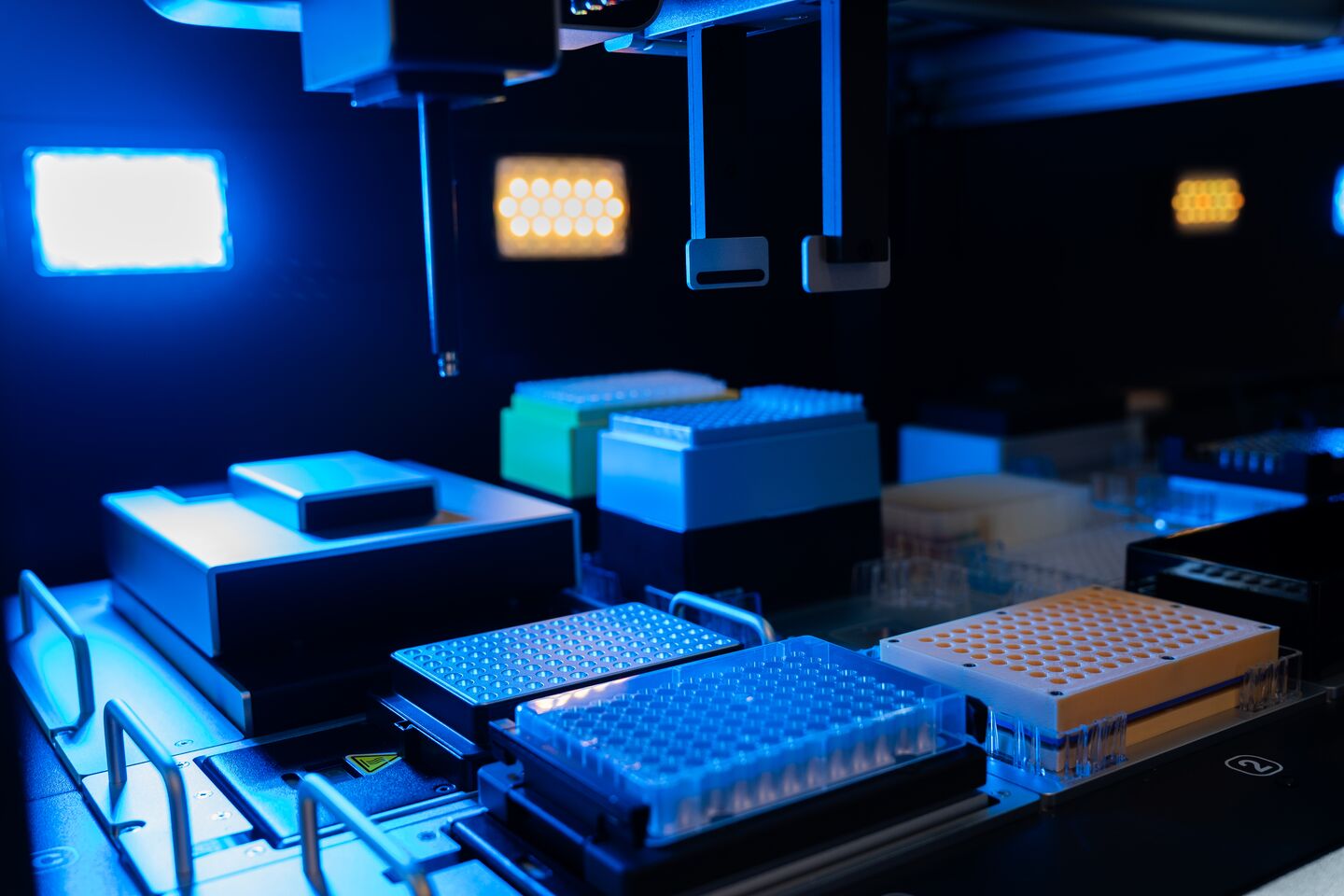
small robotic arms positioned above several trays of test tubes
The OpenTrons instrument uses a gantry robot for sample setting activities. It can pipette 1, 8, and 16 wells at a time for experiments up to a 96-well plate. The system is automated to perform complex workflows with multiple variables and activities including shakers, heaters, and plate readers. (Photo credit: Andrea Starr | Pacific Northwest National Laboratory)

Agents That Think, Plan, and Adapt

ARCADIA deploys a library of modular AI agents that act as tireless scientific collaborators across the entire research life cycle. 

Science assistant agents generate hypotheses, check novelty, and convert research ideas into rigorous experimental designs informed by available instruments, materials, and prior data. 

Experiment execution agents translate those designs into precise instructions for robotic liquid handlers, spectrometers, and plate readers, coordinating multiple instruments through standardized protocols. 

Adaptive control agents monitor live data streams and adjust experimental conditions in real time, tuning bioreactor parameters or modifying synthesis conditions on the fly.

Finally, data analysis agents interpret results, refine conditions through machine learning, and feed insights back into the next round of experiments. 

Together, these agents help create an integrated learning environment where data, experiments, simulations, and scientific reasoning continuously inform one another, enabling faster and more informed decision-making over time.

Robotics That Bring Experiments to Life

ARCADIA turns digital plans into physical discovery through an integrated robotics ecosystem that conducts experiments at speeds and scales no human team could match.

Robotics platforms for liquid handling such as the OpenTrons and Tecan Fluent execute high-throughput batches with precision, while robotic arms shuttle samples between synthesis stations, spectroscopy suites, centrifuges, and mass spectrometers. 

In-line characterization tools, such as UV-vis plate readers and Raman spectrometers, provide real-time feedback that closes the loop between action and analysis. 

Whether recovering critical materials from complex feedstocks or optimizing engineered microbes to produce industrially valuable molecules, ARCADIA's robotics transform the laboratory into a continuously running, integrated discovery platform—one where science happens around the clock, and every experiment contributes to a growing body of scientific knowledge that helps guide future discovery.

ARCADIA is evolving from an emerging capability into a foundational platform for autonomous science across PNNL.

We are building ARCADIA from the ground up with researcher needs in mind. 

ARCADIA is more than a software platform. It is an integrated ecosystem that brings together AI, robotics, data, simulation, and scientific expertise to accelerate discovery.

ARCADIA connects experimentation, analysis, reasoning, and adaptation into a unified ecosystem that accelerates the path from hypothesis to impact.

ARCADIA represents PNNL’s long-term vision for autonomous science, providing a scalable foundation for integrating AI, robotics, intelligent data systems, and scientific expertise across the laboratory.

Contacts

Malachi Schram
Data Scientist
malachi.schram@pnnl.gov
Dave Novelli
Data Scientist
dave.novelli@pnnl.gov
+1 (509) 375-6614

PNNL

  • Get in Touch
    • Contact
    • Careers
    • Doing Business
    • Environmental Reports
    • Security & Privacy
    • Vulnerability Disclosure Policy
    • Notice to Applicants
  • Research
    • Scientific Discovery
    • Energy Resiliency
    • National Security
Subscribe to PNNL News
Department of Energy Logo Battelle Logo
Pacific Northwest National Laboratory (PNNL) is managed and operated by Battelle for the Department of Energy
  • YouTube
  • Facebook
  • X (formerly Twitter)
  • Instagram
  • LinkedIn