PNNL

  • About
  • News & Media
  • Careers
  • Events
  • Research
    • Scientific Discovery
      • Autonomous Science
      • Biology
        • Chemical Biology
        • Computational Biology
        • Ecosystem Science
        • Human Health
          • Cancer Biology
          • Exposure Science & Pathogen Biology
        • Integrative Omics
          • Advanced Metabolomics
          • Chemical Biology
          • Mass Spectrometry-Based Measurement Technologies
          • Spatial and Single-Cell Proteomics
          • Structural Biology
        • Microbiome Science
          • Biofuels & Bioproducts
          • Human Microbiome
          • Soil Microbiome
          • Synthetic Biology
        • Predictive Phenomics
      • Earth & Coastal Sciences
        • Global Change
        • Atmospheric Science
          • Atmospheric Aerosols
          • Human-Earth System Interactions
          • Modeling Earth Systems
        • Coastal Science
        • Ecosystem Science
        • Subsurface Science
        • Terrestrial Aquatics
      • Materials Sciences
        • Materials in Extreme Environments
        • Nondestructive Examination
        • Precision Materials by Design
        • Science of Interfaces
        • Smart Advanced Manufacturing
          • Cold Spray
          • Friction Stir Welding & Processing
          • ShAPE
      • Nuclear & Particle Physics
        • Dark Matter
        • Neutrino Physics
        • Fusion Energy Science
      • Quantum Information Sciences
      • Chemistry
        • Computational Chemistry
        • Chemical Separations
        • Chemical Physics
        • Catalysis
      • Fusion Energy Science
    • Energy Resiliency
      • Electric Grid Modernization
        • Emergency Response
        • Grid Analytics
          • AGM Program
          • Tools and Capabilities
        • Grid Architecture
        • Grid Cybersecurity
        • Grid Energy Storage
        • Transmission
        • Distribution
      • Energy Efficiency
        • Appliance and Equipment Standards
        • Building Energy Codes
        • Building Technologies
          • Advanced Building Controls
          • Advanced Lighting
          • Building-Grid Integration
        • Commercial Buildings
        • Federal Buildings
          • Federal Performance Optimization
          • Resilience and Security
        • Residential Buildings
          • Building America Solution Center
          • Energy Efficient Technology Integration
          • Home Energy Score
        • Energy Efficient Technology Integration
      • Energy Storage
        • Electrochemical Energy Storage
        • Flexible Loads and Generation
        • Grid Integration, Controls, and Architecture
        • Regulation, Policy, and Valuation
        • Science Supporting Energy Storage
        • Chemical Energy Storage
      • Environmental Management
        • Waste Processing
        • Radiation Measurement
        • Environmental Remediation
      • Fossil Energy
        • Subsurface Energy Systems
        • Advanced Hydrocarbon Conversion
      • Nuclear Energy
        • Fuel Cycle Research
        • Advanced Reactors
        • Reactor Operations
        • Reactor Licensing
        • Nondestructive Examination
      • Renewable Energy
        • Solar Energy
        • Wind Energy
          • Wind Resource Characterization
          • Wildlife and Wind
          • Wind Systems Integration
          • Wind Data Management
          • Distributed Wind
        • Marine Energy
          • Environmental Monitoring for Marine Energy
          • Marine Biofouling and Corrosion
          • Marine Energy Innovation
          • Marine Energy Resource Characterization
          • Testing for Marine Energy
        • Hydropower
          • Environmental Performance of Hydropower
          • Hydropower Cybersecurity and Digitalization
          • Hydropower and the Electric Grid
          • Materials Science for Hydropower
          • Pumped Storage Hydropower
          • Water + Hydropower Planning
        • Grid Integration of Renewable Energy
        • Geothermal Energy
      • Transportation
        • Bioenergy Technologies
          • Algal Biofuels
          • Aviation Biofuels
          • Waste-to-Energy and Products
        • Hydrogen & Fuel Cells
        • Vehicle Technologies
          • Emission Control
          • Energy-Efficient Mobility Systems
          • Lightweight Materials
          • Vehicle Electrification
          • Vehicle Grid Integration
    • National Security
      • Chemical & Biothreat Signatures
        • Contraband Detection
        • Pathogen Science & Detection
        • Explosives Detection
        • Threat-Agnostic Biodefense
      • Cybersecurity
        • Discovery and Insight
        • Proactive Defense
        • Trusted Systems
      • Nuclear Material Science
      • Nuclear Nonproliferation
        • Radiological & Nuclear Detection
        • Nuclear Forensics
        • Ultra-Sensitive Nuclear Measurements
        • Nuclear Explosion Monitoring
        • Global Nuclear & Radiological Security
      • Stakeholder Engagement
        • Disaster Recovery
        • Global Collaborations
        • Legislative and Regulatory Analysis
        • Technical Training
      • Systems Integration & Deployment
        • Additive Manufacturing
        • Deployed Technologies
        • Rapid Prototyping
        • Systems Engineering
      • Threat Analysis
        • Advanced Wireless Security
          • 5G Security
          • RF Signal Detection & Exploitation
        • Border Security
        • Internet of Things
        • Maritime Security
        • Millimeter Wave
        • Mission Risk and Resilience
    • Data Science & Computing
      • Artificial Intelligence
      • Graph and Data Analytics
      • Software Engineering
      • Computational Mathematics & Statistics
      • Future Computing Technologies
        • Adaptive Autonomous Systems
    • Lab Objectives
    • Publications & Reports
    • Featured Research
  • People
    • Inventors
    • Lab Leadership
    • Lab Fellows
    • Staff Accomplishments
  • Partner with PNNL
    • Education
      • Undergraduate Students
      • Graduate Students
      • Post-graduate Students
      • University Faculty
      • University Partnerships
      • K-12 Educators and Students
      • STEM Education
        • STEM Workforce Development
        • STEM Outreach
      • Internships
    • Community
      • Philanthropy
      • Volunteering
    • Industry
      • Why Partner with PNNL
      • Explore Types of Engagement
      • How to Partner with Us
      • Available Technologies
      • Procurement
      • Technology Ombuds
  • Facilities & Centers
    • All Facilities
      • Atmospheric Radiation Measurement User Facility
      • Electricity Infrastructure Operations Center
      • Energy Sciences Center
      • Environmental Molecular Sciences Laboratory
      • Grid Storage Launchpad
      • Institute for Integrated Catalysis
      • Interdiction Technology and Integration Laboratory
      • PNNL Portland Research Center
      • PNNL-Seattle
      • PNNL-Sequim (Marine and Coastal Research)
      • Radiochemical Processing Laboratory
      • Shallow Underground Laboratory

Center for Robotics and Autonomy @ PNNL

  • Leadership
  • ARCADIA
  • SciLink
  • Autonomous Labs
  • News & Media
    • News
    • Multimedia
    • Publications
  • Partnerships

Breadcrumb

  1. Home
  2. Projects
  3. Center for Robotics and Autonomy @ PNNL

SciLink

A Multi-Agent AI Platform for Scientific Research Automation

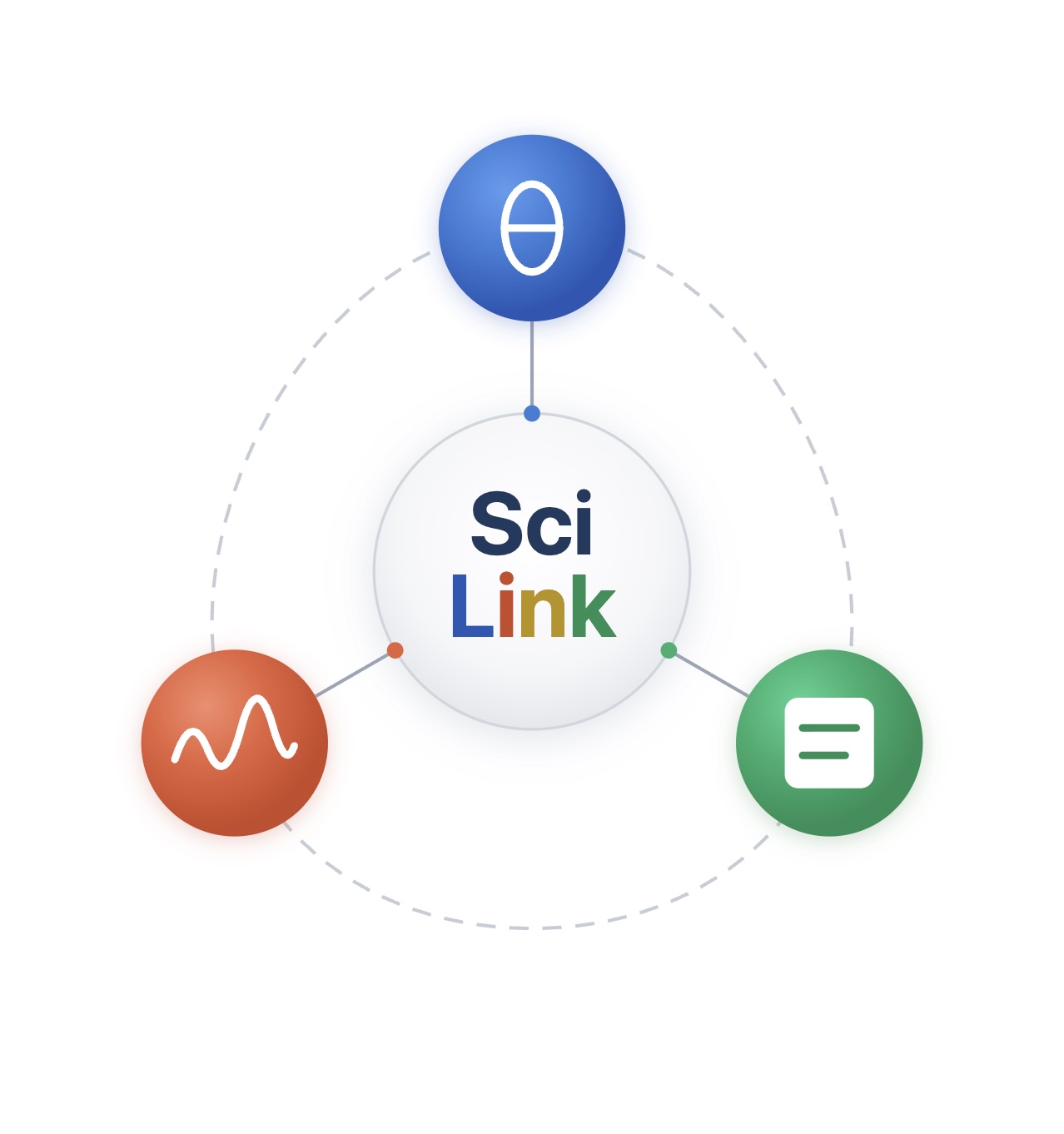
A visual highlighting SciLink

SciLink is a multi-agent AI platform that helps researchers automate, accelerate, and scale scientific workflows. Designed for complex experimental and computational campaigns, SciLink connects scientific knowledge, structured data, AI agents, analysis tools, simulation codes, and laboratory automation systems into a coordinated research environment.

SciLink supports scientists across the full discovery loop, from hypothesis generation and experiment design to data analysis, simulation, verification, and iterative refinement.

As part of the Center for Robotics and Autonomy @PNNL’s capabilities, SciLink provides an AI-enabled foundation for integrated learning across experiments, simulations, data, and decision-making.

What SciLink Does

SciLink combines large language model–based agents with scientific tools, user-supplied knowledge, structured data, and executable workflows. Its capabilities include:

Knowledge-Aware Scientific Reasoning

SciLink uses retrieval-augmented generation over user-provided papers, project notes, instrument manuals, prior results, and other research materials. This allows agents to generate hypotheses, design experiments, and make recommendations grounded in the scientific context of a project.

Structured Data Querying

SciLink complements document-based reasoning with agentic querying of structured data, including tabular files and record databases. Agents can dynamically generate and execute query code without requiring researchers to define a schema in advance.

Tool and Code Integration

SciLink can combine pre-built tools, user-provided models, and on-the-fly code generation to produce runnable analysis scripts, simulation inputs, or laboratory automation protocols. These workflows can be executed locally, on high-performance computing systems, or on connected laboratory instruments.

Pluggable Scientific Skills

SciLink can be extended through modular skill bundles that add support for new instrument data types, simulation methods, or domain-specific workflows. Domain experts can contribute self-contained markdown files and optional Python helpers that SciLink automatically discovers and routes.

Configurable Levels of Autonomy

SciLink supports three levels of autonomy:

  • Co-pilot: The human researcher reviews and approves agent actions
  • Autopilot: The system advances routine steps while escalating key decisions
  • Autonomous: The agent system holds the acceptance gate for defined workflows.

This allows researchers to select the right level of oversight for each scientific task.

How SciLink Works

SciLink is organized as a multi-tier team of AI agents modeled after the structure of a research organization. At the top are three mode orchestrators that serve as project leads for:

  • Experimental analysis
  • Campaign planning
  • Computational simulation.

Each orchestrator delegates work to specialist agents responsible for scientific tasks within their domain. The specialists are supported by role-specific agents that help generate, execute, verify, and refine outputs.

Within this workflow, dissent, verification, and reconciliation are built into the system. Separate agents review results, challenge assumptions, evaluate quality, and help determine whether a workflow should proceed, be revised, or escalate to a human researcher.

Supporting the Full Scientific Campaign Loop

SciLink is designed to support integrated research campaigns across experimental, analytical, and computational modes.

Campaign Planning

SciLink can support closed-loop optimization campaigns, moving from hypothesis to experiment, measurement, revision, and next-step selection. Multi-objective Bayesian optimization can guide the campaign, with optional generation of laboratory automation code when experiments are performed on robotic systems.

Experimental Analysis

SciLink can ingest and interpret data across major materials and life-science modalities, including:

  • One-dimensional spectroscopy and kinetics, such as X-ray diffraction, Raman, UV-Vis, differential scanning calorimetry, enzyme kinetics, dose-response curves, plate-reader curves, quantitative polymerase chain reaction, and chromatography
  • Two-dimensional imaging, such as optical microscopy, scanning electron microscopy, transmission electron microscopy, atomic force microscopy, atomic-resolution scanning transmission electron microscopy, fluorescence microscopy, and histology
  • Three-dimensional hyperspectral datacubes, such as electron energy loss spectroscopy, energy-dispersive spectroscopy, and Raman imaging, with spectral unmixing workflows.

Computational Simulation

SciLink supports atomistic simulations across scales—from quantum (density functional theory) calculations to classical and machine-learning-driven molecular dynamics, including biomolecular systems—using established engines such as VASP and LAMMPS. It supports the full workflow, from building structures to preparing inputs, automatically assessing results and re-running with improvements when needed.

Adaptive Agentic Pipelines

SciLink includes simulated-annealing agentic pipelines that balance scientific rigor with adaptive problem solving. These pipelines initially hold scientific priors and domain rules tightly, then progressively relax implementation constraints only when iterative refinements fail to converge.

Verifier-driven acceptance steps help determine whether proposed changes improve the outcome before the system proceeds.

Why It Matters

SciLink turns scientific intent into actionable research: its AI agents design experiments, analyze multimodal data, and run simulations all while reasoning about the science, grounding decisions in the literature, and verifying their own work as they go. Adjustable autonomy provides flexible collaboration. Scientists and SciLink work side-by-side, pairing human intuition and judgment with the speed and reach of AI.

Contacts

Maxim Ziatdinov
Materials Scientist
maxim.ziatdinov@pnnl.gov
Sarah Allec
Materials Scientist
sarah.allec@pnnl.gov

PNNL

  • Get in Touch
    • Contact
    • Careers
    • Doing Business
    • Environmental Reports
    • Security & Privacy
    • Vulnerability Disclosure Policy
    • Notice to Applicants
  • Research
    • Scientific Discovery
    • Energy Resiliency
    • National Security
Subscribe to PNNL News
Department of Energy Logo Battelle Logo
Pacific Northwest National Laboratory (PNNL) is managed and operated by Battelle for the Department of Energy
  • YouTube
  • Facebook
  • X (formerly Twitter)
  • Instagram
  • LinkedIn