
PNNL

  • About
  • News & Media
  • Careers
  • Events
  • Research
    • Scientific Discovery
      • Autonomous Science
      • Biology
        • Chemical Biology
        • Computational Biology
        • Ecosystem Science
        • Human Health
          • Cancer Biology
          • Exposure Science & Pathogen Biology
        • Integrative Omics
          • Advanced Metabolomics
          • Chemical Biology
          • Mass Spectrometry-Based Measurement Technologies
          • Spatial and Single-Cell Proteomics
          • Structural Biology
        • Microbiome Science
          • Biofuels & Bioproducts
          • Human Microbiome
          • Soil Microbiome
          • Synthetic Biology
        • Predictive Phenomics
      • Earth & Coastal Sciences
        • Global Change
        • Atmospheric Science
          • Atmospheric Aerosols
          • Human-Earth System Interactions
          • Modeling Earth Systems
        • Coastal Science
        • Ecosystem Science
        • Subsurface Science
        • Terrestrial Aquatics
      • Materials Sciences
        • Materials in Extreme Environments
        • Nondestructive Examination
        • Precision Materials by Design
        • Science of Interfaces
        • Smart Advanced Manufacturing
          • Cold Spray
          • Friction Stir Welding & Processing
          • ShAPE
      • Nuclear & Particle Physics
        • Dark Matter
        • Neutrino Physics
        • Fusion Energy Science
      • Quantum Information Sciences
      • Chemistry
        • Computational Chemistry
        • Chemical Separations
        • Chemical Physics
        • Catalysis
      • Fusion Energy Science
    • Energy Resiliency
      • Critical Minerals and Materials
      • Electric Grid Modernization
        • Emergency Response
        • Grid Analytics
          • AGM Program
          • Tools and Capabilities
        • Grid Architecture
          • Basic Terms & Principles
          • Resource Library
        • Grid Cybersecurity
        • Grid Energy Storage
        • Transmission
        • Distribution
      • Energy Efficiency
        • Appliance and Equipment Standards
        • Building Energy Codes
        • Building Technologies
          • Advanced Building Controls
          • Advanced Lighting
          • Building-Grid Integration
        • Commercial Buildings
        • Federal Buildings
          • Federal Performance Optimization
          • Resilience and Security
        • Residential Buildings
          • Building America Solution Center
          • Energy Efficient Technology Integration
          • Home Energy Score
        • Energy Efficient Technology Integration
      • Energy Storage
        • Electrochemical Energy Storage
        • Flexible Loads and Generation
        • Grid Integration, Controls, and Architecture
        • Regulation, Policy, and Valuation
        • Science Supporting Energy Storage
        • Chemical Energy Storage
      • Environmental Management
        • Waste Processing
        • Radiation Measurement
        • Environmental Remediation
      • Fossil Energy
        • Subsurface Energy Systems
        • Advanced Hydrocarbon Conversion
      • Nuclear Energy
        • Fuel Cycle Research
        • Advanced Reactors
        • Reactor Operations
        • Reactor Licensing
        • Nondestructive Examination
      • Renewable Energy
        • Solar Energy
        • Wind Energy
          • Wind Resource Characterization
          • Wildlife and Wind
          • Wind Systems Integration
          • Wind Data Management
          • Distributed Wind
        • Marine Energy
          • Environmental Monitoring for Marine Energy
          • Marine Biofouling and Corrosion
          • Marine Energy Innovation
          • Marine Energy Resource Characterization
          • Testing for Marine Energy
        • Hydropower
          • Environmental Performance of Hydropower
          • Hydropower Cybersecurity and Digitalization
          • Hydropower and the Electric Grid
          • Materials Science for Hydropower
          • Pumped Storage Hydropower
          • Water + Hydropower Planning
        • Grid Integration of Renewable Energy
        • Geothermal Energy
          • Geothermal Materials Research
      • Transportation
        • Bioenergy Technologies
          • Algal Biofuels
          • Aviation Biofuels
          • Waste-to-Energy and Products
        • Hydrogen & Fuel Cells
        • Vehicle Technologies
          • Emission Control
          • Energy-Efficient Mobility Systems
          • Lightweight Materials
          • Vehicle Electrification
          • Vehicle Grid Integration
    • National Security
      • Chemical & Biothreat Signatures
        • Contraband Detection
        • Pathogen Science & Detection
        • Explosives Detection
        • Threat-Agnostic Biodefense
      • Cybersecurity
        • Discovery and Insight
        • Proactive Defense
        • Trusted Systems
      • Nuclear Material Science
      • Nuclear Nonproliferation
        • Radiological & Nuclear Detection
        • Nuclear Forensics
        • Ultra-Sensitive Nuclear Measurements
        • Nuclear Explosion Monitoring
        • Global Nuclear & Radiological Security
      • Stakeholder Engagement
        • Disaster Recovery
        • Global Collaborations
        • Legislative and Regulatory Analysis
        • Technical Training
      • Systems Integration & Deployment
        • Additive Manufacturing
        • Deployed Technologies
        • Rapid Prototyping
        • Systems Engineering
      • Threat Analysis
        • Advanced Wireless Security
          • 5G Security
          • RF Signal Detection & Exploitation
        • Border Security
        • Internet of Things
        • Maritime Security
        • Millimeter Wave
        • Mission Risk and Resilience
    • Data Science & Computing
      • Artificial Intelligence
      • Graph and Data Analytics
      • Computational Mathematics & Statistics
      • Future Computing Technologies
        • Adaptive Autonomous Systems
    • Publications & Reports
    • Featured Research
  • People
    • Inventors
    • Lab Leadership
    • Lab Fellows
    • Staff Accomplishments
  • Partner with PNNL
    • Education
      • Undergraduate Students
      • Graduate Students
      • Post-graduate Students
      • University Faculty
      • University Partnerships
      • K-12 Educators and Students
      • STEM Education
        • STEM Workforce Development
        • STEM Outreach
      • Internships
    • Community
      • Philanthropy
      • Volunteering
    • Industry
      • Why Partner with PNNL
      • Explore Types of Engagement
      • How to Partner with Us
      • Available Technologies
      • Procurement
      • Technology Ombuds
  • Facilities & Centers
    • All Facilities
      • Atmospheric Radiation Measurement User Facility
      • Electricity Infrastructure Operations Center
      • Energy Sciences Center
      • Environmental Molecular Sciences Laboratory
      • Grid Storage Launchpad
      • Institute for Integrated Catalysis
      • Interdiction Technology and Integration Laboratory
      • PNNL Portland Research Center
      • PNNL-Seattle
      • PNNL-Sequim (Marine and Coastal Research)
      • Radiochemical Processing Laboratory
      • Shallow Underground Laboratory

Art and Energy Research at PNNL

  • Advancing Energy Futures Through Art Workshop
  • Artist-in-Residence: Lindsay Olson Residency
  • Science as Art Calendar

Breadcrumb

  1. Home
  2. Projects
  3. Art and Energy Research at PNNL

Lindsay Olson Residency

Lindsay Olson and the Art of Hydropower

Textile artist Lindsay Olson was selected as PNNL’s Artist-in-Residence to explore hydropower through art, research, and material storytelling.

During her residency, Olson visited PNNL, met with researchers, toured laboratories, and visited McNary Dam. Her project, From Flow to Power: The Art of Hydropower, translates what she learned into textile art using fabric, thread, stitch, texture, and color.

The work explores how flowing water becomes electricity, and how hydropower systems connect with fish, rivers, turbines, energy infrastructure, and people.
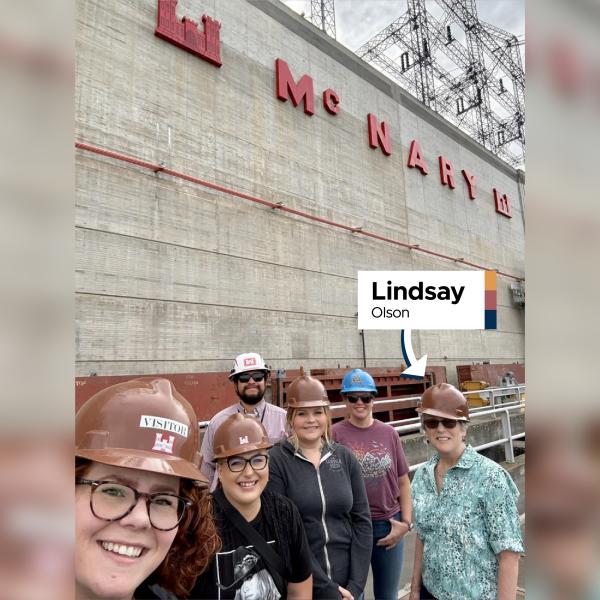
Lindsay visits the McNary Dam with a PNNL crew.
Textile artist Lindsay Olson visits McNary Dam with PNNL researchers Shannon Bates and Alison Colotelo. The tour provided visual references for her hydropower-inspired textile art. (Photo courtesy of Lindsay Olson.)

About the Artist

Lindsay Olson creates textile art inspired by science. Her work begins with research: conversations with scientists and engineers, close observation, technical references, and time spent in the places where science happens.

Through embroidery, beadwork, fabric, and layered textile techniques, Olson turns complex scientific ideas into artwork that invites people to slow down, look closely, and ask questions.

Learn more: Lindsay Olson Art

From Flow to Power

Olson’s PNNL project focuses on hydropower as both an energy system and a river system.

Her developing artwork includes references to spillways, fish-friendly turbines, fish ladders, bypass systems, flow batteries, transformers, pylons, transmission lines, and migrating fish species. 

Fish research became an important entry point for the project. Olson wrote that she was inspired by the idea that fish-friendly infrastructure can support energy generation at dams while helping fish move through hydropower systems. 

The creative process
Olson’s worktable and stitching frame show her hydropower triptych taking shape through fabric, thread, beadwork, and layered textile techniques. (Photo courtesy of Lindsay Olson.)

The Residency Visit

Olson’s residency included tours, research conversations, and a visit to McNary Dam.

During her visit, she learned about fish research, bio-acoustics and flow, manufacturing methods, digital twins, civil engineering, physical modeling, irrigation hydropower, telemetry, battery storage, and renewable energy. 

The McNary Dam visit became one of the project’s key visual references, informing Olson’s use of turbine forms, spillway movement, dam interior colors, and Columbia River imagery. 

Art as a Way to See Hydropower Differently

Much of hydropower is difficult to see: turbines inside dams, fish passage systems, underwater movement, electrical transmission, and the engineering choices that connect rivers to the grid.

Olson’s artwork brings some of those hidden systems into view. Her process uses textile forms to suggest water movement, fish migration, power generation, and the infrastructure that carries electricity beyond the dam.

The result is not a technical diagram. It is an artist’s interpretation of a complex energy system, shaped by research, scientific input, and the physical language of textile art.

Explore More

  • Visit Lindsay Olson Art 
  • View Lindsay’s project page: From Flow to Power: The Art of Hydropower 
  • Learn more about PNNL research in Water Power, Hydropower, and Marine Energy 
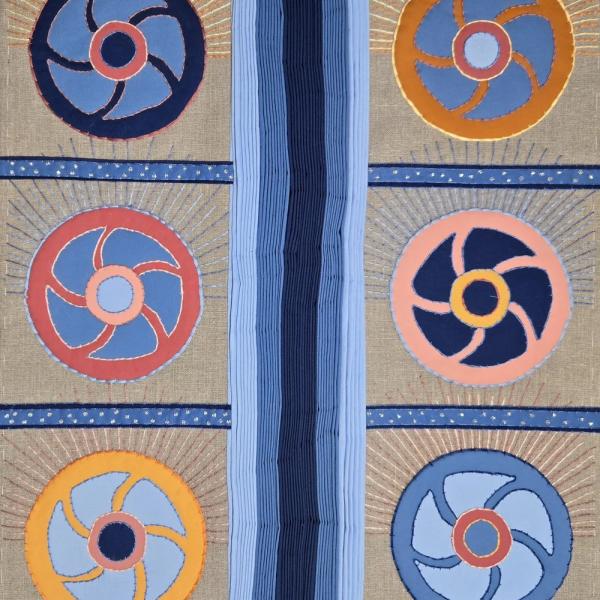
Center panel of art
The center panel of Olson’s hydropower triptych uses textile forms to interpret flowing water, turbines, electricity generation, and fish passage. (Artwork and photo courtesy of Lindsay Olson.)

PNNL

  • Get in Touch
    • Contact
    • Careers
    • Doing Business
    • Environmental Reports
    • Security & Privacy
    • Vulnerability Disclosure Policy
    • Notice to Applicants
  • Research
    • Scientific Discovery
    • Energy Resiliency
    • National Security
Subscribe to PNNL News
Department of Energy Logo Battelle Logo
Pacific Northwest National Laboratory (PNNL) is managed and operated by Battelle for the Department of Energy
  • YouTube
  • Facebook
  • X (formerly Twitter)
  • Instagram
  • LinkedIn