PNNL Paper Ranks Among Journal’s Top 10% Most-Read Publications
A decade-long evolution in making omics data easier to analyze earns widespread recognition

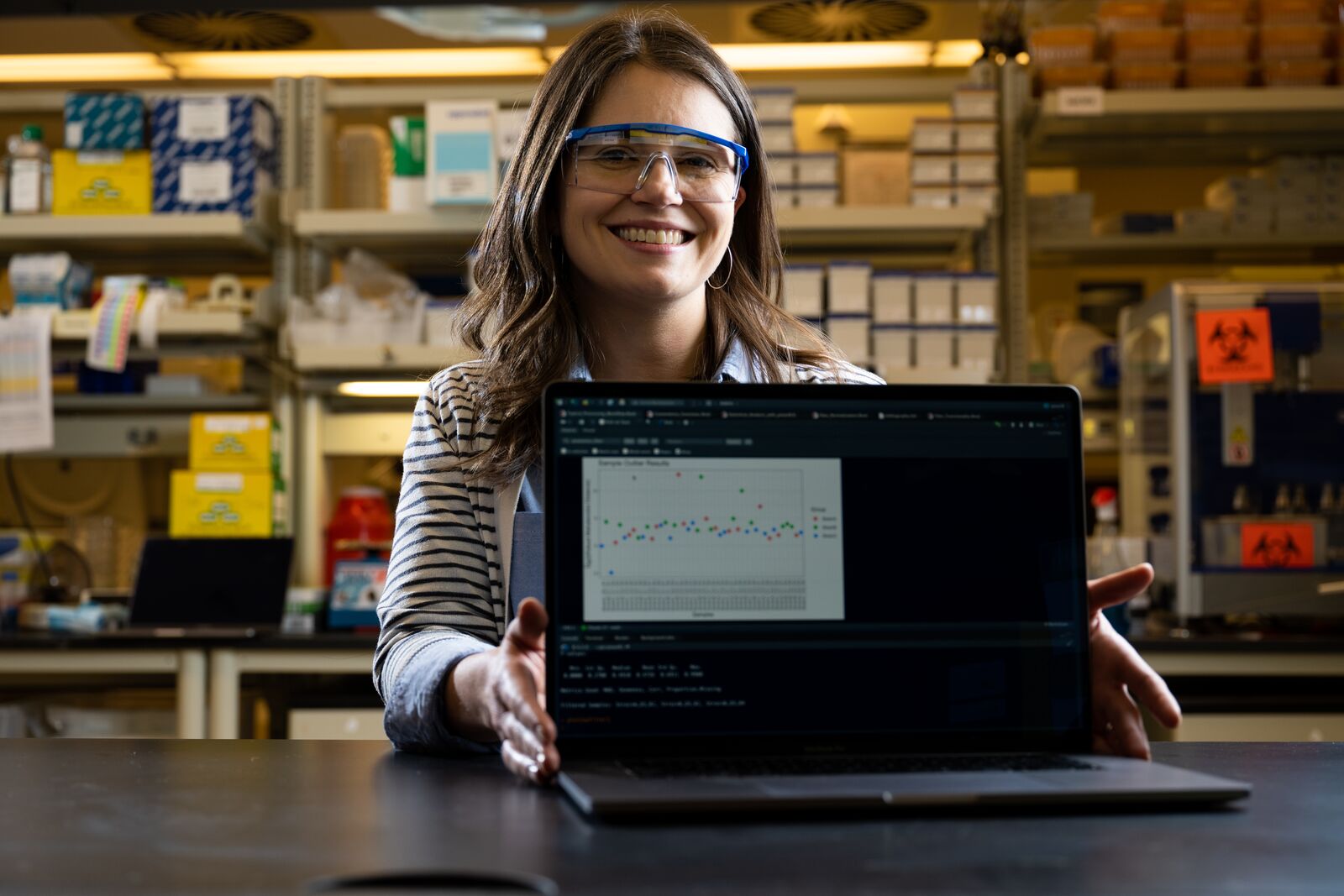
Lisa Bramer, data scientist at Pacific Northwest National Laboratory.
(Photo by Andrea Starr | Pacific Northwest National Laboratory)
Today’s scientific instruments generate large, complex datasets, and interpreting them often requires specialized computational expertise. To help bridge that gap, data scientist Lisa Bramer and a team of researchers at Pacific Northwest National Laboratory (PNNL), have spent the past decade developing software that makes omics data analysis more accessible to researchers, regardless of their programming experience.
One milestone in that effort is Fourier-Transform Mass Spectrometry R Exploratory Data Analysis (FREDA), an open-source web application that helps scientists process, visualize, and analyze complex Fourier-transform mass spectrometry data through an intuitive interface. Rather than writing custom code, researchers can use FREDA to assess data quality, compare experimental conditions, identify meaningful biological patterns, and document every step of their analysis.
Bramer and fellow PNNL researchers published FREDA: A Web Application for the Processing, Analysis, and Visualization of Fourier-Transform Mass Spectrometry Data to Wiley Analytical Science journal in 2024. Less than two years later, the journal recognized it as one of the top 10 percent most-read papers published that year, highlighting the scientific community’s growing demand for accessible data analysis tools.
“The goal with FREDA is to continue making data analysis more accessible, so researchers can spend less time figuring out how to analyze their data and more time making discoveries,” Bramer said. “It’s about expanding the utility of this application or other applications that deal with new data types and continue to remove the barrier that a lot of non-computational scientists can face when they’re trying to make sense of and understand their data quickly.”
FREDA was developed to help researchers analyze the large, information-rich datasets produced by Fourier-transform mass spectrometry instruments, including the exceptionally detailed data generated by the 21 Tesla Fourier-transform ion cyclotron resonance (FTICR) mass spectrometer available at EMSL, the Environmental Molecular Sciences Laboratory, a Department of Energy Office of Science User Facility located at and operated by PNNL. As these instruments have become more powerful, they have also produced increasingly complex datasets, creating a growing need for user-friendly tools.
FREDA guides users through an end-to-end workflow. Unlike many existing tools, it enables users to identify peaks unique to experimental groups using statistical tests and connects molecular formulas to biological pathway databases.
To demonstrate the application’s capabilities, the team analyzed soil samples collected at different depths using the data generated by EMSL’s 21 Tesla FTICR. The study showed that all processing, visualization, and statistical analyses could be completed entirely within FREDA. The application provides a reproducible workflow that allows researchers to move from raw instrument output to publication-ready analyses. And because FREDA is open source, new analysis methods and visualization capabilities can be added as scientific needs evolve.
Today, FREDA is available through the EMSL Multiomics Analysis Portal (MAP), a web-based platform that helps researchers explore and integrate complex multiomics datasets without requiring specialized programming or statistical expertise. FREDA has joined MAP’s growing ecosystem of user-friendly software for omics data analysis.
“FREDA has grown from a data analysis workflow performed with statistical programming into a valuable, web-based capability within EMSL’s Multiomics Analysis Portal,” said PNNL data scientist Kelly Stratton. “In my role as an Integrated Research Platform lead at EMSL, one of the capabilities that I steward in the User Program is MAP and the tools it contains. Integrating FREDA into MAP gives researchers a more streamlined and accessible approach to data analysis that translates complex data into biological insights.”
This work was performed by a strong multidisciplinary team that included David J. Degnan, Daniel M. Claborne, Amanda M. White, Sarah M. Akers, Natalie M. Winans, Yuri E. Corilo, Clayton W. Strauch, Vanessa L. Bailey, and Lee Ann McCue.
Published: August 21, 2026