March 17, 2026
Feature

One Invention Nearly Every Day: Sixty Years of Innovation

Explore the past, present, and future of PNNL technological advancements

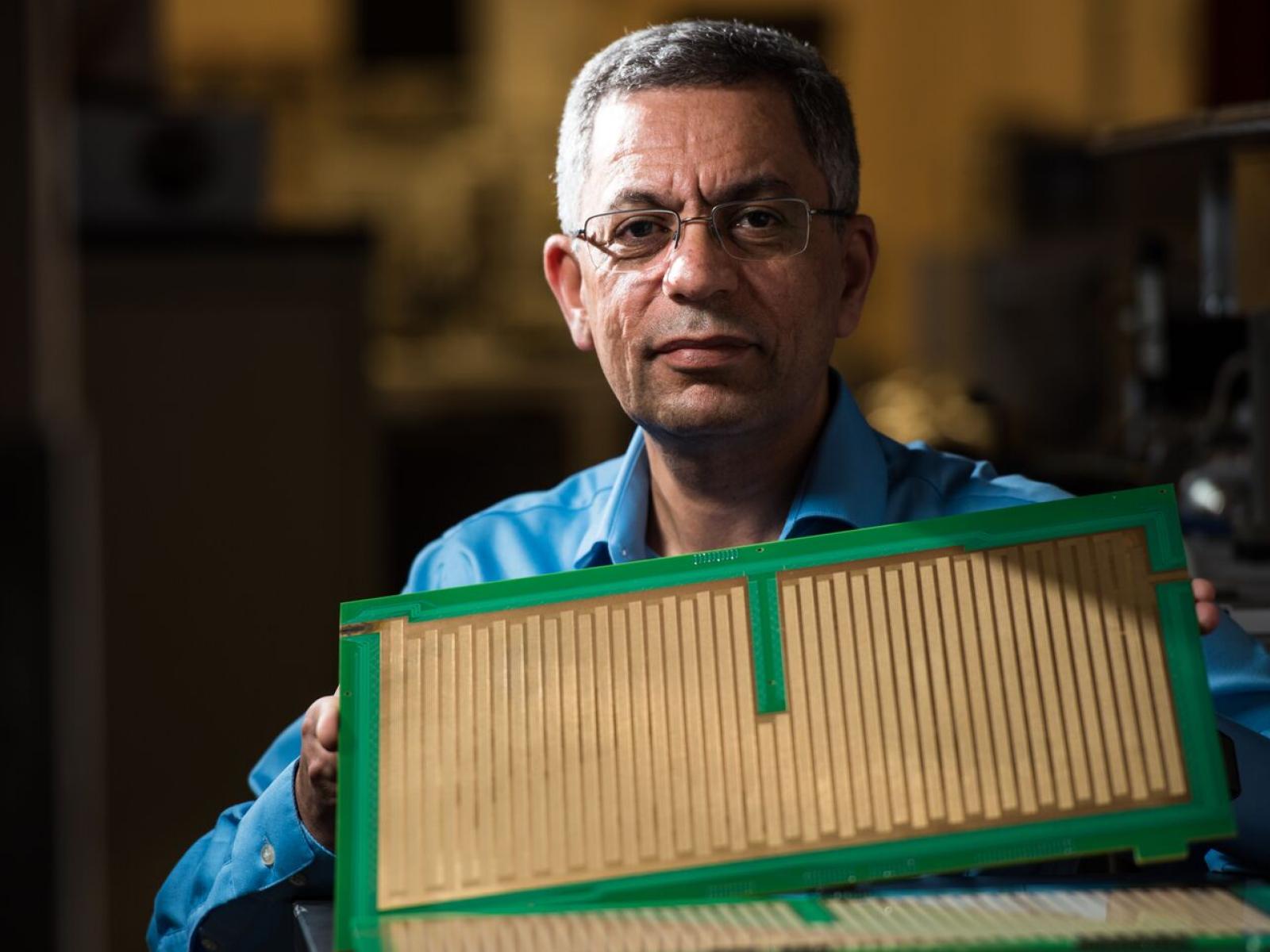
Yehia Ibrahim with the SLIM device

The PNNL-developed Structures for Lossless Ion Manipulations, or SLIM, device offers groundbreaking analytical speed and sensitivity at the molecular level. It’s capable of analyses that are orders of magnitude faster than the current technologies commonly used to distinguish the presence, structure, and abundance of different molecules in a sample. 

(Photo by Andrea Starr | Pacific Northwest National Laboratory)

A great scientist, Marie Curie, once said, “Nothing in life is to be feared, it is only to be understood. Now is the time to understand more, so that we may fear less.” 

Inspired by the opportunity to contribute to post-war efforts, called to action after 9/11, driven to find cures for illness and disease, or to respond to our nation’s complex energy demands, scientists and engineers at Pacific Northwest National Laboratory (PNNL) have channeled passion into discovery and innovation to address some of the most pressing challenges facing our nation and world. 

For six decades, the technology invented at PNNL has made its way to commercial markets, radically—and positively—changing everyday lives and making our nation safer, stronger, more competitive and secure. One of those technologies is something we have all likely encountered—the full-body scanning technology at airports around the world. Others are less widely known, like technologies based on mass spectrometry, but have significant potential to advance medicine, energy, and disease prevention. 

Since 1965, a total of 3,213 patents have been issued for research derived from PNNL and more than 210 companies have their roots in PNNL. Most recently, a technology developed at PNNL—a rice sized fish-monitoring transmitter called SHAD-TAGS+—won a prestigious R&D 100 award, adding to the list of hundreds of award-winning PNNL technologies. 

In celebration of PNNL’s 60th anniversary, dive into PNNL technologies of the past, present, and future. 

Invention in times of terror 

Remember the joy you felt after listening to your new compact disc (CD) in a CD player or maybe a boom box? While we tuned out the world and tuned into the artist’s lyrics and words, we also experienced a science phenomenon. CDs used a technique called optical digital recording and behind that technique was PNNL research and breakthroughs from decades earlier.  

That is the wonder of science. Research that becomes more than what was imagined and forms the foundation for even greater discoveries. 

In 2001, when technologies around listening to music evolved to using portable music players, or MP3s, holding thousands of songs, our country also experienced a devastating moment in history. 

In the wake of 9/11 terrorist attacks on the United States, airplane safety was critical. World leaders wanted to prevent future tragedies and scientists were called to action.

Millimeter wave technology, developed from optical and acoustic holography originating in the 1960s, became a transformational solution to increased airport security. PNNL researchers worked tirelessly to further develop an earlier patented millimeter wave holographic scanning technology with the vision that airplane passengers would walk through the scanner revealing hidden objects and contraband. The scanner uses signals similar in power to that of a cellphone to scan the body and create 3-D holographic images of foreign objects. 

The technology was licensed by Battelle in 2003 making its way into Transportation Security Administration (TSA) checkpoints and has since advanced to next-generation, high-definition scanners that can identify even smaller threats with fewer false positives. 

Today, more than 2,000 scanners are deployed on over 6 continents. 

PNNL developed a rapid imaging system that can quickly detect hidden weapons, even if they are plastic or ceramic, making them more effective than metal detectors. This has increased security and effectiveness of screenings during air travel. (Video: Pacific Northwest National Laboratory)

Technology addresses ongoing challenges 

Inventions coming out of PNNL span diverse research fields. From VOLTTRON™—which helps buildings improve energy efficiency and lower costs by detecting operational faults, identifying issues, and coordinating with the grid to manage energy consumption with minimal impacts to comfort—to highly pure medical isotopes, there are thousands of examples. 

Highly pure medical isotopes have roots in our nuclear science history. In 1960, isotope separations research began at a PNNL laboratory on the Hanford Site for beta voltaic nuclear batteries for cardiac pacemakers and the artificial heart.

Since then, PNNL scientists and engineers have developed a number of patented methods for making highly pure medical isotopes. The isotopes have been vital for cancer research and the treatment of tens of thousands of patients battling difficult to treat cancers. 

Advances in medicine rely upon fundamental research to understand processes of life and the universe. Yet, it is often difficult to distinguish the presence, structure, and abundance of different molecules in samples.

Structures for Lossless Ion Manipulations (SLIM)—another PNNL technology—helps identify trace amounts of very similar molecules with slightly different structures in even complex samples. The technique is 1,000 times faster than current methods. 

The technology is not only transformative to medicine but can help detect chemical threats and solve environmental problems.

Imagine trying to distinguish identical twins or two slightly different colors. SLIM detects differences in molecules at a scale smaller than a single cell. 

Current instruments lack the resolution and sensitivity to clearly distinguish molecules from others with similar mass and structure. SLIM is helping break through that analysis barrier.

Technology of tomorrow

While SLIM is important for fundamental research, PNNL scientists are using applied research to advance artificial intelligence (AI) and technology. AI applications are expected to push scientific discovery, strengthen energy dominance, and enhance national security.

As part of the Genesis Mission, PNNL is developing new AI models and agents in partnership with industry, academia, and other national laboratories. This bold new platform will accelerate scientific breakthroughs, driving innovation and fueling further economic growth for our nation. 

PNNL researchers are also working to improve quantum computing, an emergent field of computer science with the potential to solve problems that even super computers can’t solve and at a much higher speed. PNNL’s first functional superconducting qubit testbed is a testament to the drive and commitment to pushing the boundaries of science as demonstrated for 60 years.

Superconducting qubit sits in a dilution refrigerator
A superconducting qubit sits in a dilution refrigerator in a PNNL physics laboratory. This experimental device is the first step in establishing a qubit testbed at PNNL. (Photo by Andrea Starr | Pacific Northwest National Laboratory)

“It is hard to predict the future and the exact challenges that our country and world will face. But the research of yesterday and today may very well be the foundation for solving issues of tomorrow,” said PNNL Chief Commercialization Officer Christina Lomasney. “For 60 years we’ve done an incredible job advancing research and development and bringing technology to the market for lasting impact to our nation and people.”

To learn more about PNNL’s 60th anniversary and history, visit our website

###

About PNNL

Pacific Northwest National Laboratory draws on its distinguishing strengths in chemistry, Earth sciences, biology and data science to advance scientific knowledge and address challenges in energy resiliency and national security. Founded in 1965, PNNL is operated by Battelle and supported by the Office of Science of the U.S. Department of Energy. The Office of Science is the single largest supporter of basic research in the physical sciences in the United States and is working to address some of the most pressing challenges of our time. For more information, visit the DOE Office of Science website. For more information on PNNL, visit PNNL's News Center. Follow us on Twitter, Facebook, LinkedIn and Instagram.