July 13, 2026
Feature

The Ocean is Teeming with Critical Minerals: Here’s How We Could Get Them

PNNL researchers are studying ways to use seawater and seawater-generated chemicals to acquire magnesium, lithium, and other critical materials 

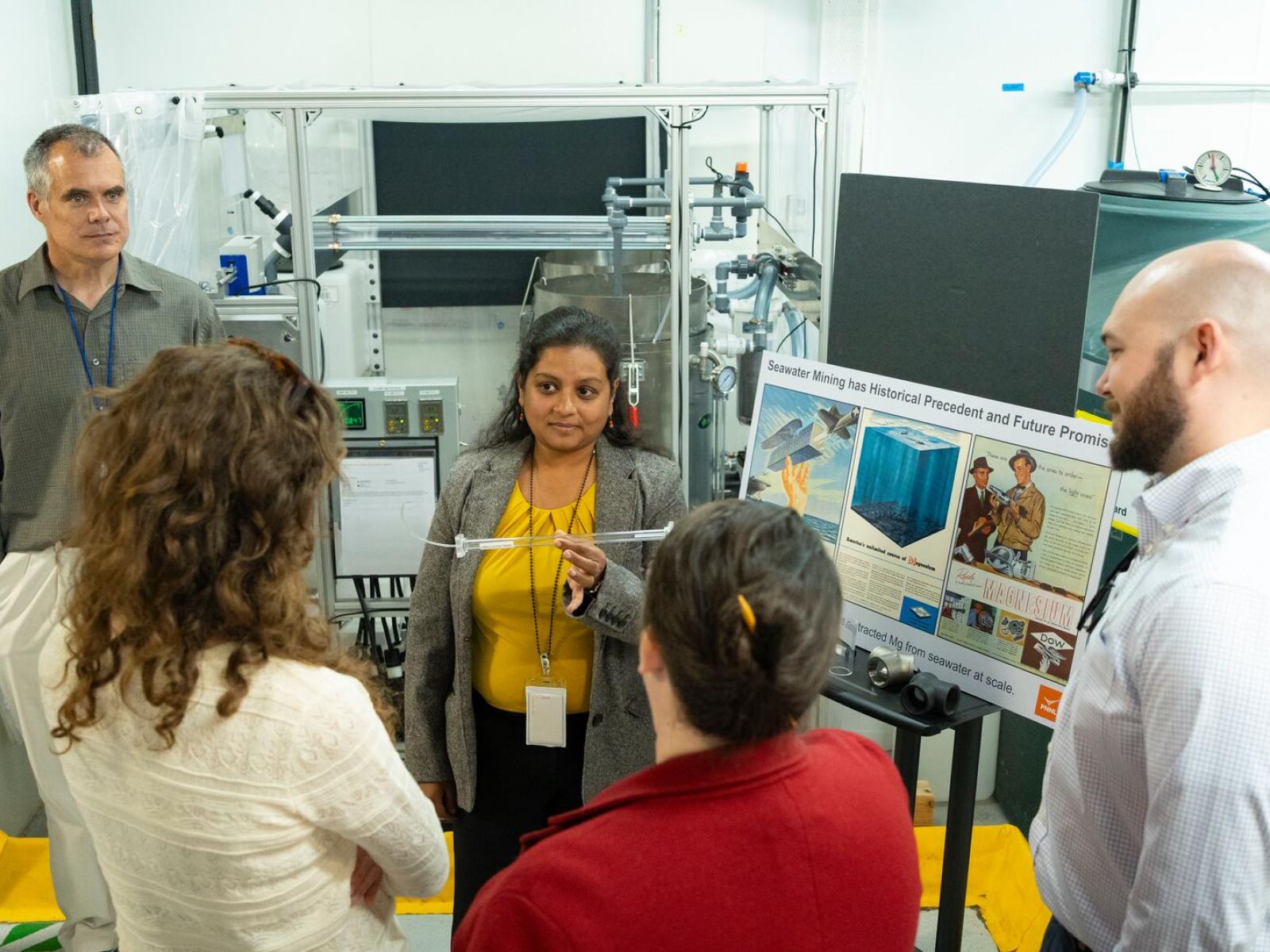
A woman in a grey blazer and yellow shirt holds up a plastic tube from a scientific instrument and shows it to a group of people.

Chemist Chinmayee Subban shows off a PNNL technology that can extract magnesium oxide from seawater. The system could be paired with a coastal desalination plant to create a domestic supply of the critical material. 

(Photo by Edward Pablo | Pacific Northwest National Laboratory)

Mining usually brings to mind mountains, heavy machinery, and piles of gravel. However, during World War II, scientists harnessed a new mining frontier in the ocean—not its rocky floor, but the water itself. The United States mined magnesium directly from seawater for 50 years before shifting to imports in the late 1990s. 

Now, through funding from the Department of Energy’s Hydropower and Hydrokinetic Office, researchers at Pacific Northwest National Laboratory (PNNL) are returning to the deep blue—not just for magnesium, but for many of the critical minerals drifting in Earth’s vast seas.  

“Just 0.1 percent of seawater contains enough critical minerals like magnesium and lithium, if we can fully extract them, to meet humanity’s needs for the next 50,000 years or more,” said Jessica Cross, a chemical oceanographer at PNNL. 

The biggest challenge with extracting critical minerals from the ocean is dilution, said Chinmayee Subban, a chemist who leads the lab’s efforts to explore the chemical benefits of the oceans. In an Olympic-sized swimming pool of seawater (which would hold around 600,000 gallons), you could find 2,980 kilograms of magnesium, but only 0.00095 kg of nickel or 0.42 kg of lithium. 

This dilution means that huge amounts of energy would be required to process large volumes of seawater. Once the dilution problem is solved, Subban said, critical minerals could be collected from most shorelines.

“The biggest advantage of seawater is that, on average, it has reasonably standard chemical composition all around the world,” Subban said. “That means that we can develop a technology for one location and rapidly scale it to be deployed in many different places."

Currently, the team has recovered magnesium, lithium, nickel, platinum-group metals, and rare-earth metals using seawater or seawater-sourced chemicals. All these materials are used to create products vital to modern life, including parts for vehicles, electronic devices, and batteries. PNNL scientists are also focusing on methods to recycle waste products and reduce impact on ecosystems. 

“Our goal is really to maximize the dollars per cubic meter of seawater that we’re pumping and to use that water efficiently and responsibly,” Subban said. “From seawater, we can extract these critical materials. The challenge will be to scale up these technologies so they can be economically feasible.”

Here are three ways PNNL researchers are pulling critical minerals from the sea:

Magnesium mine of the sea

In the years following WWII, much of the nation’s magnesium was pulled from the sea by Dow Chemical in a process involving several steps. In brief, the Dow process involves mixing lime (calcium oxide) with seawater in giant land-based pools to create magnesium hydroxide. Several more chemical reactions, including treatment with hydrochloric acid and electrolysis, were used to create magnesium metal.

At PNNL, Subban and her colleagues have developed a method that cuts at least four of the original steps. Their method works by flowing two liquids next to each other: seawater and a base, in this case sodium hydroxide. Where the two liquids meet, high-purity magnesium hydroxide precipitates out. Rather than further processing to magnesium metal, PNNL stops at magnesium hydroxide, a mineral that has its own market in the United States and is primarily imported. PNNL’s co-flow reactor system will soon be deployed at PNNL-Sequim, DOE’s only marine science laboratory, and the team has filed a patent for the technology.

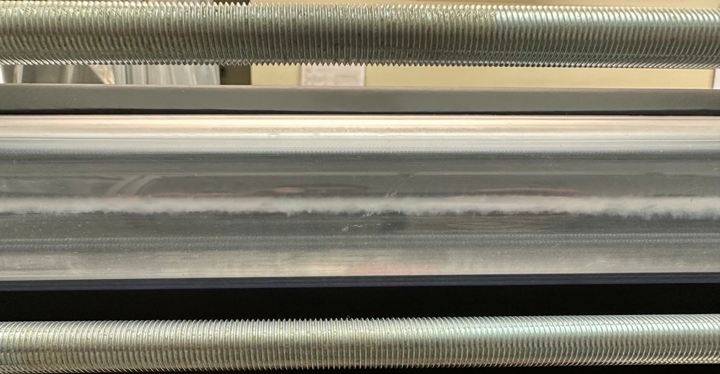
Image shows a close-up shot of two streams of liquid flowing next to each other. In between the streams of liquid, a white substance appears. This is magnesium oxide.
A close-up shot of a system that PNNL researchers developed to extract magnesium from seawater. A stream of sodium hydroxide and seawater flow next to each other, causing magnesium oxide to precipitate out. (Photo courtesy of Chinmayee Subban | Pacific Northwest National Laboratory)

But how can industry scale up this system to cost-effectively extract useful amounts of magnesium? Brooke Marten, an environmental engineer at PNNL, conducted an infrastructure analysis and found that PNNL’s co-flow reactor system could be paired with existing desalination plants, like the one in Carlsbad, California. 

“The Carlsbad plant processes 108 million gallons of seawater per day,” Marten said. “With a 100 percent magnesium recovery rate, that would provide 524,000 kilograms of magnesium hydroxide every day, which is more than triple the United States’ current rate of magnesium hydroxide use."

PNNL’s reactors are also built to be modular for scale-up and are designed to easily integrate with existing desalination infrastructure, she added. 

Once the magnesium is recovered, the remaining seawater is processed through reverse osmosis desalination, generating freshwater and an ultra-salty liquid called brine.

That brine can then be processed through an electrodialysis system called bipolar membrane electrodialysis, or BPMED, that generates acid and base products essential for all critical mineral processing.

Or it can be used to grow algae, which researchers recently found can concentrate critical minerals in their tissues (but more on that later).

Acid for nickel extraction

In standard mining, the desired critical element (like copper, zinc, or nickel) is locked within rock. Mining processes use acids to pull that element out in a process called leaching. Typically, mining processes use sulfuric acid or hydrochloric acid to dissolve the metal, so it becomes easier to extract.

On overview process diagram of nickel extraction
Nickel can be extracted from olivine using a waste acid produced by separating seawater into a base and an acid. (Figure by Chinmayee Subban | Pacific Northwest National Laboratory)

But last year, Subban and her team found that acid produced from BPMED is better than commercially available hydrochloric acid at leaching nickel from domestically sourced olivine mineral. BPMED was originally developed to create chemically alkaline seawater that, if returned to the ocean, could help slow down ocean acidification. The acid is technically a waste product, but Subban and her team strive to find uses for everything.

In a paper published earlier this year, PNNL researchers tested the acid as a leaching agent on olivine. The team found that acid resulting from the BPMED process is 37 percent more effective at leaching nickel than conventionally sourced acids. 

Biomining seaweed 

In the past few years, PNNL researchers have also found that macroalgae––better known as seaweed—accumulate critical materials in their tissues, soaking them up from the seawater in which they grow.

Animation showing marine carbon dioxide removal. Seawater on the left containing H2O and sea salt molecules enter an electrochemical device in the middle. De-acidified seawater leaves the device and goes back into the ocean. Acid containing HCl leaves the device and goes into a beaker on the right that contains seawater and microalgae. CO2 molecules form in the beaker. The microalgae eat the CO2 molecules and grow quickly.
In bipolar membrane electrodialysis, seawater is pumped through an instrument that uses electricity to split water and remove acid. The acid byproduct could be used to grow seaweed for critical mineral accumulation and extraction. (Animation by Sara Levine | Pacific Northwest National Laboratory)

“Some critical materials show up in seaweed at concentrations a million times higher than the surrounding seawater,” said Scott Edmundson, a research botanist at PNNL’s Marine Research Laboratory in Sequim, Washington. 

Edmundson and his colleagues have been investigating different species of seaweed to determine which minerals they accumulate, how to cultivate the seaweeds to maximize mineral content, and how to extract them. Through a process known as hydrothermal liquefaction, the team is also studying how to use seaweed biomass to generate additional products such as chemicals, fuels, and fertilizers to complement the critical minerals extracted from the sea algae mining process.

And with PNNL’s interdisciplinary expertise, the researchers stumbled on an additional use for the waste products from BPMED: the waste can also help seaweed grow faster. In another paper published in 2023, researchers showed that some species of algae grow faster in slightly acidic seawater—opening doors to integrating solutions and technologies for cultivated algae that can be used to soak up critical minerals, improving overall performance and economics of the integrated system.

###

About PNNL

Pacific Northwest National Laboratory draws on its distinguishing strengths in chemistry, Earth sciences, biology and data science to advance scientific knowledge and address challenges in energy resiliency and national security. Founded in 1965, PNNL is operated by Battelle and supported by the Office of Science of the U.S. Department of Energy. The Office of Science is the single largest supporter of basic research in the physical sciences in the United States and is working to address some of the most pressing challenges of our time. For more information, visit the DOE Office of Science website. For more information on PNNL, visit PNNL's News Center. Follow us on Twitter, Facebook, LinkedIn and Instagram.

Published: July 13, 2026

Research topics