March 10, 2026
Feature

Autonomy Accelerates Science on a National Scale

Labs that move at the speed of AI on the horizon at PNNL

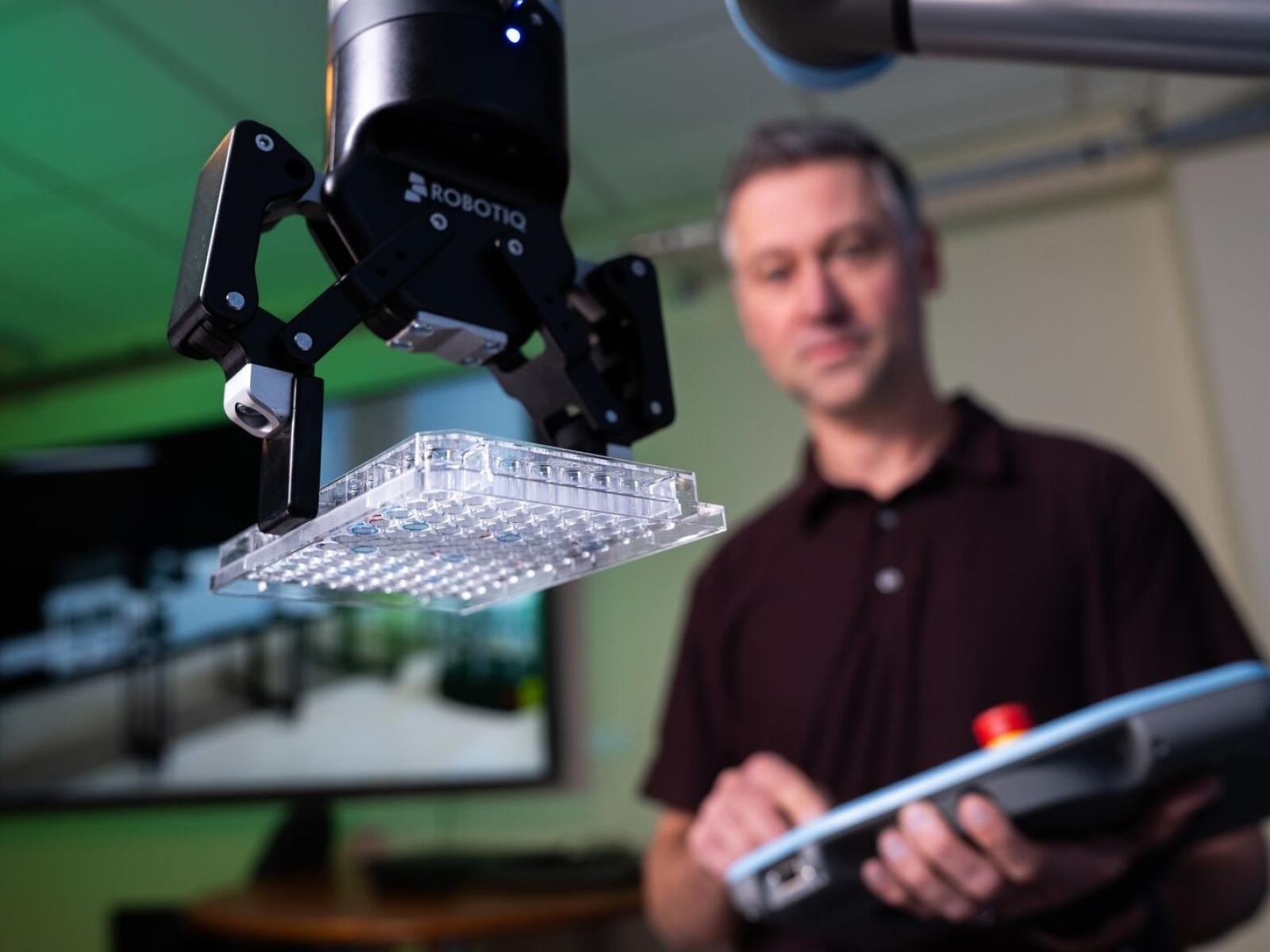
A researcher with a control device standing behind a robotic arm holding a lab sample tray.

A robotic arm moves a lab sample tray in Pacific Northwest National Laboratory’s Autonomy Studio. 

(Photo by Andrea Starr | Pacific Northwest National Laboratory)

For science to take advantage of AI’s blazing speed, science experiments and data analysis need to keep pace. At Pacific Northwest National Laboratory (PNNL), we see the future, and it is self-driving autonomous laboratories. The science of tomorrow does not look like the science of today.

“We are building out and demonstrating what an autonomous science infrastructure can accomplish at the scale of an entire national laboratory,” said Bob Runkle, a physicist applying technology to science who leads PNNL’s autonomous discovery strategy. “Our decades of investment in data science and AI, coupled to our advanced instrumentation, will fundamentally change the way we conduct science. We will accelerate the time to scientific breakthroughs and technology development, and this is critical now when American dominance in science, energy, and national security is being challenged.”

Why autonomous science?

Laboratory experiments provide essential evidence to advance science. But they are time intensive and often require complex instruments that produce a huge amount of raw data that must be analyzed to become meaningful. As science experiments tackle ever more complex problems requiring intensive data analysis, the linear progression of science that uses a single experiment to plan for the next becomes unwieldy.

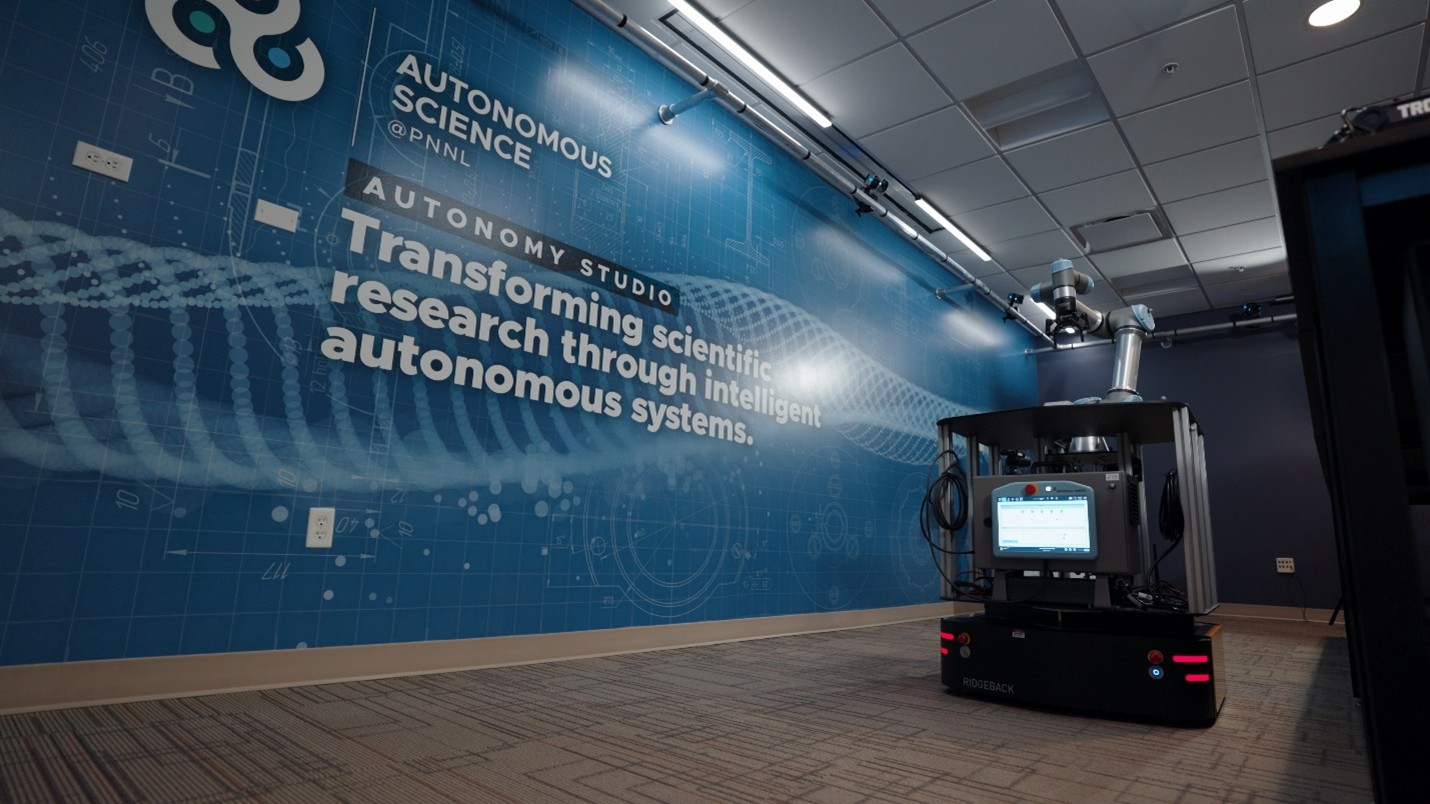
A robot on wheels inside of a room
A mobile robot learns how to maneuver. (Image by Eddie Pablo | Pacific Northwest National Laboratory)

But what if we could program a robot-driven lab platform to do 1,000 experiments at once, and tie those results to an AI agent that learns from mistakes and corrects them before designing and launching another round of experiments automatically? The convergence of automation, robotics, and AI makes this new approach to scientific discovery a reality.

This isn’t a distant vision. The transformation has already begun, led by the vision of Draguna Vrabie. She pioneered the autonomous science strategy that is aligning foundational research in AI, control, and automation with application to scientific discovery. Through her leadership, PNNL built a lab-wide capability to perform complete design–build–test–learn cycles with minimal intervention.

We are demonstrating the art of the possible in the new Autonomy Studio.

Inside PNNL’s Autonomy Studio, scientists are building a new model for laboratory research—where AI, robotics, and humans work side by side. Through digital twins, AI agents, and automated liquid-handling systems, researchers are augmenting—not replacing—scientists to accelerate discovery in areas like biological engineering and critical material separations. This is a shift toward hybrid, AI-enabled science that keeps experiments moving and redefines how research is done. (Video by Eddie Pablo | Pacific Northwest National Laboratory)

It’s science at the speed of AI but with human-driven goals and direction. Scientists are now learning how to incorporate AI agents and robotics into their workflows.

Five years. Every experiment includes autonomy. The audacious goal is set. Now we execute.

The following use cases show how PNNL is implementing autonomous science today.

How to recover critical minerals at the scale of industry

Minerals like lithium, cobalt, and nickel form the backbone of modern technology and national security, yet U.S. production of these critical minerals lags behind foreign suppliers. Securing supply chains for U.S. production is a key to strengthening U.S. industrial competitiveness.

PNNL materials scientists have already demonstrated lab-scale critical minerals recovery from industrial waste, such as permanent magnets used by the electronics industry.

Now the PNNL team is collaborating with industry partners to economically recover critical minerals as a value-added commodity from magnets and wastewater generated from oil and gas extraction, among other sources.

“We have developed an AI platform called SciLink that can conduct economic analyses, propose and plan experiments, analyze the data, and use that information to refine a hypothesis or propose a new hypothesis,” said Maxim Ziatdinov, a PNNL physical scientist whose research has merged AI, data science, and instrument controls.

Ziatdinov and colleague Elias Nakouzi, a materials separations expert, and his team are assembling a self-driving autonomous lab for critical minerals separations.

“There is automation, and there is autonomy,” he said. “Robots give you automation, but AI gives you autonomy at the level of decision-making. That’s where we are in 2026.”

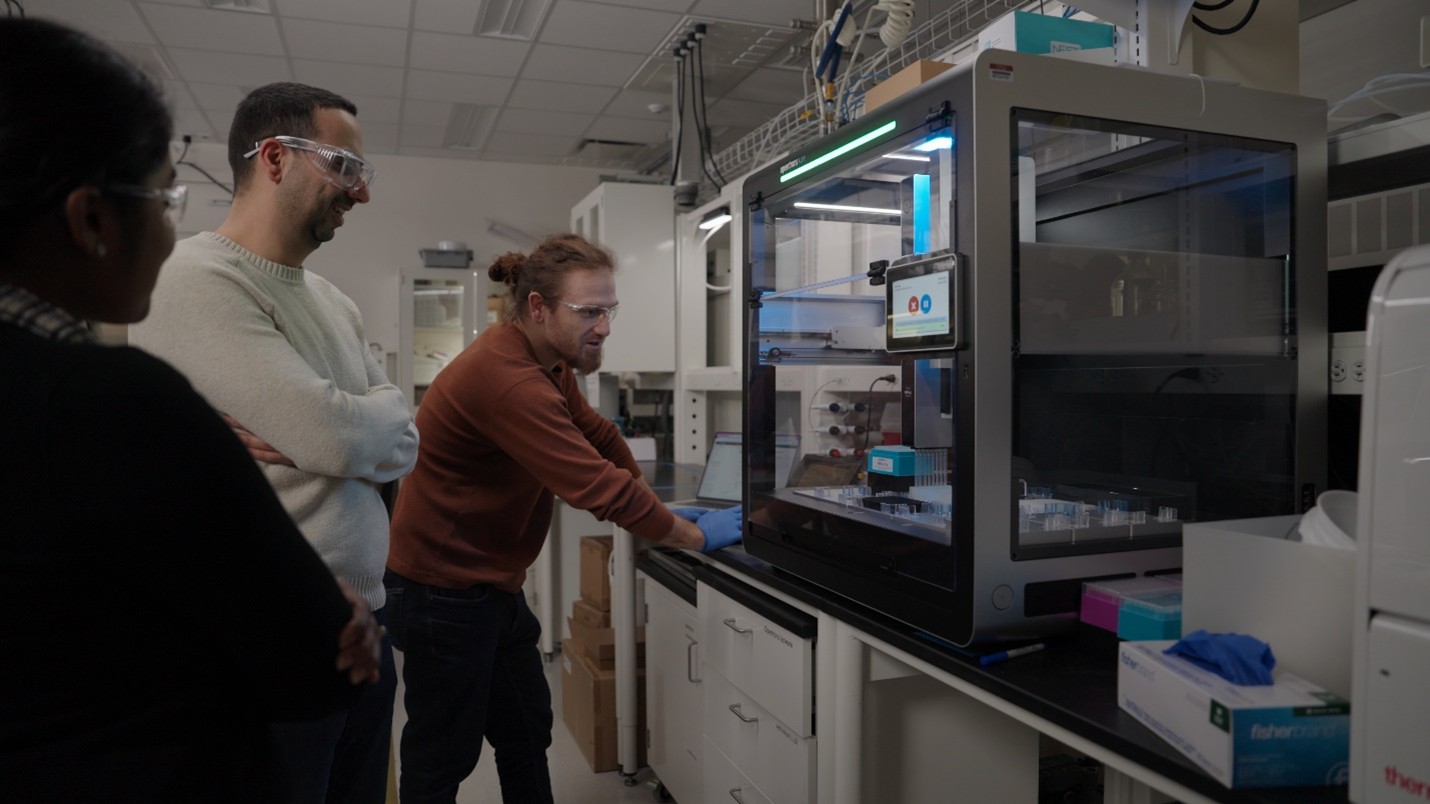
Three researchers wearing safety goggles operating an enclosed machine.
Elias Nakouzi (center) and his team assemble a self-driving autonomous lab for critical minerals separations. (Image by Eddie Pablo | Pacific Northwest National Laboratory)

“What you are seeing in the Autonomy Studio now is that the robot is moving samples to the microscope for analysis,” Nakouzi said. “We are taking mundane human interventions in experiments out of the loop completely so we can focus on delivering results.”

How to automate biotechnology

Biological systems are powerful but also complex. Much like an urban center, a biological community can rapidly adapt to changing conditions like increased heat, overcrowding, or fewer available nutrients.

For biologists trying to optimize growth conditions, the number and variety of variations, or “variables,” can quickly become overwhelming. But what if it was possible to do thousands of experiments at once and then deploy an AI agent trained to detect and eliminate unpromising directions? Ultimately, fewer lab experiments would be needed to reach desired results.

That’s where the new Anaerobic Microbial Phenotyping Platform, known as AMP2, comes in. The platform, located at the Environmental Molecular Sciences Laboratory, a DOE Office of Science Biological and Environmental Research program user facility on the PNNL campus, marks a major step in redefining how biology is being harnessed to produce food, energy, and other useful commodities.

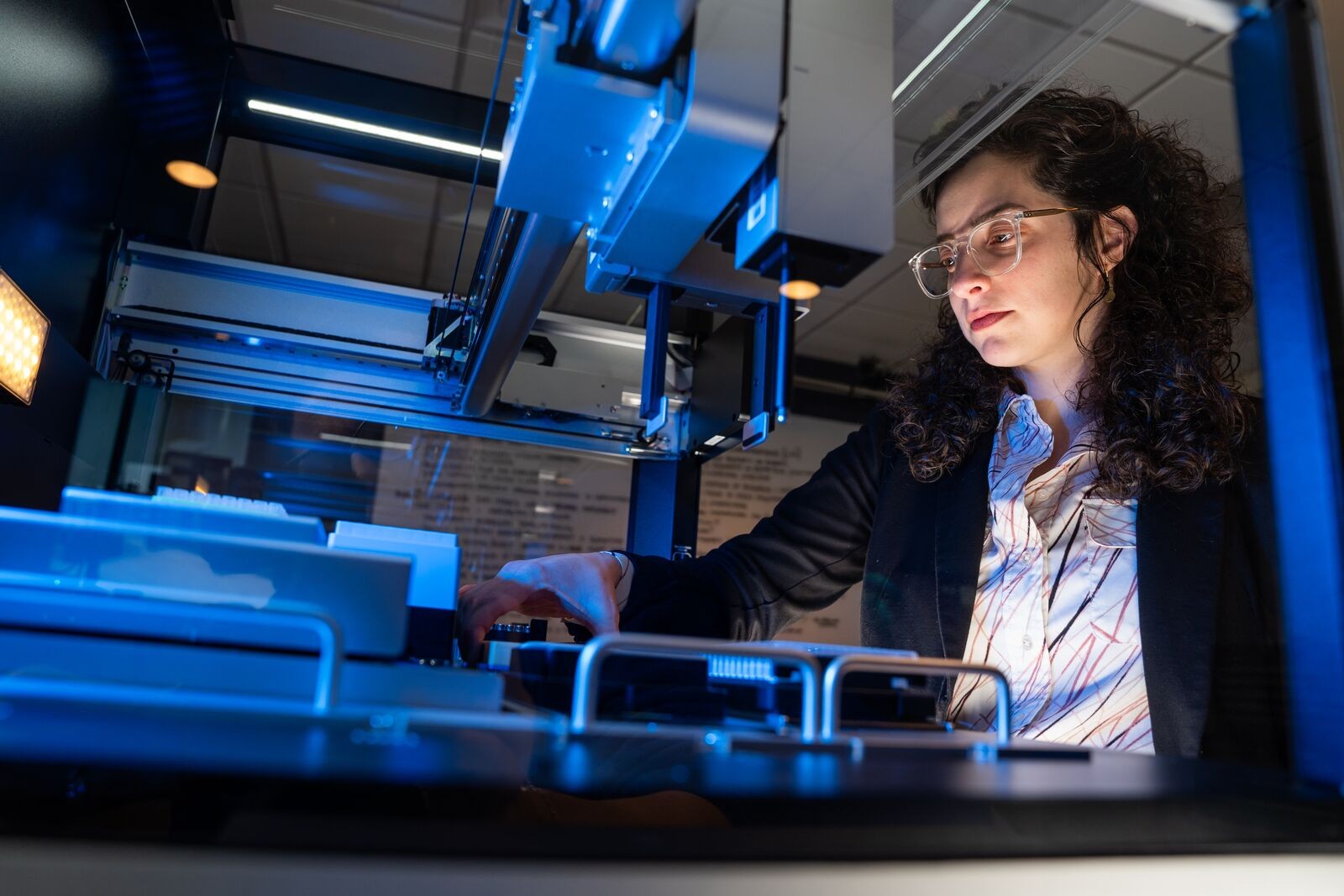
A researcher in safety goggles interacting with the Anaerobic Microbial Phenotyping Platform.
A researcher supervises work being done at the Anaerobic Microbial Phenotyping Platform, located within the Environmental Molecular Sciences Laboratory, a Department of Energy user facility at Pacific Northwest National Laboratory. (Photo by Andrea Starr | Pacific Northwest National Laboratory)

“We’re focused on engineering biological systems to improve bioproduction of organic acids, which are versatile building blocks used across multiple industries to make products like medicine, food preservatives, cosmetics, and cleaners,” said Rob Egbert, team lead for synthetic biology at PNNL.

“We want to optimize their growth and production at the industrial scale,” he said. “We are working toward partnering with AI to identify which samples should be most highly prioritized and then based on the data that comes back, have our robotic liquid-handling system conduct the next logical experiment. So, the robotics are a core component of making that future a reality.”

No longer will scientific experts spend so much of their time on mundane tasks that are much better suited to automation and robotics. Data collected from thousands of experiments will feed an AI system that can make independent decisions on what data to keep and how to change the course of an experiment.

The vision is being deployed through the Genesis Mission, which is building a powerful AI infrastructure designed to work seamlessly with autonomous science platforms.

The Autonomy Studio was funded through a Laboratory Directed Research and Development investment by PNNL.

That’s autonomous science moving at the scale of a nation on a mission.

###

About PNNL

Pacific Northwest National Laboratory draws on its distinguishing strengths in chemistry, Earth sciences, biology and data science to advance scientific knowledge and address challenges in energy resiliency and national security. Founded in 1965, PNNL is operated by Battelle and supported by the Office of Science of the U.S. Department of Energy. The Office of Science is the single largest supporter of basic research in the physical sciences in the United States and is working to address some of the most pressing challenges of our time. For more information, visit the DOE Office of Science website. For more information on PNNL, visit PNNL's News Center. Follow us on Twitter, Facebook, LinkedIn and Instagram.