
April 29, 2026
Feature

Exploring the Exposome

Researchers from PNNL and Oregon State University team up to disentangle the many factors at play within exposure science

Four people in a backyard. Two sitting at a table and two manning a grill.

Many factors influence our health and our “exposome” – the totality of exposures a person will be exposed to in their lifetime. These include natural processes like sunlight, synthetic products like plastic, events such as wildfires, and chemicals produced through everyday activities like barbecuing. 

(Photo by Impact Photography | Shutterstock.com)

Take a brief walk outside and you’re likely to encounter a wide range of things that could influence your health—the sunlight beaming on your face, a plume of exhaust, or even noise from a car driving by. Each exposure carries with it the possibility of affecting your physical well-being.

Tracking and understanding this vast galaxy of exposures and the factors that influence them—what you eat, how you eat it, where you live, how you commute to work—could deliver a much richer understanding of personal health. In turn, that could lead to more informed choices about the risks people accept as they navigate the world. That is the core charge of “exposomics.”

“The exposome is the totality of exposures you’ll encounter in your lifetime, from your prenatal experience to the end of your life,” said toxicologist Alison Clark at Oregon State University (OSU). “But it’s also the route of exposure, like whether you’ve eaten something or inhaled it.” 

Building such an understanding amounts to a massive scientific undertaking, not unlike genomics, where scientists aim to understand both the genes that define us and how they interact with one another and the environment. Scientists like Clark have teamed up with researchers at the Department of Energy’s Pacific Northwest National Laboratory (PNNL) to advance the field of exposure science. Just last year, the team published two papers that examine variability within personal chemical exposure. 

Wristbands fill in the gaps 

Traditionally, studies of chemical exposure have long relied on outdoor stationary monitors. Sensors fitted onto the monitors can detect air pollutants. They might track the air quality in your city or identify specific kinds of pollutants floating around you, such as petroleum combustion products. 

But they have limitations: they can’t tell you when you were exposed, the frequency or duration of the exposure, or if you were exposed inside your home. Past work from the PNNL-OSU research team has shown that variability of personal exposure escapes these monitors’ view

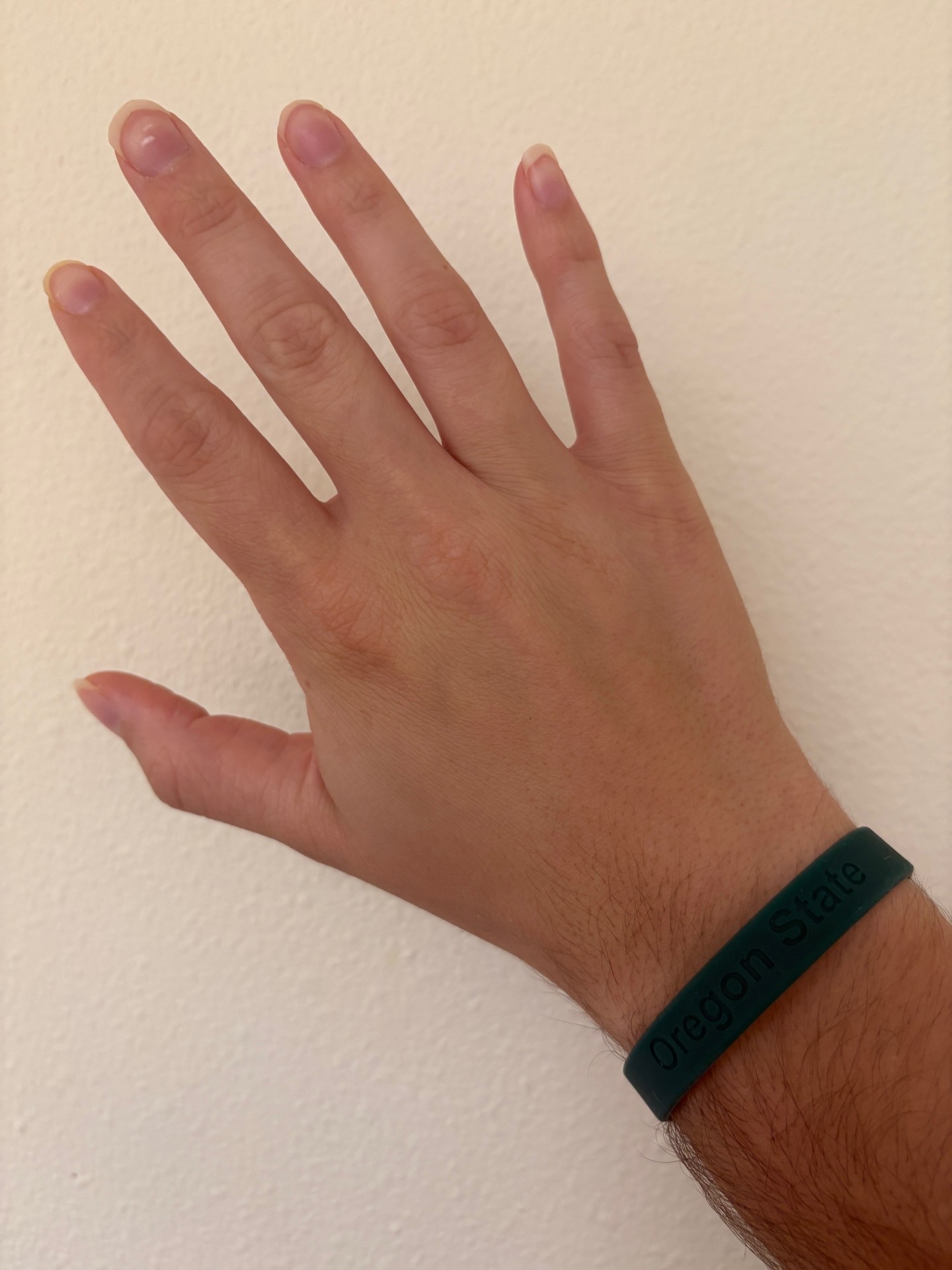
In addition to stationary monitors, the team uses silicone wristbands. The wristbands trap chemicals, like phthalates or flame retardants, that make contact with those who wear them. Those chemicals are later extracted for analysis. 

“We have quite a few studies now, many of them copublished with PNNL authors, illustrating that the difference between a stationary monitor and the diversity of exposures an individual receives is huge,” said Professor Kim Anderson, an environmental chemist at OSU and senior author on the study. “And that makes a lot of sense. You spend a lot of time inside, and you move where the station doesn’t.” 

A hand with a wristband on it.
Researchers used wristband samplers to record the exposures of study participants. (Photo courtesy of Oregon State University)

Anderson has pursued the field of exposure science for decades. She and other researchers have used wristbands to study what harmful substances firefighters encounter on the job and how personal chemical exposure changes after a hurricane. 

Clark, who is pursuing her PhD under Anderson, added that using wristbands alongside stationary monitors allows access to a wider range of communities, from large to small, without much burden. “One of the reasons why the wristbands make this research much easier to carry out is that they stay on the participant the entire time. It goes everywhere you go, pretty unobtrusively.” 

Which factors shape exposure? 

For their two most recent studies, the group focused on a specific subset of chemicals known as polycyclic aromatic hydrocarbons, or PAHs. These chemicals are produced when something organic (made mostly of carbon) is burned or turned into crude oil, such as wildfires or coal tar. PAHs can be breathed in from sources like car and stove exhaust or fumes from petroleum sources, eaten when grilled food is charred, or absorbed through the skin if ash or gasoline is touched. Some PAHs have been linked to cancer, complications in fetal development, and cardiovascular disease.

One of the team’s aims was to better understand the sources of variability underpinning personal exposure. They examined factors like the time of year, the age of the participants, what type of flooring they used in their home, and whether they operated heavy machinery, among other factors. One manuscript considered over 23,000 chemical data points, how often PAHs and other chemicals were seen and in what quantities, making it one of the largest investigations of personal variability in chemical exposure utilizing wristbands. 

But disentangling the many factors at play requires heavy computational effort, said data scientist Lisa Bramer, a coauthor of the two 2025 studies. “One thing PNNL has brought to the field of exposure science alongside OSU is the modeling approaches we used in this recent work.” Bramer added that a combination of statistical modeling and machine learning were key in identifying which factors were most important in dialing PAH exposure up or down. 

Because exposomics is a relatively young scientific field, studies like these represent an important, early step in uncovering the nuanced relationships between different exposure factors. 

“We’re not talking about just a one-off, one-chemical exposure,” said Anderson. “You’re exposed to many chemicals simultaneously. There could be synergistic effects. And we’re trying to get at the temporality of it. Are you exposed to different things in August rather than September, and how different are those exposures?” 

Their most recent paper indeed indicated that exposure varied from person to person, as well as over time. Some participants received consistent exposures over the study period, while others were exposed in a much more varied way across repeated measurements.  

Sampling month was revealed to be an important predictor of greater PAH exposure, along with flooring type and participant age. Winter and summer generally brought the highest concentrations of PAHs. 

One potential explanation: study participants may have spent more time indoors using a fireplace or wood-burning stove in winter, as was indicated in study questionnaires. Wood-burning stoves and use of heavy machinery were linked to greater PAH exposure, more specifically to PAHs known as napthalenes, which may destroy and damage red blood cells. 

Long-range transport of wildfire smoke from north of the study site, too, could have delivered PAHs to participants in summer. Spring correlated with the lowest PAH exposure for nearly all of the highest-molecular-weight compounds under study. 

Interestingly, carpet and hardwood flooring were identified as important indicators of elevated PAH exposure. It’s possible that the greater surface area of carpet, given all its fibers, could trap and later release PAHs when vacuumed. Flooring material itself, or even cleaning supplies, could also give off PAHs in the home. At the very least, the study identified flooring type as a factor worth further study.  

The research team identified age as another important indicator. Age may play a role in day-to-day life as an indicator of behavior; for example, participants under 18 were most likely in school during their sampling, and those over 65 were most likely in their homes. The more time a participant spent in their home, the more likely they were to have higher total PAH exposure from sources within their home. Unsurprisingly, smoking indoors also led to greater PAH exposure. 

Looking toward the future, the team hopes to expand their work and help instill a unified approach to computational analysis as the field of exposomics grows. 

“These studies represent a growing body of evidence that indicates personal exposure is not static,” said Katrina Waters, chief scientist on the study from PNNL. “To advance the use of exposomics for risk assessment, we must better capture the variability at play and determine which behaviors most impact exposure. We do that through repeated measurements of chemical exposure, studying different communities, and looking at wider geographical areas. Computational approaches that take into account different methods of study, too, will help us glean important details that could help others understand how to mitigate exposure and manage risk.”

The abovementioned work was supported by the National Institute of Environmental Health Sciences.

###

About PNNL

Pacific Northwest National Laboratory draws on its distinguishing strengths in chemistry, Earth sciences, biology and data science to advance scientific knowledge and address challenges in energy resiliency and national security. Founded in 1965, PNNL is operated by Battelle and supported by the Office of Science of the U.S. Department of Energy. The Office of Science is the single largest supporter of basic research in the physical sciences in the United States and is working to address some of the most pressing challenges of our time. For more information, visit the DOE Office of Science website. For more information on PNNL, visit PNNL's News Center. Follow us on Twitter, Facebook, LinkedIn and Instagram.