May 27, 2026
News Release

AI Speeds Selective and High-Yield Recovery of Critical Minerals from Industrial Waste

Researchers at PNNL developed an AI-guided workflow to optimize purification of critical minerals for industry partners using cheap commodity chemicals

A smiling man in a lab setting

Materials scientist Elias Nakouzi is creating an autonomous critical minerals recovery workflow that utilizes AI. 

(Photo by Andrea Starr | Pacific Northwest National Laboratory)

RICHLAND, Wash.—A research team at the Department of Energy’s Pacific Northwest National Laboratory has deployed AI agents with the potential to accelerate the recovery of critical minerals from real-world industrial waste in days instead of the months or years required for manual experimentation. 

The team, led by PNNL materials scientist Elias Nakouzi, created a semi-autonomous lab tied to a series of specially designed AI agents to accomplish their goal. The system, named Computer Intelligence for Critical Elements Recovery and Optimization (CICERO), evaluates not only the best method for purifying the desired element, but also provides a first assessment of whether the method is economically feasible and scalable. The researchers reported their results in the journal Materials Horizons.

“We connected a liquid-handling robot, a sample handling device, and two analytical instruments and created an AI-aided workflow that quickly isolated critical minerals from industrial samples,” said Nakouzi. “These industrial feedstocks are a complex soup of chemicals. Developing an effective method to isolate one element from the soup can take months or years. We have reduced that time to days with CICERO.”

Elias Nakouzi, a PNNL materials scientist, talks about building a semi-autonomous workflow for critical materials recovery from industrial waste. (Video by Eddie Pablo | Pacific Northwest National Laboratory)

To demonstrate the value of the system, the research team tested three different industrial wastes: two different kinds of spent magnets and wastewater from oil and gas extraction. 

The scientists fed a description of what was in the waste to specially designed AI agents. The agents then evaluated the value, concentration, and potential product purity after a separation procedure, before making a technical and economic recovery recommendation. In the trial runs, the AI agents recommended recovery of the element magnesium from wastewater produced during oil and gas extraction, of neodymium and praseodymium from magnet waste, and of samarium, a rare-earth element critical to high-performance aerospace magnets and nuclear reactors. 

Such feedstock evaluations traditionally take months of analysis and preliminary lab protocol preparation. 

Instead, within a day, the AI agents used published scientific literature to develop a plan for 96 simultaneous experiments, including recipes for all chemicals used for separation, their order of addition, and timing steps. A liquid-handling robot then executed the orders. 

For these initial experiments, human operators prepared the completed experimental samples for final chemical analysis. But the resulting data were automatically evaluated by AI for any necessary refinements, and if needed, a second round of 96 experiments to optimize purity and yield. 

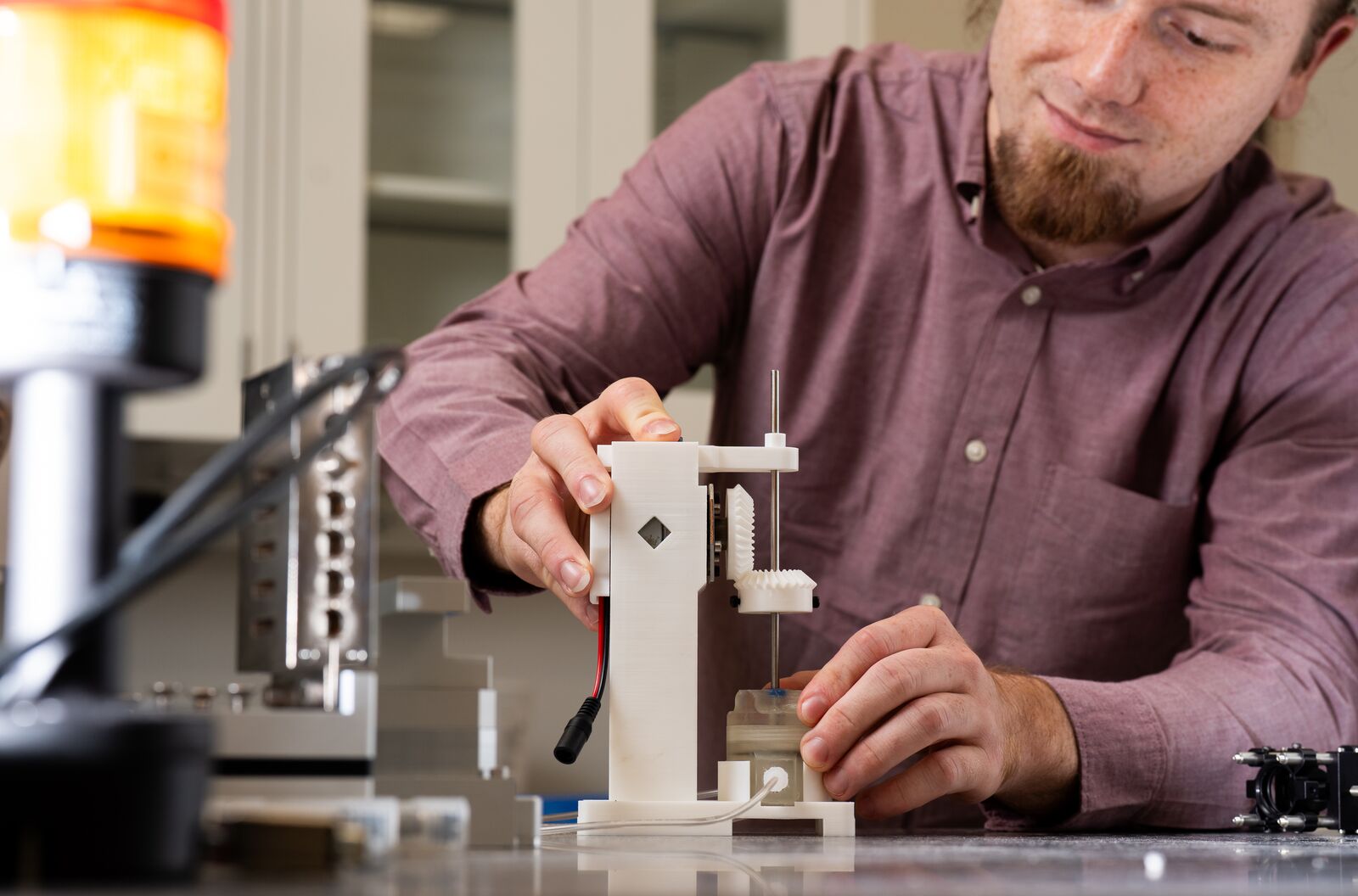
A man working in a lab
Andrew Ritchhart, a materials scientist, handles lab equipment. He and his colleagues are working to reduce the need for manual lab work like this using automation. (Photo by Andrea Starr | Pacific Northwest National Laboratory)

“We were able to build and execute this workflow within a few months because it is built upon years of institutional materials science, chemistry, separations, and geosciences expertise at PNNL,” said Nakouzi.

CICERO is powered by SciLink, an agentic AI platform developed at PNNL and supported by the DOE Office of Science. 

“The agentic AI allows us to get more mileage out of existing industry practices for critical mineral recovery,” said Maxim Ziatdinov, a PNNL physical scientist whose research has merged AI, data science, and instrument controls.

Ziatdinov and his colleagues are rapidly moving toward additional opportunities for CICERO, asking it to reason beyond initial ideas and incorporate data from early experiments to generate even better ideas. “It may be possible to target additional critical materials in a broader range of feedstocks as more and more experimental results are processed,” he said.

As demand for critical materials produced in the United States increases, a rapid solution developed by workflows like CICERO could offer new incentives to industry to maximize production of valuable commodities from what had been waste. 

While recycling magnets and petroleum wastewater have not yet been done on an industrial scale, the pathway provided by CICERO demonstrates industrial feasibility because the cheap commodity chemicals used in the experiments are already used at an industry scale in other chemical separations, the researchers said.

“We are on the cusp of something exciting here, not just for optimization and efficiency, as we’ve shown here, but also potentially for new chemistry and new materials science that we could discover with these platforms,” said Nakouzi.

In addition to Ziatdinov and Nakouzi, PNNL researchers Andrew Ritchhart, Sarah I. Allec, Pravalika Butreddy, Krista KulesaQingpu Wang and Dan Thien Nguyen contributed to the study. This research was made possible by several internal investments made by PNNL: the Non-Equilibrium Transport Driven Separations (NETS) initiative, the Adaptive Tunability for Synthesis and Control via Autonomous Learning on Edge (ATSCALE) initiative and the Foundational Autonomy Investment.

###

About PNNL

Pacific Northwest National Laboratory draws on its distinguishing strengths in chemistry, Earth sciences, biology and data science to advance scientific knowledge and address challenges in energy resiliency and national security. Founded in 1965, PNNL is operated by Battelle and supported by the Office of Science of the U.S. Department of Energy. The Office of Science is the single largest supporter of basic research in the physical sciences in the United States and is working to address some of the most pressing challenges of our time. For more information, visit the DOE Office of Science website. For more information on PNNL, visit PNNL's News Center. Follow us on Twitter, Facebook, LinkedIn and Instagram.