ARPA-E 2026 Energy Innovation Summit
A premier event showcasing new technology and fostering collaboration, innovation, and investment

San Diego, California
Join researchers from Pacific Northwest National Laboratory (PNNL) at the Advanced Research Projects Agency-Energy (ARPA-E) 2026 Energy Innovation Summit. The conference brings together industry leaders, entrepreneurs, investors, and researchers to showcase the latest energy technologies.
This year’s conference will feature eight PNNL projects on display. A complete list of the projects, along with their principal investigator (PI) and booth number, is provided below.
PNNL Projects on Display
AutonomIA
PI: Sonja Glavaski

Ready for gridlock to be a thing of the past? Autonomous Intelligent Assistant (AutonomIA) is a new AI-based traffic management system that leverages advanced sensing, adaptive signaling technologies, and connected automated vehicle technology. The research team will demonstrate a 20 percent reduction in congestion and energy expenditure of regional transportation systems compared with current traffic management policies.
Exploring Macroalgae as Critical Mineral Crops E(MC)²
PNNL is pioneering a new approach for extracting valuable rare-earth elements and platinum-group metals from marine macroalgae, a unique “biological ore.” PNNL’s sustainable methods maximize resource efficiency by recycling chemical extractants and preserving algae for biofuels and industrial uses, thereby minimizing waste. With advanced instrumentation, researchers can unlock new insights into metal variability in algae while developing innovative adsorbents using specialized metal-organic frameworks to selectively capture rare-earth elements from solution.
Optimal Global Platform for Transportation (Opt-GPT)
PI: Nawaf Nazir
This project enhances intermodal freight efficiency by introducing a tool for prioritizing technology and fuel investments across transport modalities (e.g., road, rail, and waterways). Using the Global Change Analysis Model (GCAM), it assesses life-cycle costs and emissions of various fuels amid energy, economy, and land-use interactions. The tool aids planners in navigating uncertainties in policy and technology, fostering informed long-term decisions for infrastructure placement. By considering production, transportation, and fuel use intricacies, it provides a research-backed vision for sustainable freight sector transformation.
Rapid AI-Based Geophysical Imaging and Advanced Visualization
PI: Fred Day-Lewis

PNNL researchers are harnessing AI to revolutionize undergrounding of electrical grids by rapidly building subsurface digital twins using multisensor geophysical data. These systems autonomously analyze sensor data to detect unmapped subsurface utilities and other obstacles, potentially generating detailed maps in minutes instead of weeks. By enabling faster, more accurate underground mapping, this technology promises significant cost savings and accelerated drilling or excavation.
Supercritical CO²–Based Mining
PI: Todd Schaef
PNNL is developing the first integrated, comprehensive suite of methods to deliver a proprietary supercritical carbon dioxide (scCO2)–based leaching fluid to mafic-ultramafic ores for in situ enhanced critical mineral (e.g., nickel, copper, and cobalt) recovery and CO2 sequestration. The project aims to enhance the U.S. critical mineral supply chain through the use of existing horizontal drilling technologies to inject scCO2 to mine low-value mafic-ultramafic ores that are not typically mined. The goal is to create a carbon-negative pathway, reduce mineral beneficiation energy costs by 57 percent, and mineralize approximately 110 kg of CO2 per kilogram of critical mineral extracted.
Ferritic and Vanadium Alloys with Nanoparticle Strengthening for Fusion (FAVA-NSF)
PI: Stuart Maloy
PNNL will make new nanoparticle-strengthened vanadium alloys that exhibit increased strength and irradiation resistance. The powder material will be made into plates through spraying of the powder and friction stir processing onto a surface. This new fabrication technique can be performed at temperatures below the melting point and bypass problems related to microstructural inhomogeneities during melting.
Additive Friction Surfacing for Large Scale Additive Manufacturing with Improved Service Life in Extreme Environments
PI: Ken Ross
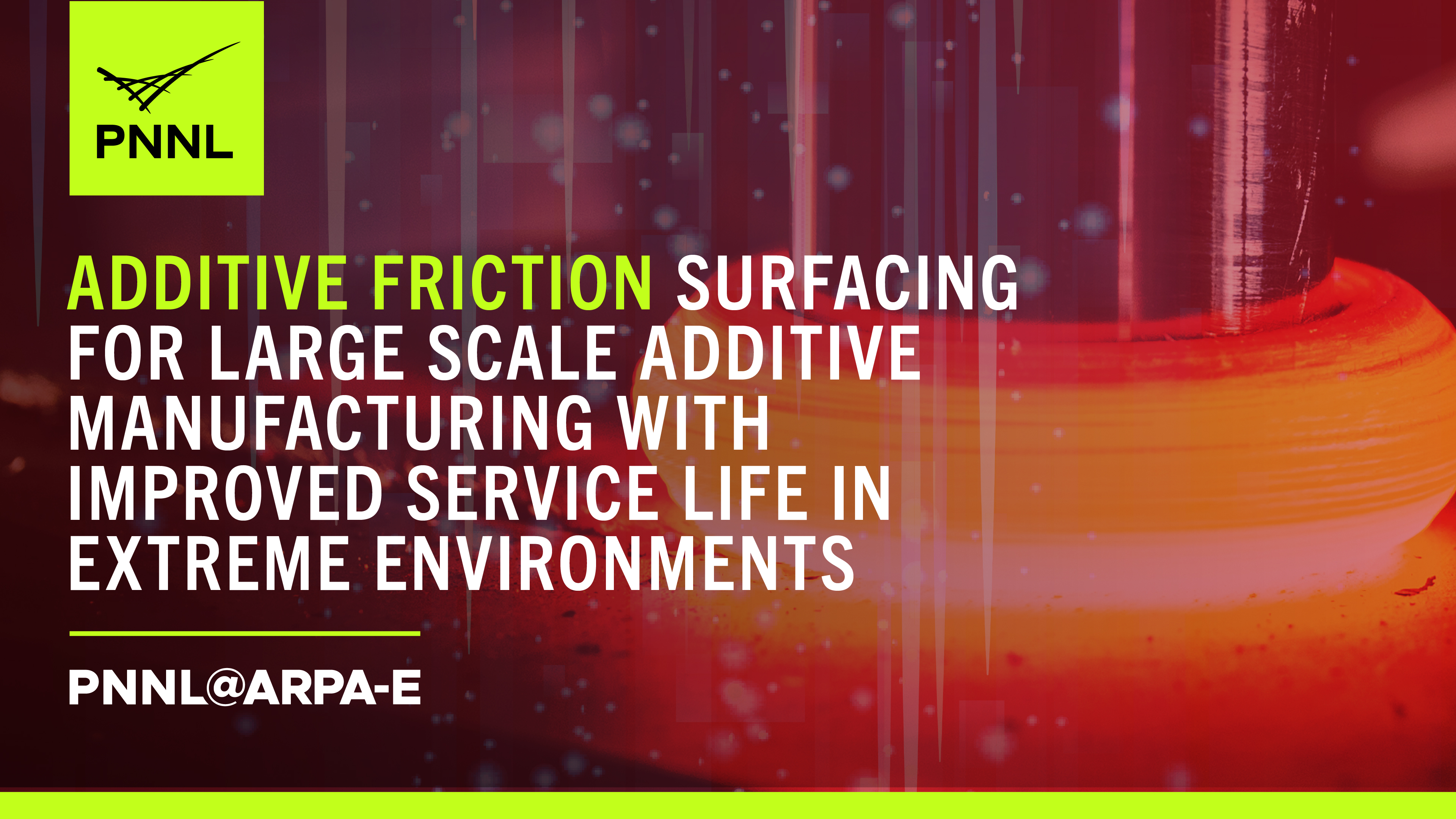
PNNL is developing an additive friction surfacing (AFS) technology for the purpose of enabling an order-of-magnitude reduction in lead times and improved microstructures for large steel components essential for the power generation and manufacturing sectors. AFS is a solid phase manufacturing process where a rotating bar feedstock traverses along a path while applying downward pressure. The technology employs frictional heating and shear forces to enable feedstock material to plasticize and deposit, producing microstructures in steels that result in superior properties than the properties resulting from fusion-based additive manufacturing processes. The proposed technology will be applicable to domestic power generation and manufacturing sectors.
PNNL Subawardees on Display
Quantification of Atmospheric Carbon Dioxide Removal Using an Autonomous Ocean Sensor that Measures Sinking Particulate Carbon Flux
PI: Matthew O’Hara
Foam-Assisted Enhanced Hydrogen Recovery
PI: Todd Schaef