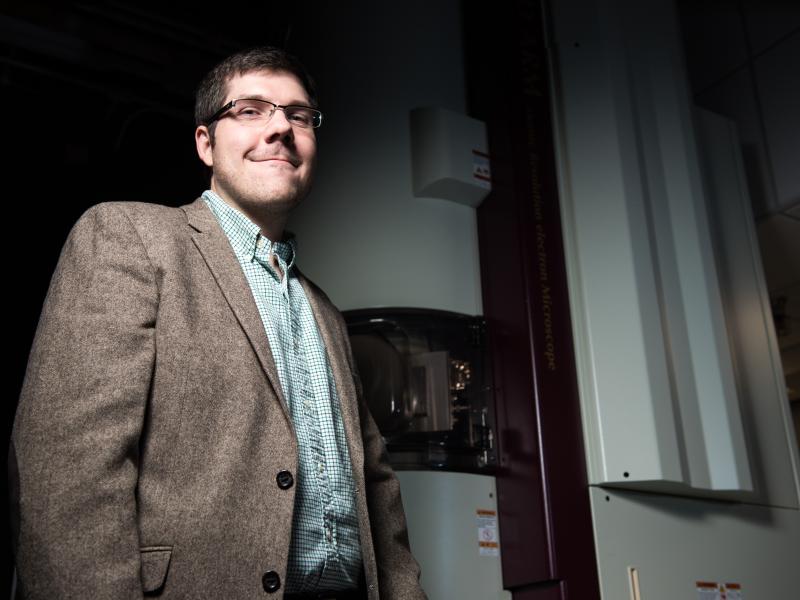
Steven Spurgeon’s research is featured in the cover of the MRS Bulletin along with his team’s invited perspective on the future of machine learning for electron and scanning probe microscopy.
The American Chemical Society Richland Section has been recognized by its national organization with the Best Overall Section Minority Affairs award for 2022.
Three PNNL bioenergy experts have received adjunct appointments at Washington State University (WSU), working closely with the WSU-PNNL Bioproducts Institute and students.
PNNL bioenergy expert Karthikeyan Ramasamy was a co-guest editor in an American Chemical Society Energy & Fuels virtual special issue on advances in biomass and wastes thermochemical processing.
PNNL Chief Scientist for Computing Jim Ang will be part of a DOE Office of Science virtual discussion regarding industry collaborations on AI hardware.
PNNL data scientist to edit collection of research articles focused on understanding how microcircuits function in the brain and in artificial intelligence systems.
A paper co-authored by Courtney Corley was recently selected as the most influential paper for the Twenty-First National Conference on Artificial Intelligence.
Anika Halappanavar’s research into COVID-19 misinformation earned her recognition by the Washington State Academy of Sciences as one of the state’s top high school researchers.
Four research staff from PNNL are part of an international team that earned top honors for a journal paper focused on a new algorithm-evaluation approach for buildings.
Steven Spurgeon, a materials scientist and microscopy researcher at PNNL, has accepted an affiliate associate professorship at the University of Washington Department of Physics.
Human-machine teaming may sound like something from the distant future. In “Human-Machine Teaming: A Vision of Future Law Enforcement” in Domestic Preparedness, Corey Fallon, Kris Cook, and Grant Tietje of PNNL examine this topic.
PNNL has published a workshop report that outlines recommended actions to bring sustainable aviation fuel to the airline industry, using a PNNL-developed technology.
PNNL is highlighting scientific and technical experts in the national security domain who were recently promoted to scientist and engineer Level 5, one of PNNL’s most senior research roles.