From Technology Void to Next-Gen Solution: PNNL Reinvents ERT Monitoring
Modernizing subsurface monitoring for the Department of Energy's Environmental Management cleanup mission
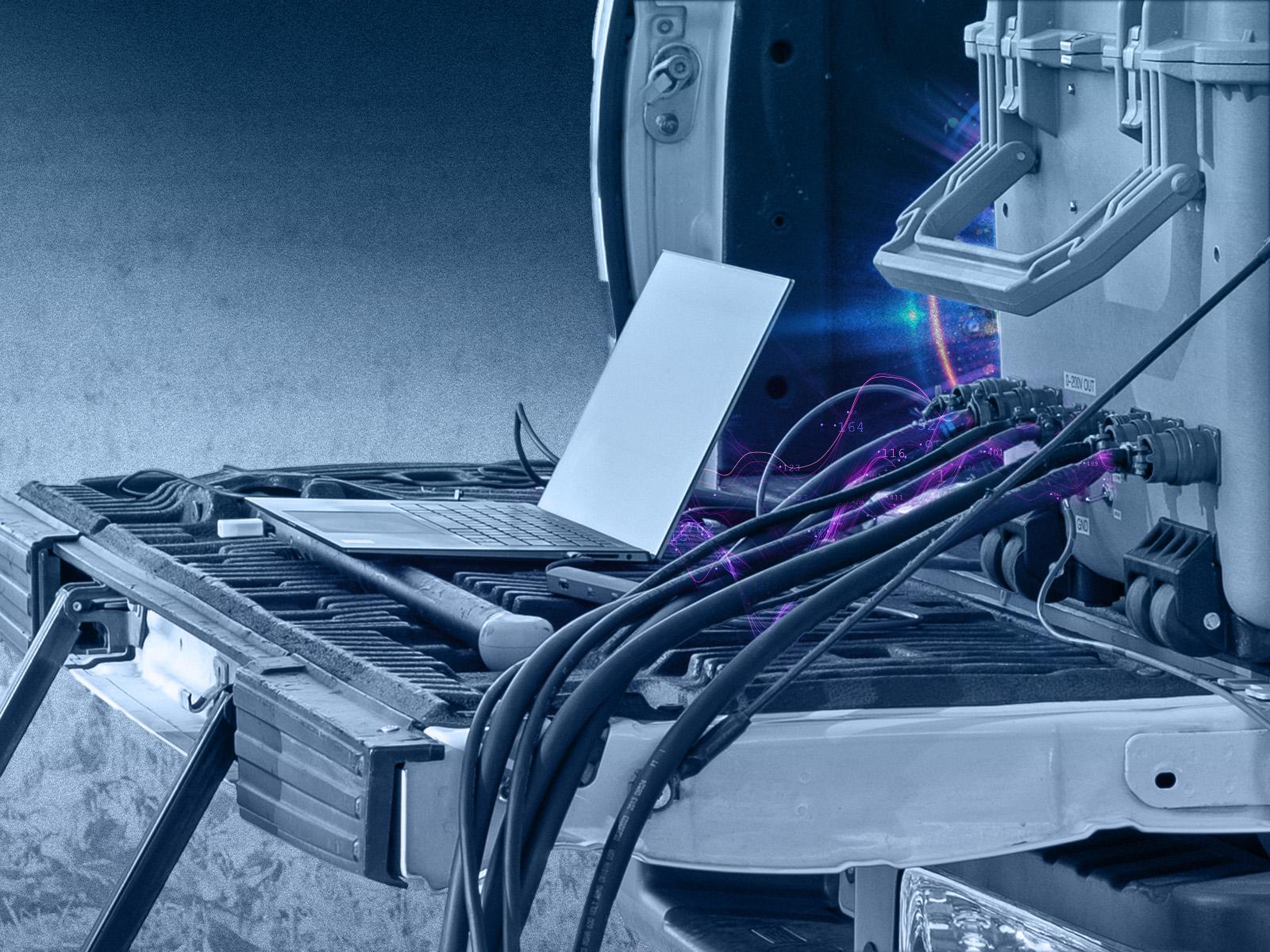
Pacific Northwest National Laboratory has designed and built a next-generation electrical resistivity tomography (ERT) system that is a significant upgrade over any commercially available system. This ERT system will support long-term environmental remediation monitoring capabilities and research with real-time computer modeling of subsurface images. The ERT system is operated and controlled in the field through a laptop interface.
(Composite image by Melanie Hess-Robinson and Andrea Starr | Pacific Northwest National Laboratory)
Electrical resistivity tomography (ERT) plays a critical role in monitoring subsurface conditions during environmental remediation at Department of Energy sites. Deployed at locations such as the Savannah River Site, Moab Uranium Mill Tailings Remedial Action (UMTRA), and the Hanford Site, ERT systems provide real-time imaging that helps track changes underground during complex cleanup operations.
The DOE Office of Environmental Management (DOE-EM) faced a technology void, however, when the original vendor of the current ERT systems closed during COVID-19 and no commercial repair or replacement options were available. This created a risk of losing monitoring capabilities to provide critical subsurface information for more efficient remediation.
To support DOE-EM's mission continuity, Pacific Northwest National Laboratory (PNNL) has designed and built a next-generation ERT system. Soon, PNNL will have two fully operational systems ready for deployment, along with a supply chain to support future builds.
Addressing the void
Many commercial systems are designed for one-time site characterization rather than autonomous, long-term monitoring. Other systems also lack the speed and multi-channel capability required for real-time remediation support.

PNNL computational scientist Tim C. Johnson, conceptualized a new monitoring system that modernizes legacy hardware while establishing a sustainable manufacturing pathway for future systems. Johnson attributes PNNL electrical engineer Anton Sinkov and former PNNL physicist Matt Taubman for helping bring the project to life.
“One of the unique things we can do here is real-time imaging,” Johnson said. “With the previous commercial units, we would get an image every hour. We now get an image about every five minutes, so time resolution is increased significantly.”
The first production system was recently assembled, bench-tested, and field-tested at the PNNL-Richland campus using a 64-electrode configuration. Its modular, plug-and-play architecture allows rapid on-site component replacement, which minimizes downtime.
Turning measurements into real-time 3D images
Testing included multiple imaging surveys at increasing transmission power to validate performance. The system produced high-fidelity waveforms at high speed, and processing those waveforms with PNNL’s award-winningReal-Time Four-Dimensional Subsurface Imaging (E4D) software demonstrated consistency between predicted and measured data.
"Most of the commercial systems by far were made to go out and take one static image, but PNNL's next-gen ERT system is made to do time-lapse imaging and can be redeployed at other EM sites if not used for long-term modeling,” explained Johnson. “That type of processing is difficult to do, especially in real time, which is why E4D is important.”
ERT works by injecting an electrical current into the ground and measuring voltage responses that reflect subsurface conditions such as moisture, fluid chemistry, and geologic structure. Those measurements alone, however, do not immediately reveal what is taking place underground.
By using E4D, researchers can process this data through AI-enhanced inversion and scalable 3D modeling to generate high-resolution subsurface images. When measurements are repeated over time, E4D produces time-lapse (4D) images that show how underground conditions change.
These evolving images provide critical information for environmental management teams. By revealing how fluids, contaminants, or remediation treatments are moving through the subsurface layers of soil and groundwater, the system can help guide operational decisions such as adjusting injection strategies, relocating monitoring wells, or redeploying sensors to areas where changes are occurring.
From imaging to predictive intelligence
Expanding beyond imaging, Johnson presented at the 2026 Waste Management Symposia the advancements fostered by postdoctoral researcher José Hernandez Mejia on applying Generative AI to calibrate subsurface remediation simulators using time-lapse ERT data. By integrating 4D observations with AI-driven model calibration, this approach assesses uncertainty and enables near real-time updates to remediation forecasts, advancing from monitoring to predictive decision support.
“We’ll integrate this with AI at some point where it’s all automated,” said Johnson. “I envision AI being able to say which measurement should we take next and then processing the data to provide a more enhanced picture of what’s happening in the subsurface, especially as we start linking it to reactive transport models. PNNL’s high-performance reactive transport model PFLOTRAN was recently modified for just this purpose.”
This next-gen ERT project, developed with funding from the DOE-EM Technology Operations Office, has established a repeatable manufacturing process for a system with no current market equivalent. A second production system is now under assembly.
While the system exceeds the transmitting power of most commercial environmental monitoring systems, further optimization with a larger transmitter will support challenging DOE applications such as deep vadose zone imaging at the Hanford Site in Washington state and high-conductivity conditions at the Moab UMTRA site in Utah.
“We’re also using ERT for enhanced geothermal research applications, to image fracture rock fluid transport pathways and changes in rock stress,” said Johnson. “We plan to use it in the national security space for research regarding underground explosion monitoring. At the Savannah River F-Area Site, we’re monitoring one of their landfills to make sure water doesn’t bypass the clay surface barrier. That barrier will be monitored for decades. ERT is used in many underground settings, not just in EM, but EM is certainly where it was matured.”
For research collaboration and commercialization inquiries, please contact commercialization@pnnl.gov.