Coastal Floods Impact Soil Pore Structure and Oxygen Flux
Lab experiments show that just a few saltwater pulses can rapidly alter soil pore structure and reduce oxygen flow, stressing tree roots in coastal forest soils

The Science
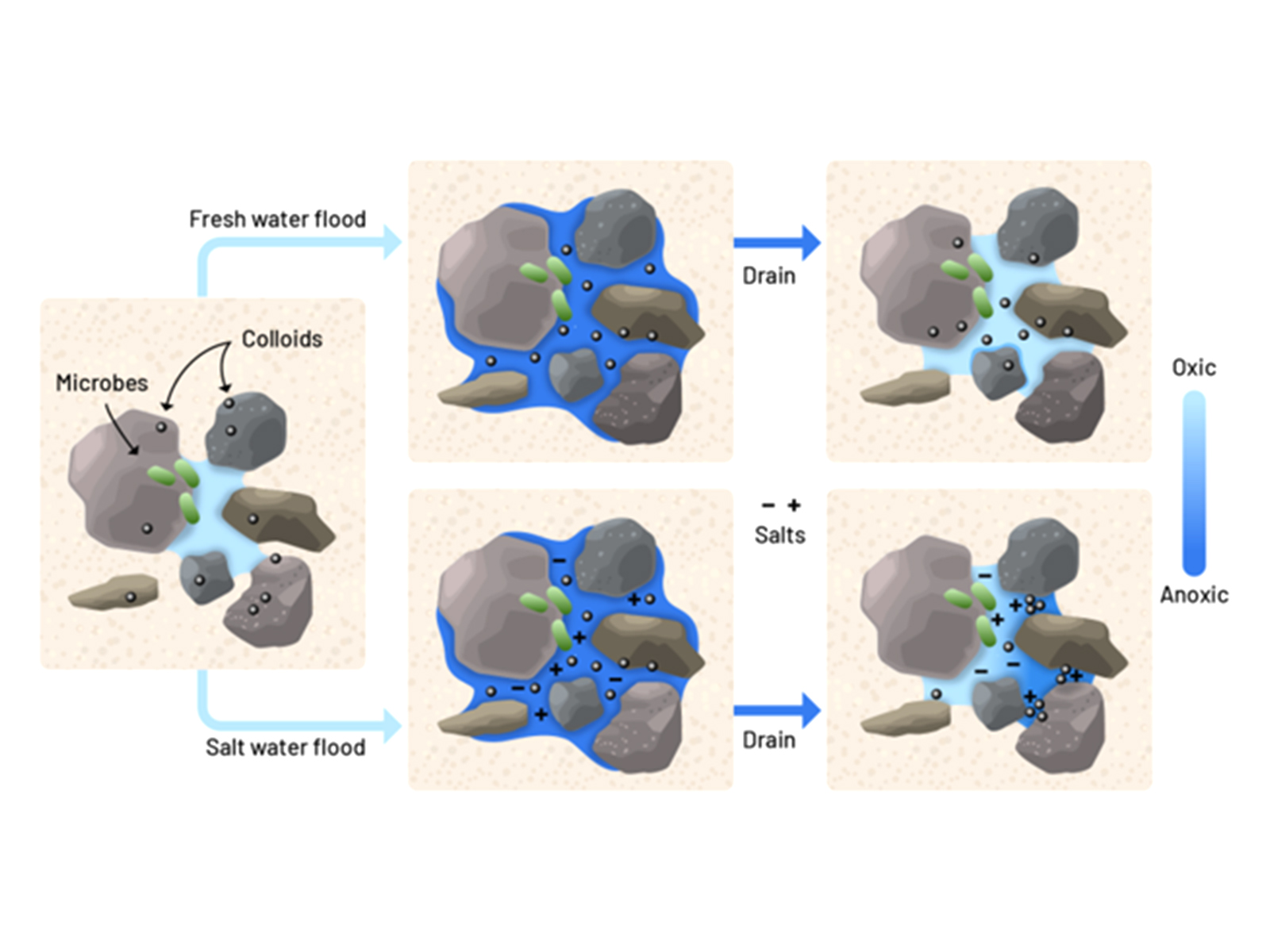
Coastal forests are increasingly exposed to both saltwater and freshwater flooding due to sea-level rise and storms. We tested how these pulses affect soil pore structure and biogeochemistry by repeatedly flooding intact coastal forest soil cores in the lab. In treatments with alternating salt water and fresh water, soil colloids mobilized and clogged fine pores, reducing oxygen diffusion during water drainage. These effects emerged after only a few saltwater pulses, suggesting that coastal flooding can quickly compromise soil pore structure and air exchange. This reduced reoxygenation could increase root stress and contribute to forest decline.
The Impact
Our findings reveal a fast-acting mechanism that may help to explain the rapid spread of ghost forests along marine coasts. Saltwater exposure not only alters soil chemistry but also physically reconfigures soil pore structure, potentially limiting oxygen availability to tree roots. This is one of the first controlled demonstrations of pore clogging and sodicity emergence in coastal forest soils. These insights could improve models of forest vulnerability and inform land management in regions facing more frequent tidal flooding and extreme weather.
Summary
Coastal forests are increasingly vulnerable to saltwater intrusion from rising seas and storm-driven flooding events. These short-term salt pulses are often followed by fresh water inundation from rainfall or runoff, creating alternating flood conditions that could reshape soil pore structure and function. We tested how these conditions affect air movement through oxygen concentration in soil using intact cores collected from a Chesapeake Bay coastal forest. Over six flood and drain cycles, we compared freshwater-only flooding to alternating saltwater and freshwater treatments. Mobilized colloids from saltwater treatments migrated and clogged fine pores, altering the pore size distribution.
These structural changes reduced oxygen diffusion back into the soil during drainage, particularly in the topsoil, where tree roots are most active. Just three saltwater pulses were enough to elevate exchangeable sodium to levels consistent with sodicity, a soil state that promotes long-term structural breakdown. Together, these results suggest a fast-acting physical mechanism linking storm surge exposure to reduced oxygen availability for roots. Our findings offer a new explanation for the rapid onset of coastal forest dieback and demonstrate that even brief saltwater intrusions can trigger lasting changes in soil function.
Contact
Daniel Stover, Environmental System Science Program, daniel.stover@science.doe.gov, (301) 903-0289
Kenton Rod, Soil Scientist, Pacific Northwest National Laboratory, Kenton.rod@pnnl.gov, (509) 372-4191
Vanessa L. Bailey, COMPASS-FME principal investigator, Pacific Northwest National Laboratory, vanessa.bailey@pnnl.gov, (509) 375-6695
Funding
This research was supported by Coastal Observations, Mechanisms, and Predictions Across Systems and Scales, Field, Measurements, and Experiments (COMPASS-FME), a multi-institutional project supported by the U.S. Department of Energy (DOE), Office of Science, Biological and Environmental Research as part of the Environmental System Science Program (https://compass.pnnl.gov/FME/COMPASSFME). The Pacific Northwest National Laboratory (PNNL) leads this project, operating under contract DE-AC05-76RL01830 through Battelle Memorial Institute for the DOE. This work was also supported by the Smithsonian Environmental Research Center and the University of Toledo.
Related Link
Published: September 9, 2026
Rod, K. A., K. O. Doro, K. F. Patel, K. M. Kemner, S. J. Wilson, J. P. Megonigal, N. D. Ward, M. N. Weintraub, and V. L. Bailey. (2026). Alternating salt and freshwater floods of coastal soils impact soil structure, hydraulic properties, and oxygen dynamics. Vadose Zone Journal, 25, e70073. DOI: 10.1002/vzj2.70073