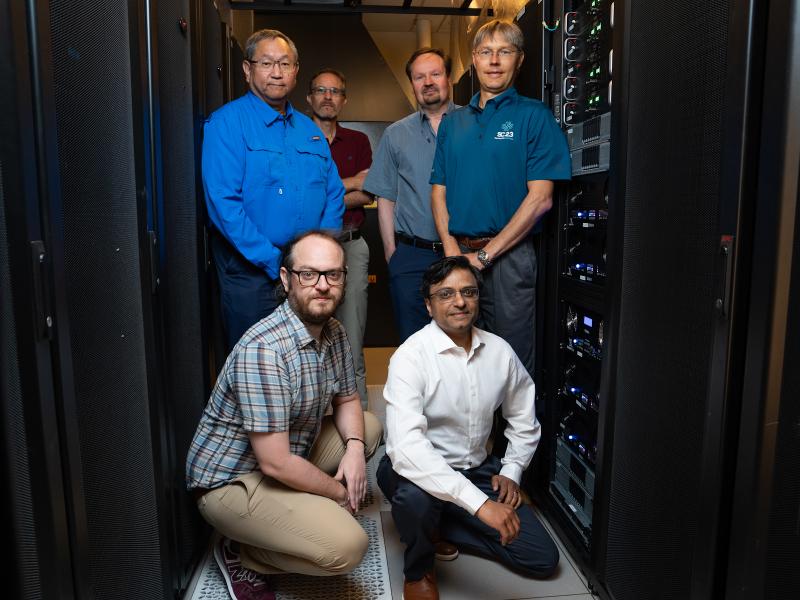
For PNNL’s Jonathan Evarts, Hope Lackey, and Erik Reinhart, this partnership with WSU opened doors and provided opportunities for their scientific careers to flourish.
By combining computational modeling with experimental research, scientists identified a promising composition that reduces the need for a critical material in an alloy that can withstand extreme environments.
A team from PNNL contributed several articles to the Domestic Preparedness Journal showcasing recent efforts to explore the emergency management and artificial intelligence research and development landscape.
Adam Attarian, a PNNL applied mathematician and data scientist in the Applied Artificial Intelligence Systems group, has been accepted into an Office of the Director of National Intelligence fellowship.
Harilal, a physicist at PNNL and a Jedi in laser-produced plasma applications, has been named a member of the Institute of Electrical and Electronics Engineers Class of 2025 fellows.
For 50 years, the NNSA and its predecessor DOE organizations have stewarded the resources and capabilities to respond to nuclear and radiological emergencies in the United States and around the world.
Led by interns from multiple DOE programs, a newly expanded dataset allows researchers to use easy-to-obtain measurements to determine the elemental composition of a promising carbon storage mineral.
PNNL’s year in review includes highlights ranging from advancing soil science to understanding Earth systems, expanding electricity transmission, detecting fentanyl, and applying artificial intelligence to aid scientific discovery.
A multi-institutional team of researchers systematically compared extraction techniques for characterizing plant litter composition that relies on organic matter extraction.
A team of researchers recently coordinated a series of international workshops aimed at enhancing chemical research security and fostering collaboration among scientists and academic researchers from both countries.